


Development of salutogenetic factors in mental health - Antonovsky's sense of coherence and Bandura's self-efficacy related to Derogatis' symptom check list (SCL-90-R)
- PMID: 23656898
- PMCID: PMC3655857
- DOI: 10.1186/1477-7525-11-80
Development of salutogenetic factors in mental health - Antonovsky's sense of coherence and Bandura's self-efficacy related to Derogatis' symptom check list (SCL-90-R)
Abstract
Background: The paper analyses how resilience factors and mental health problems interrelate in a 3-year-longitudinal study with 16-19 year olds.
Methods: Resilience was measured with a 13-item short version of the Life-Orientation-Scale by Antonovsky (sense-of-coherence, SOC) and a 10-item self-efficacy-scale (SWE) by Jerusalem and Schwarzer. Mental health problems were measured with Derogatis Symptom Check list (SCL-90-R). The data set included 155 participants and was analyzed using Structural Equation Modeling (SEM) designed to examine mutual influence in longitudinal data with Mplus software.
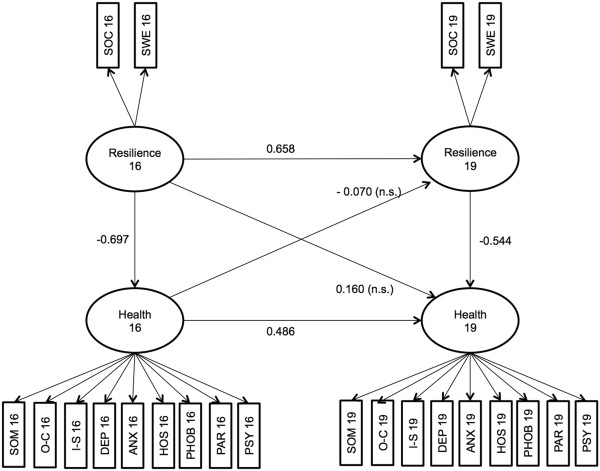
Results: The descriptive data analysis indicates (1) negative correlations between SOC and SCL-90-R at both age 16 and 19 in all subscales but somatization and likewise (2) between self-efficacy and SCL-90-R. (3) SOC correlates positively with SWE at age 16 and 19. Results of SEM analysis were based on the assumption of two latent variables at two points in time: resilience as measured with mean SOC and mean self-efficacy scores and health problems measured with sub scale scores of SCL-90-R - both at ages 16 and 19. The first SEM model included all possible paths between the two latent variables across time. We found (4) that resilience influences mental health problems cross-sectionally at age 16 and at age 19 but not across time. (5) Both resilience and mental health problems influenced their own development over time. A respecified SEM model included only significant paths. (6) Resilience at age 16 significantly influences health problems at age 16 as well as resilience at age 19. Health problems at age 16 influence those at age 19 and resilience at age 19 influences health problems at age 19.
Conclusion: (a) SOC and self-efficacy instruments measure similar phenomena. (b) Since an influence of resilience on mental health problems and vice versa over time could not be shown there must be additional factors important to development. (c) SOC and self-efficacy are both very stable at 16 and 19 years. This refutes Antonovsky's assumption that SOC achieves stability first around the age of 30. SOC and self-efficacy are protective factors but they seem to form in (early) childhood.
Figures

References
-
- Antonovsky A. Unraveling the mystery of health: How people manage stress and stay well. San Francisco, CA US: Jossey-Bass; 1987.
-
- Antonovsky A. In: Personality and stress: Individual differences in the stress process. Cooper CL, Payne R, editor. Oxford England: John Wiley & Sons; 1991. The structural sources of salutogenic strengths; pp. 67–104. Wiley series on studies in occupational stress.
-
- Antonovsky A, McCubbin HI, Thompson EA, Thompson AI, Fromer JE. Stress, coping, and health in families: Sense of coherence and resiliency. Thousand Oaks, CA US: Sage Publications, Inc; 1998. The sense of coherence: An historical and future perspective; pp. 3–20. Resiliency in families series, Vol. 1.
Publication types
MeSH terms
LinkOut - more resources
Full Text Sources
Other Literature Sources
Medical
Research Materials
Miscellaneous
