


Dim light at night interacts with intermittent hypoxia to alter cognitive and affective responses
- PMID: 23657638
- PMCID: PMC3727029
- DOI: 10.1152/ajpregu.00100.2013
Dim light at night interacts with intermittent hypoxia to alter cognitive and affective responses
Abstract
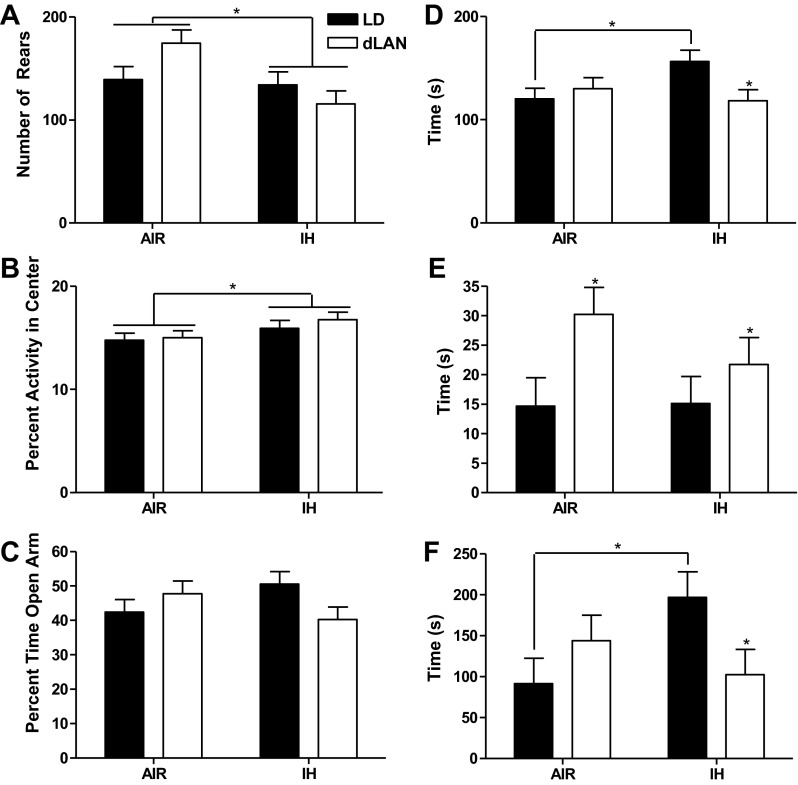
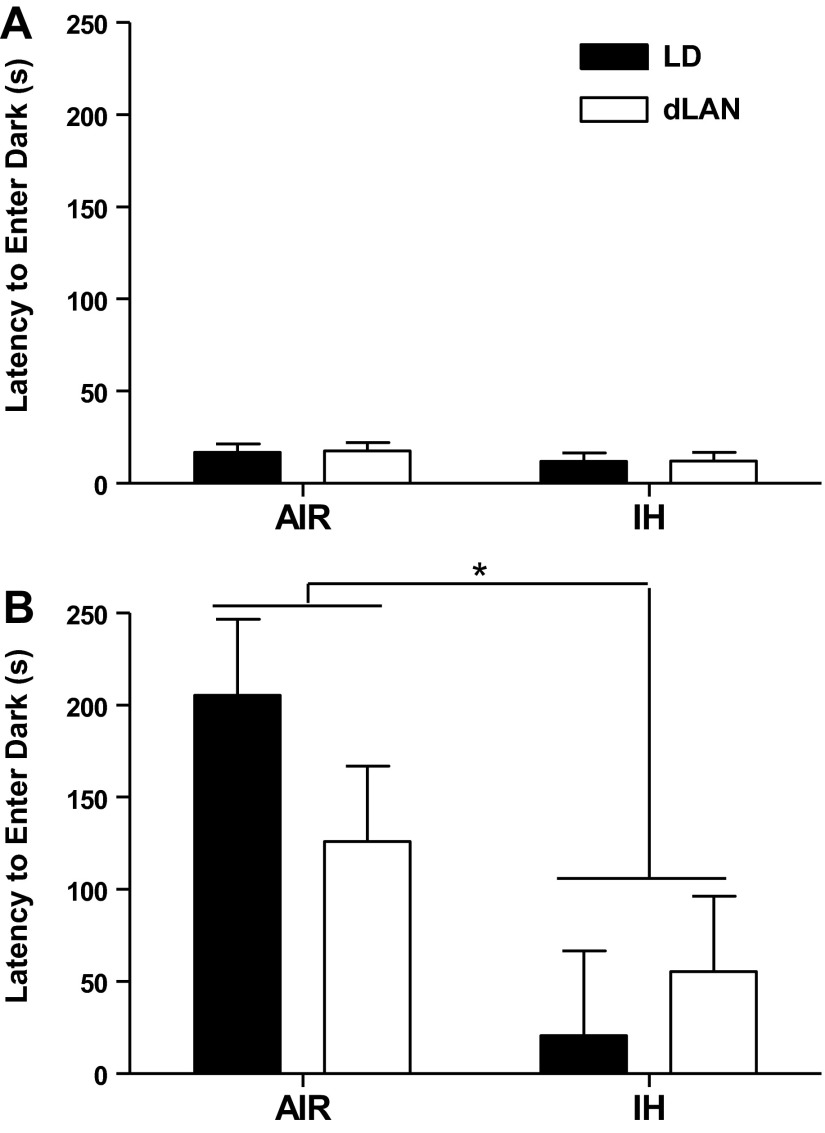
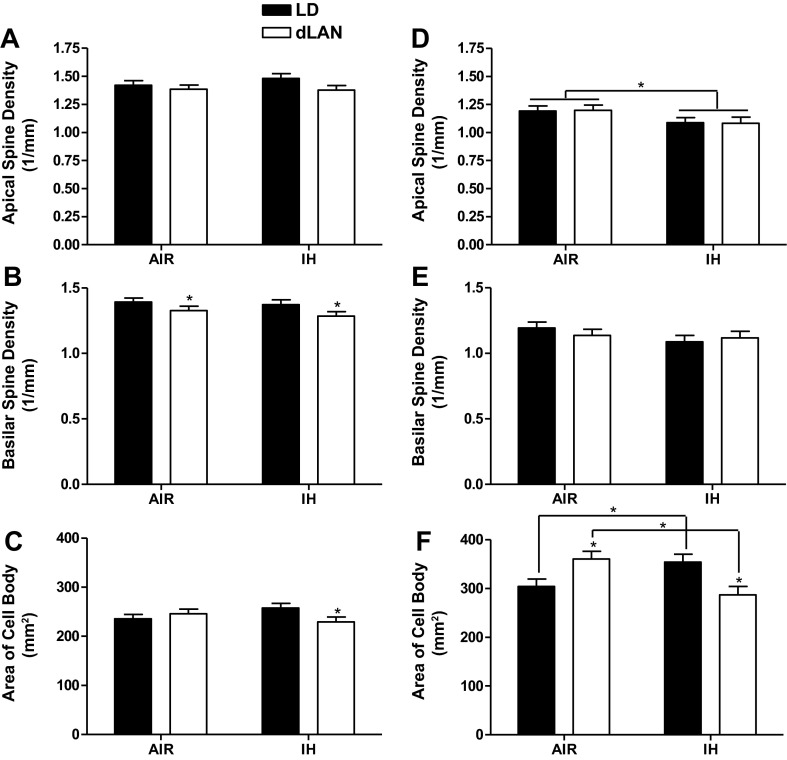
Obstructive sleep apnea (OSA) and dim light at night (dLAN) have both been independently associated with alterations in mood and cognition. We aimed to determine whether dLAN would interact with intermittent hypoxia (IH), a condition characteristic of OSA, to alter the behavioral, cognitive, and affective responses. Adult male mice were housed in either standard lighting conditions (14:10-h light-dark cycle; 150 lux:0 lux) or dLAN (150 lux:5 lux). Mice were then exposed to IH (15 cycles/h, 8 h/day, FiO2 nadir of 5%) for 3 wk, then tested in assays of affective and cognitive responses; brains were collected for dendritic morphology and PCR analysis. Exposure to dLAN and IH increased anxiety-like behaviors, as assessed in the open field, elevated plus maze, and the light/dark box. dLAN and IH increased depressive-like behaviors in the forced swim test. IH impaired learning and memory performance in the passive avoidance task; however, no differences were observed in spatial working memory, as assessed by y-maze or object recognition. IH combined with dLAN decreased cell body area in the CA1 and CA3 regions of the hippocampus. Overall, IH decreased apical spine density in the CA3, whereas dLAN decreased spine density in the CA1 of the hippocampus. TNF-α gene expression was not altered by IH or lighting condition, whereas VEGF expression was increased by dLAN. The combination of IH and dLAN provokes negative effects on hippocampal dendritic morphology, affect, and cognition, suggesting that limiting nighttime exposure to light in combination with other established treatments may be of benefit to patients with OSA.
Keywords: anxiety; depression; intermittent hypoxia; learning; light at night; memory.
Figures
References
-
- Adams N, Strauss M, Schluchter M, Redline S. Relation of measures of sleep-disordered breathing to neuropsychological functioning. Am J Respir Crit Care Med 163: 1626–1631, 2001 - PubMed
-
- Bedrosian TA, Fonken LK, Walton JC, Haim A, Nelson RJ. Dim light at night provokes depression-like behaviors and reduces CA1 dendritic spine density in female hamsters. Psychoneuroendocrinology 36: 1062–1069, 2010 - PubMed
-
- Bedrosian TA, Weil ZM, Nelson RJ. Chronic dim light at night provokes reversible depression-like phenotype: possible role for TNF. Mol Psychiatry In press. - PubMed
-
- Brogi E, Wu T, Namiki A, Isner JM. Indirect angiogenic cytokines upregulate VEGF and bFGF gene expression in vascular smooth muscle cells, whereas hypoxia upregulates VEGF expression only. Circulation 90: 649–652, 1994 - PubMed
-
- Cistulli PA. Craniofacial abnormalities in obstructive sleep apnoea: implications for treatment. Respirology 1: 167–174, 1996 - PubMed
Publication types
MeSH terms
Substances
Grants and funding
LinkOut - more resources
Full Text Sources
Other Literature Sources
Miscellaneous
