. 2014 Jan;472(1):105-10.
doi: 10.1007/s11999-013-3040-5.

Total knee arthroplasty after high tibial osteotomy: no differences between medial and lateral osteotomy approaches

Affiliations

Total knee arthroplasty after high tibial osteotomy: no differences between medial and lateral osteotomy approaches

Stephen Preston et al. Clin Orthop Relat Res. 2014 Jan.

Abstract

Background: High tibial osteotomy (HTO) has long been accepted as an effective treatment for unicompartmental osteoarthritis of the knee in young, active adults. For varus knees, the two most commonly performed valgus-producing HTOs are the lateral closing wedge and the medial opening wedge. Regardless of technique, some HTOs fail and are converted to TKA. To our knowledge, no studies have directly compared TKAs done after lateral closing-wedge osteotomies to those done after medial opening-wedge osteotomies.

Questions/purposes: We compared pain- and function-related outcomes and survivorship of TKAs in patients who previously underwent medial opening-wedge and lateral closing-wedge HTOs.

Methods: We reviewed our institutional database to identify all patients having undergone a HTO with subsequent conversion to TKA and identified 188 lateral closing-wedge HTOs and 77 medial opening-wedge HTOs. Mean followup was 88 months (range, 3-264 months) for the lateral closing-wedge HTO cohort and 59 months (range, 3-180 months) for the medial opening-wedge cohort. SF-12, WOMAC, and Knee Society Scores, as well as survivorship at 5 years, were compared between the two groups. Statistical analysis was completed using the independent-samples t-test.

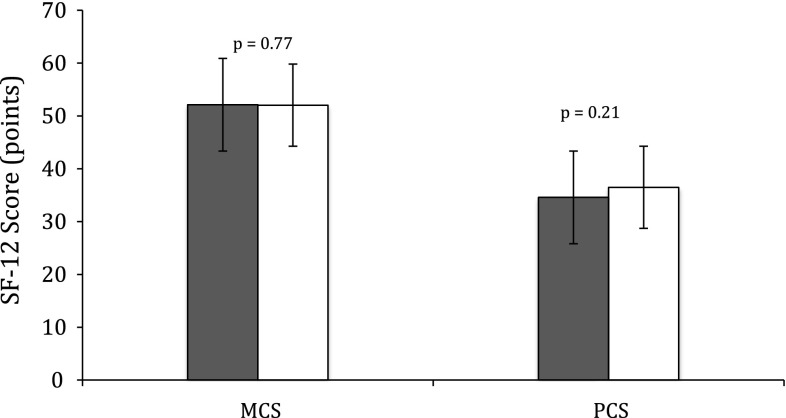
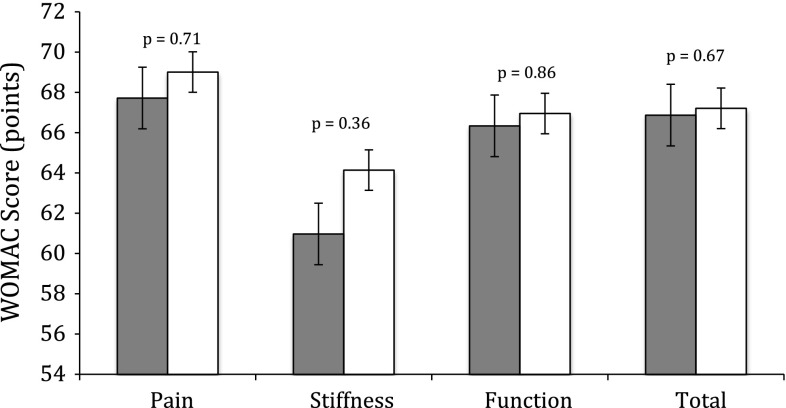
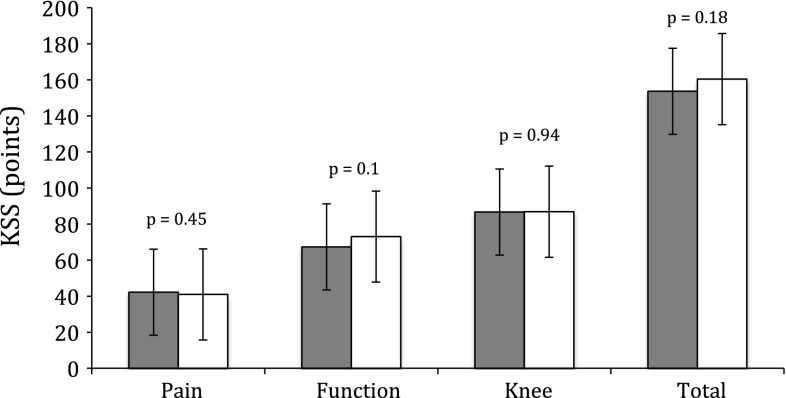
Results: No differences were found between groups in postoperative SF-12 scores (p = 0.77 for the mental component summary score and p = 0.21 for the physical component summary score), WOMAC scores (p = 0.67), or Knee Society Scores (p = 0.80). No difference was found in survivorship between groups at 5 years.

Conclusions: Our results suggest there is no difference in functional outcomes or survivorship of TKA in patients having previously undergone medial opening-wedge and lateral closing-wedge HTOs.


Figures
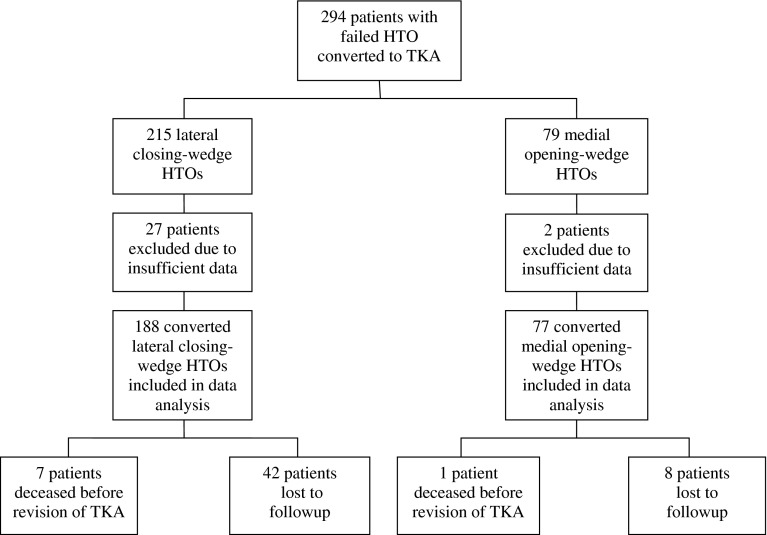
Fig. 1
Fig. 1
A flowchart demonstrates the distribution of patients between the medial lateral-closing and medial opening-wedge cohorts, mortality, and loss to followup.
Fig. 2
Fig. 2
A graph shows latest SF-12 scores in patients converted to TKA from lateral closing-wedge and medial opening-wedge HTOs. Dark gray and white bars represent the lateral closing-wedge and medial opening-wedge cohorts, respectively. SF-12 scores were not different between groups for either the mental component summary score (MCS) (p = 0.77) or the physical component summary score (PCS) (p = 0.21).
Fig. 3
Fig. 3
A graph shows latest WOMAC scores in patients converted to TKA from lateral closing-wedge and medial opening-wedge HTOs. Dark gray and white bars represent the lateral closing-wedge and medial opening-wedge cohorts, respectively. WOMAC scores revealed no differences between groups for pain, stiffness, function, and total scores (p = 0.71, p = 0.36, p = 0.86, and p = 0.67, respectively).
Fig. 4
Fig. 4
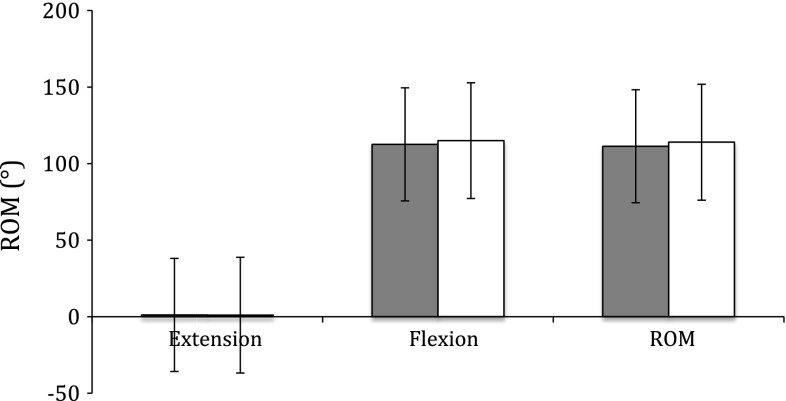
A graph shows latest knee ROM in patients converted to TKA from lateral closing-wedge and medial opening-wedge HTOs. Dark gray and white bars represent the lateral closing-wedge and medial opening-wedge cohorts, respectively. No difference between groups was found for this outcome measure.
Fig. 5
Fig. 5
A graph shows latest KSSs in patients converted to TKA from lateral closing-wedge and medial opening-wedge HTOs. Dark gray and white bars represent the lateral closing-wedge and medial opening-wedge cohorts, respectively. KSSs revealed no differences between groups for pain, function, knee, and total scores (p = 0.45, p = 0.1, p = 0.95, and p = 0.18, respectively).
Fig. 6
Fig. 6
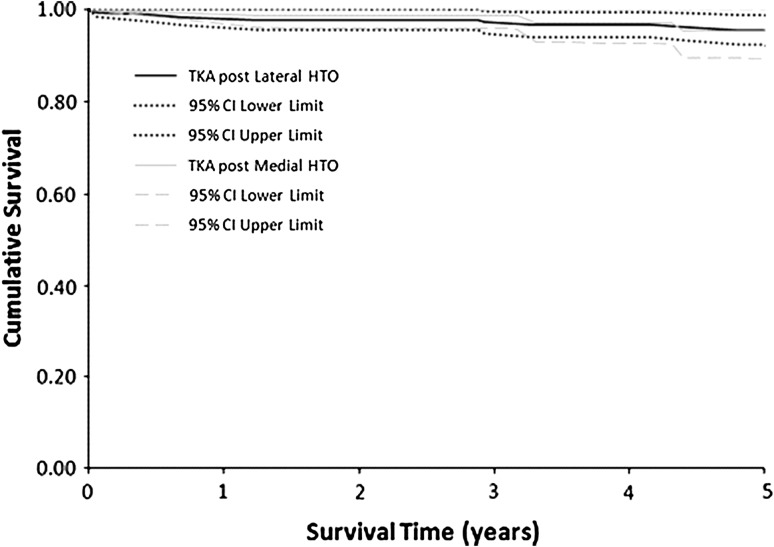
Kaplan-Meier survivorship curves with revision for any reason as the end point are shown in patients converted to TKA from lateral closing-wedge and medial opening-wedge HTOs. Average 5-year survival rates were 95% (95% CI: 94%–97%) for the lateral closing-wedge cohort and 95% (95% CI: 93%–98%) for the medial opening-wedge cohort.
Fig. 7
Fig. 7
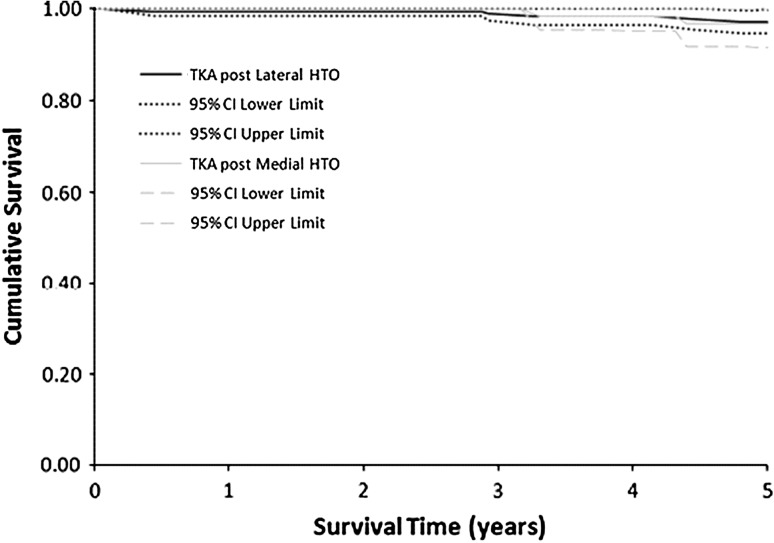
Kaplan-Meier survivorship curves with aseptic revisions only as the end point are shown in patients converted to TKA from lateral closing-wedge and medial opening-wedge HTOs. Average 5-year survival rates were 97% (95% CI: 96%–98%) for the lateral closing-wedge cohort and 96% (95% CI: 94%–99%) for the medial opening-wedge cohort.

References

    1. Erak S, Naudie D, MacDonald SJ, McCalden RW, Rorabeck CH, Bourne RB. Total knee arthroplasty following medial opening wedge high tibial osteotomy: technical issues early clinical radiological results. Knee. 2011;18:499–504. doi: 10.1016/j.knee.2010.11.002. - DOI - PubMed
    1. Fowler PJ, Tan JL, Brown GA. Medial opening wedge osteotomy: how I do it. Oper Tech Sports Med. 2000;8:32–38. doi: 10.1016/S1060-1872(00)80022-2. - DOI
    1. Haddad FS, Bentley G. Total knee arthroplasty after high tibial osteotomy: a medium-term review. J Arthroplasty. 2000;15:597–603. doi: 10.1054/arth.2000.6621. - DOI - PubMed
    1. Haslam P, Armstrong M, Geutjens G, Wilton TJ. Total knee arthroplasty after failed high tibial osteotomy: long-term follow-up of matched groups. J Arthroplasty. 2007;22:245–250. doi: 10.1016/j.arth.2006.01.031. - DOI - PubMed
    1. Hooper G, Leslie H, Burn J, Schouten R, Beci I. Oblique upper tibial opening wedge osteotomy for genu varum. Oper Orthop Traumatol. 2005;17:662–673. doi: 10.1007/s00064-005-1157-8. - DOI - PubMed