


Cultural phylogeography of the Bantu Languages of sub-Saharan Africa
- PMID: 23658203
- PMCID: PMC3673054
- DOI: 10.1098/rspb.2013.0695
Cultural phylogeography of the Bantu Languages of sub-Saharan Africa
Abstract
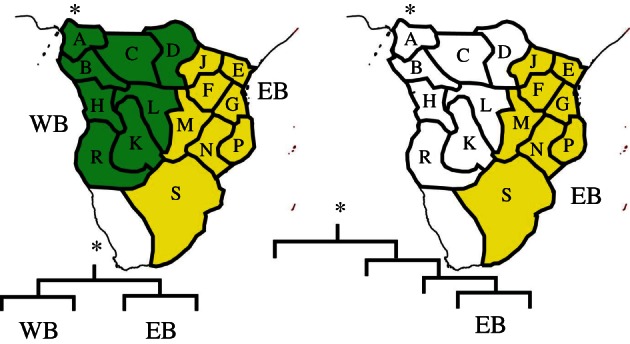
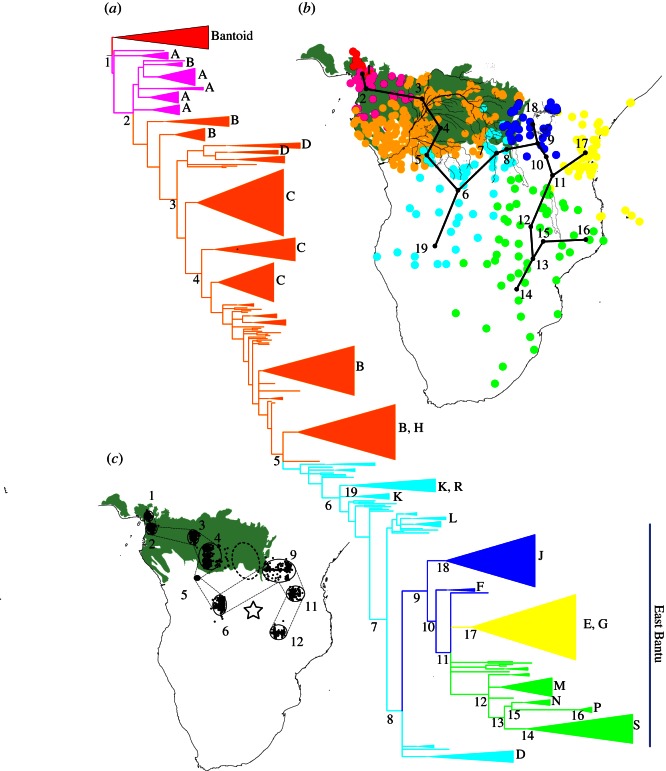
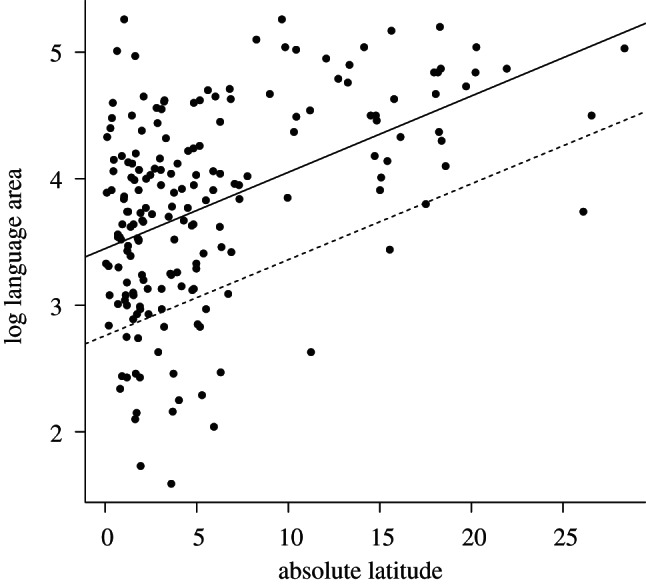
There is disagreement about the routes taken by populations speaking Bantu languages as they expanded to cover much of sub-Saharan Africa. Here, we build phylogenetic trees of Bantu languages and map them onto geographical space in order to assess the likely pathway of expansion and test between dispersal scenarios. The results clearly support a scenario in which groups first moved south through the rainforest from a homeland somewhere near the Nigeria-Cameroon border. Emerging on the south side of the rainforest, one branch moved south and west. Another branch moved towards the Great Lakes, eventually giving rise to the monophyletic clade of East Bantu languages that inhabit East and Southeastern Africa. These phylogenies also reveal information about more general processes involved in the diversification of human populations into distinct ethnolinguistic groups. Our study reveals that Bantu languages show a latitudinal gradient in covering greater areas with increasing distance from the equator. Analyses suggest that this pattern reflects a true ecological relationship rather than merely being an artefact of shared history. The study shows how a phylogeographic approach can address questions relating to the specific histories of certain groups, as well as general cultural evolutionary processes.
Keywords: cultural diversity; language diversity; language evolution; phylogenetic comparative methods; phylogenetic inference; phyloplasty.
Figures
References
-
- Lewis MP. 2009. Ethnologue: languages of the world, 16th edn Dallas, TX: SIL International
-
- Huffman TN. 2007. Handbook to the Iron Age: the archaeology of pre-colonial farming societies in Southern Africa. Scottsville, South Africa: University of KwaZulu-Natal Press
-
- Phillipson DW. 2005. African archaeology. Cambridge, UK: Cambridge University Press
-
- Ehret C. 2001. Bantu expansions: re-envisioning a central problem of early African History. Int. J. Afr. Hist. Stud. 34, 5–4110.2307/3097285 (doi:10.2307/3097285) - DOI - DOI
-
- Nurse D. 2003. Bantu languages. London, UK: Taylor & Francis
Publication types
MeSH terms
Grants and funding
LinkOut - more resources
Full Text Sources
Other Literature Sources
