


Contribution of follicular dendritic cells to persistent HIV viremia
- PMID: 23658450
- PMCID: PMC3700220
- DOI: 10.1128/JVI.00556-13
Contribution of follicular dendritic cells to persistent HIV viremia
Erratum in
- J Virol. Jul;87(14):7893
Abstract
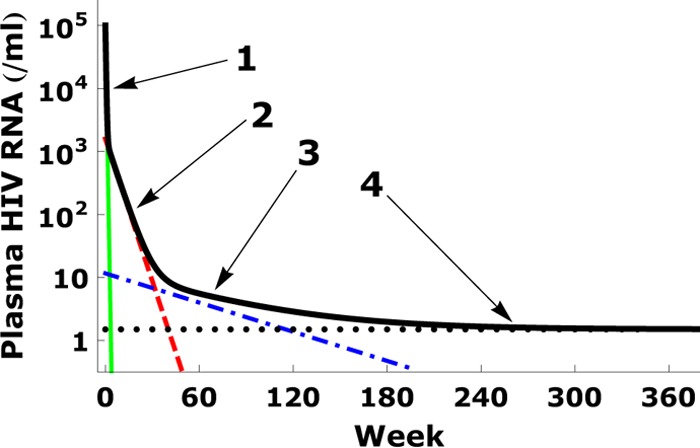
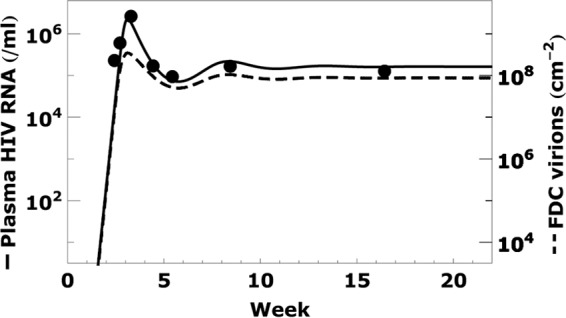
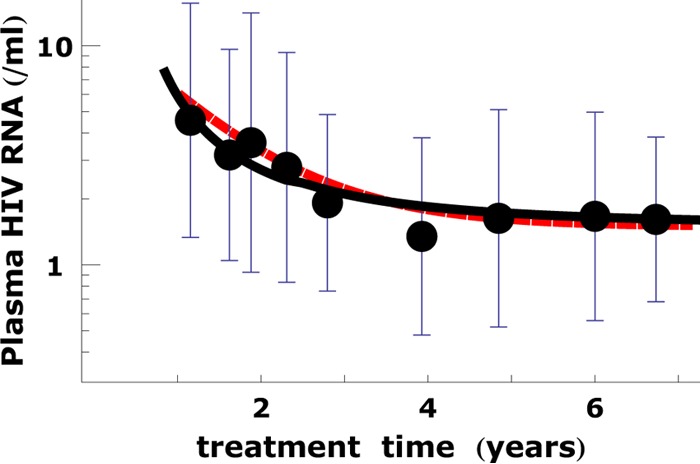
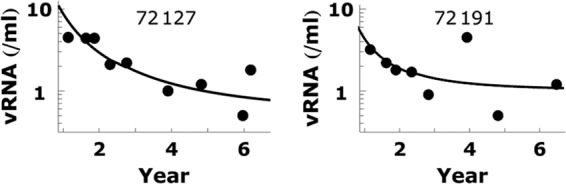
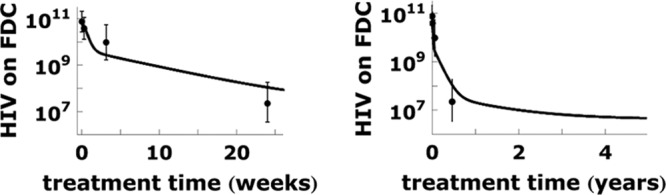
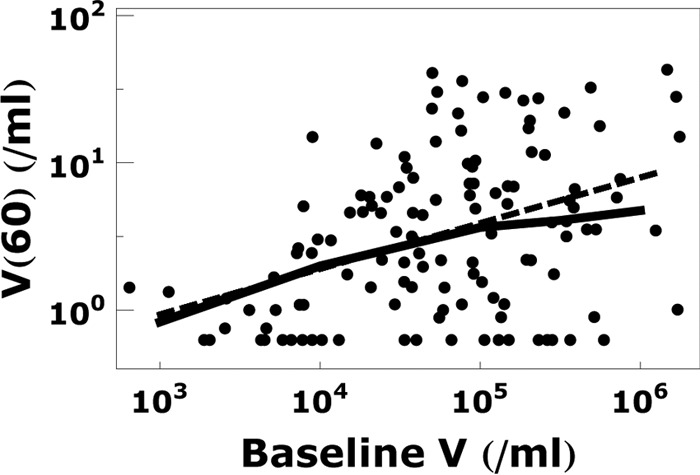
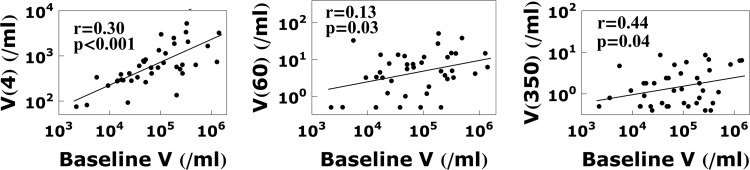
HIV-1 infections cannot be completely eradicated by drug therapy, as the virus persists in reservoirs. Low-level plasma viremia has been detected in patients treated for over 7 years, but the cellular compartments that support this low-level viremia have not been identified. The decay of HIV-1 during treatment appears to occur in four phases, with the 3rd and 4th phases occurring when the virus is below the limit of detection of conventional assays. Here, we focus on the 3rd phase of decay, which has been estimated to have a half-life of 39 months. We show that follicular dendritic cells (FDC), which have been identified as an HIV reservoir, can be the main source of the low-level viremia detected during the 3rd phase of decay and contribute to viremia at even longer times. Our calculations show that the kinetics of leakage of virus from FDC is consistent with three types of available clinical data.
Figures

References
-
- Ho DD, Neumann AU, Perelson AS, Chen W, Leonard JM, Markowitz M. 1995. Rapid turnover of plasma virions and CD4 lymphocytes in HIV-1 infection. Nature 373:123–126 - PubMed
-
- Perelson AS, Neumann AU, Markowitz M, Leonard JM, Ho DD. 1996. HIV-1 dynamics in vivo: virion clearance rate, infected cell life-span, and viral generation time. Science 271:1582–1586 - PubMed
-
- Perelson AS, Essunger P, Cao Y, Vesanen M, Hurley A, Saksela K, Markowitz M, Ho DD. 1997. Decay characteristics of HIV-1-infected compartments during combination therapy. Nature 387:188–191 - PubMed
-
- Finzi D, Siliciano RF. 1998. Viral dynamics in HIV-1 infection. Cell 93:665–671 - PubMed
Publication types
MeSH terms
Substances
Grants and funding
LinkOut - more resources
Full Text Sources
Other Literature Sources
Medical
