Review
doi: 10.1371/journal.ppat.1003230.
Epub 2013 May 2.
Polyphosphate and its diverse functions in host cells and pathogens
Affiliations
- PMID: 23658515
- PMCID: PMC3642070
- DOI: 10.1371/journal.ppat.1003230
Item in Clipboard
Review
Polyphosphate and its diverse functions in host cells and pathogens
PLoS Pathog.
2013.
No abstract available
Conflict of interest statement
The authors have declared that no competing interests exist.
Figures
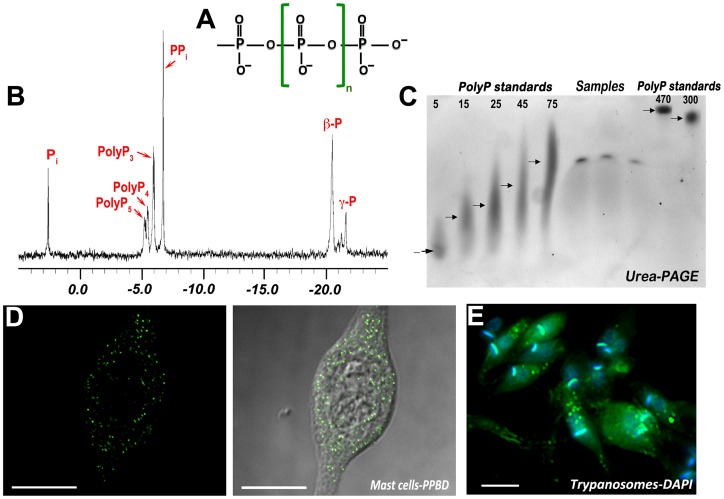
(A) Structure of polyP. (B) 303.6-MHz spectrum (1H decoupled) of a perchloric acid extract of isolated acidocalcisomes from epimastigotes of T. cruzi, showing peaks corresponding to Pi; the α phosphates of pentapolyphosphate (polyP5), tetrapolyphosphate (polyP4), tripolyphosphate (polyP3); PPi; the β phosphates of tri-, tetra-, and pentapolyphosphate (β-P); and the γ phosphate (central) of pentapolyphosphate (γ-P). Reproduced with permission from reference , © the American Society for Biochemistry and Molecular Biology. (C) Urea-PAGE analysis of polyP from human platelets from three different donors. PolyP extracted from platelets was electrophoresed by 6% urea-PAGE. Chain lengths of standards are on the left. The lanes named “Samples" show the position of migration of samples from three different donors. Reproduced with permission from reference , © the American Society for Biochemistry and Molecular Biology. (D) Fluorescence analysis (left) and merge with bright field image (right) of the localization of polyP in mast cell granules (acidocalcisomes) using the recombinant polyP binding domain (PPBD) of Escherichia coli PPX linked with an Xpress epitope tag. Reproduced with permission from reference , © the American Society for Biochemistry and Molecular Biology. (E) DAPI staining of epimastigotes of T. cruzi showing the punctate staining of acidocalcisomes. Kinetoplast DNA is stained blue.
References
-
- Rao NN, Gomez-Garcia MR, Kornberg A (2009) Inorganic polyphosphate: essential for growth and survival. Annu Rev Biochem 78: 605–647. - PubMed
-
- Docampo R, de Souza W, Miranda K, Rohloff P, Moreno SN (2005) Acidocalcisomes - conserved from bacteria to man. Nat Rev Microbiol 3: 251–261. - PubMed
-
- Reusch RN (2012) Physiological importance of poly-(R)-3-hydroxybutyrates. Chem Biodivers 9: 2343–2366. - PubMed
Publication types
MeSH terms
Substances
Grants and funding
LinkOut - more resources
Full Text Sources
Other Literature Sources