


Immunological assessment of influenza vaccines and immune correlates of protection
- PMID: 23659300
- PMCID: PMC9002926
- DOI: 10.1586/erv.13.35
Immunological assessment of influenza vaccines and immune correlates of protection
Abstract
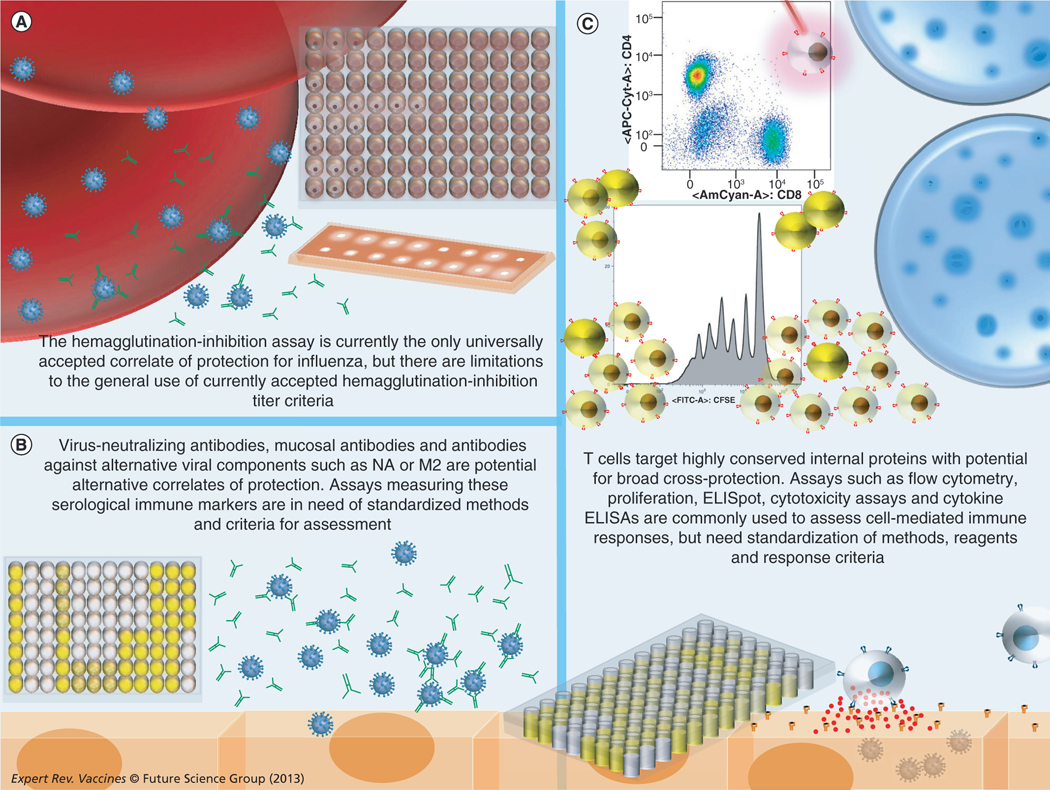
Influenza vaccines remain the primary public health tool in reducing the ever-present burden of influenza and its complications. In seeking more immunogenic, more effective and more broadly cross-protective influenza vaccines, the landscape of influenza vaccines is rapidly expanding, both in near-term advances and next-generation vaccine design. Although the first influenza vaccines were licensed over 60 years ago, the hemagglutination-inhibition antibody titer is currently the only universally accepted immune correlate of protection against influenza. However, hemagglutination-inhibition titers appear to be less effective at predicting protection in populations at high risk for severe influenza disease; older adults, young children and those with certain medical conditions. The lack of knowledge and validated methods to measure alternate immune markers of protection against influenza remain a substantial barrier to the development of more immunogenic, broadly cross-reactive and effective influenza vaccines. Here, the authors review the knowledge of immune effectors of protection against influenza and discuss assessment methods for a broader range of immunological parameters that could be considered in the evaluation of traditional or new-generation influenza vaccines.
Figures
References
-
- Barr IG, McCauley J, Cox N et al. Epidemiological, antigenic and genetic characteristics of seasonal influenza A(H1N1), A(H3N2) and B influenza viruses: basis for the WHO recommendation on the composition of influenza vaccines for use in the 2009–2010 Northern Hemisphere season. Vaccine 28(5), 1156–1167 (2010). - PubMed
-
- Fiore AE, Bridges CB, Cox NJ. Seasonal influenza vaccines. Curr. Top. Microbiol. Immunol. 333, 43–82 (2009). - PubMed
-
- Johansen K, Nicoll A, Ciancio BC, Kramarz P. Pandemic influenza A(H1N1) 2009 vaccines in the European Union. Euro Surveill. 14(41), 19361 (2009). - PubMed
-
- Calcagnile S, Zuccotti GV. The virosomal adjuvanted influenza vaccine. Expert Opin. Biol. Ther. 10(2), 191–200 (2010). - PubMed
-
- Sullivan SJ, Jacobson R, Poland GA. Advances in the vaccination of the elderly against influenza: role of a high-dose vaccine. Expert Rev. Vaccines 9(10), 1127–1133 (2010). - PubMed
Websites
-
- US Department of Health and Human Services. U.S. Food and Drug Administration (FDA). News and Events: Jan. 16, 2013. www.fda.gov/NewsEvents/Newsroom/PressAnnouncements/ucm335891.htm
-
- WHO. WHO Global Influenza Surveillance Network. Manual for the laboratory diagnosis and virological surveillance of influenza. www.who.int/influenza/resources/documents/manual_diagnosis_surveillance_...
-
- European Medicines Agency (EMA). Committee for Proprietary Medicinal Products (CPMP). Note for guidance on harmonisation of requirements for influenza vaccines. www.emea.europa.eu/docs/en_GB/document_library/Scientific_guideline/2009...
-
- FDA. Guidance for industry: clinical data needed to support the licensure of seasonal inactivated influenza vaccines. www.fda.gov/BiologicsBloodVaccines/GuidanceComplianceRegulatoryInformati...
-
- EMA. Committee for Medicinal Products for Human Use (CHMP).Guideline on dossier structure and content for pandemic influenza vaccine marketing authorisation application. www.emea.europa.eu/docs/en_GB/document_library/Scientific_guideline/2009...
Publication types
MeSH terms
Substances
Grants and funding
LinkOut - more resources
Full Text Sources
Other Literature Sources
Medical
