. 2013 May;1287(1):1-16.
doi: 10.1111/nyas.12116. Epub 2013 May 9.

Application of combined omics platforms to accelerate biomedical discovery in diabesity

Affiliations
Free PMC article

Application of combined omics platforms to accelerate biomedical discovery in diabesity

Irwin J Kurland et al. Ann N Y Acad Sci. 2013 May.
Free PMC article

Abstract

Diabesity has become a popular term to describe the specific form of diabetes that develops late in life and is associated with obesity. While there is a correlation between diabetes and obesity, the association is not universally predictive. Defining the metabolic characteristics of obesity that lead to diabetes, and how obese individuals who develop diabetes different from those who do not, are important goals. The use of large-scale omics analyses (e.g., metabolomic, proteomic, transcriptomic, and lipidomic) of diabetes and obesity may help to identify new targets to treat these conditions. This report discusses how various types of omics data can be integrated to shed light on the changes in metabolism that occur in obesity and diabetes.


Figures

Figure 1
Figure 1
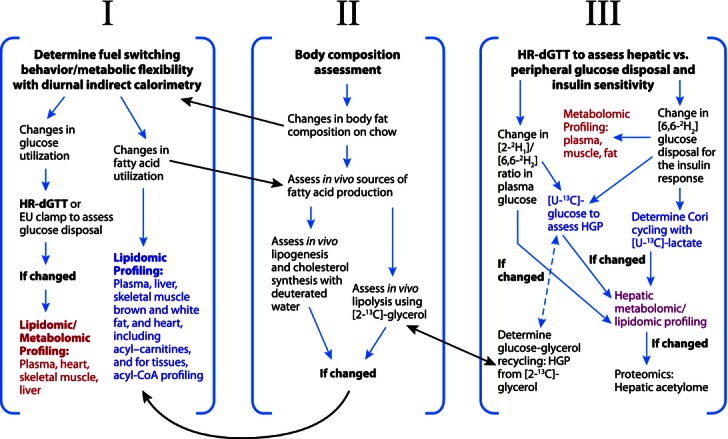
Framework for integrating fluxomic, metabolomic and lipidomic profiling. Our approach is to use fluxomics as a primary tool for metabolic phenotyping, and to layer additional omic information, such as metabolomics, lipidomics, and proteomics (acetylome determination), in a hypothesis-driven manner, and vice versa, to use fluxomics to elucidate the importance of other omic findings. (I) Discovery framework resulting from observing changes in fuel utilization with indirect calorimetry. (II) Discovery framework resulting from observing changes in body composition. (III) Discovery framework resulting from observing changes in flux measured via the hepatic recycling glucose (deuterated) tolerance test (HR-dGTT). The HR-dGTT yields information about peripheral and hepatic glucose disposal that can localize tissue specific metabolic/lipidomic screening. Changes in hepatic versus peripheral glucose disposal are assessed from the time course of percent differences in plasma [2-2H1]-glucose vs. [6,6-2H2]-glucose enrichments (1-ratio([2-2H1]/ [6,6-2H2])-glucose). The correlation with the hepatic global acetylome can be assessed in a hypothesis-driven framework, along with other fluxomic methodologies for assessing lipolysis (adipose), hepatic-adipose/glucose-glycerol recycling (HGP from [2-13C]-glycerol), lipogenesis, and Cori cycling (HGP from [U-13C]-lactate). The stable isotope tests shown are closed loop tests that are performed at the basal glucose and insulin levels (glycerol production and HGP), or dynamic tests incorporating the HR-dGTT and insulin responses. Closed loop tests do not require experimental groups to have identical, fixed values in glucose and insulin that are needed for open loop tests like the euglycemic hyperinsulinemic (EU) clamp. Tissue assessments in this framework assume an animal model. HGP, hepatic glucose production; D2O, deuterated water. Image courtesy of Irwin J. Kurland.
Figure 2
Figure 2
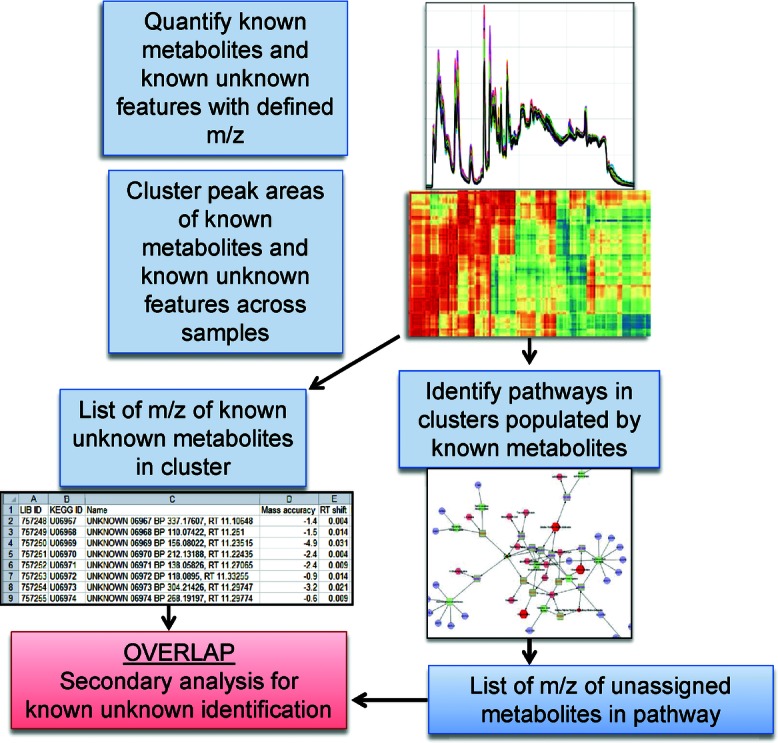
Schematic of Coolmap workflow to identify metabolic pathways. Automatic clustering of metabolite levels can identify metabolic pathways generated by known compounds contained in the clusters. ‘Known Unknown’ features with masses matching other metabolites in the identified pathway can aid in the identification of unknown metabolites. Image courtesy of Charles Burant.
Figure 3
Figure 3
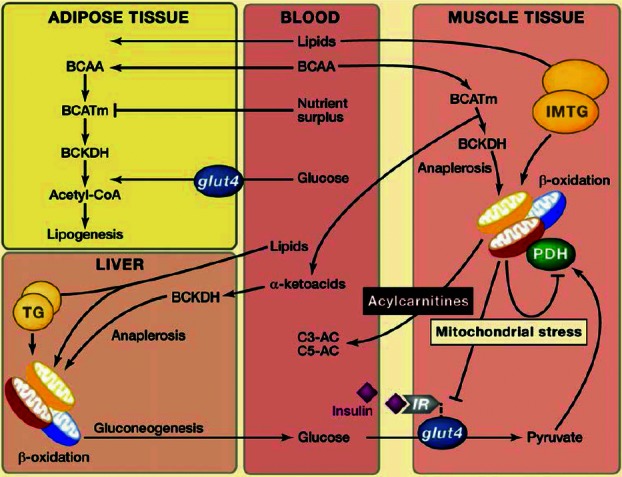
Schematic of a working model of potential crosstalk between lipids and branched chain amino acids (BCAA) in the development of obesity-related insulin resistance. Anaplerosis refers to repletion or filling up of TCA cycle intermediates via entry points other than acetyl CoA. TG, triglyceride; IMTG, intramyocellular triglyceride; IR, insulin receptor; BCATm, mitochondrial branched-chain aminotransferase; BCKDH, branched chain keto acid dehydrogenase; PDH, pyruvate dehydrogenase. Image courtesy of Christopher Newgard.
Figure 4
Figure 4
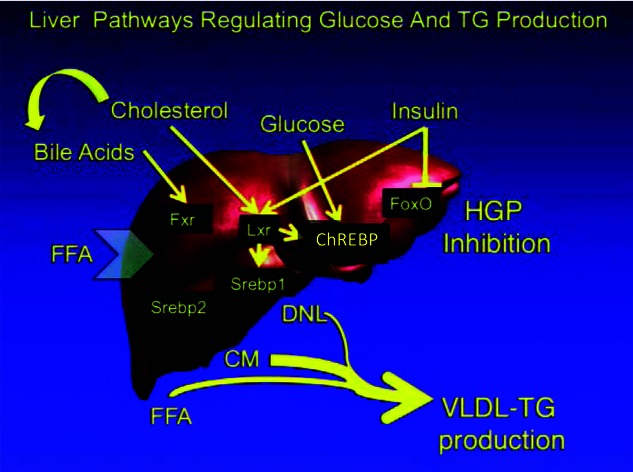
Outline of a working hypothesis for liver signaling pathways that affect diabetic dyslipidemia and hyperglycemia, linking bile acid, cholesterol, glucose, and insulin signaling to glucose, cholesterol, fatty acid, and triglyceride synthesis. FFA, free fatty acids; Srebp, Sterol regulatory element-binding protein; ChREBP, Carbohydrate-responsive element-binding protein; Lxr, Liver X receptor; Fxr, farnesoid X receptor; FoxO, Forkhead box O transcription factor; HGP, hepatic glucose production; DNL, de novo lipogenesis; TG, triglyceride; VLDL, very low density lipoprotein; CM, chylomicron. Image courtesy of Domenico Accili.
Figure 5
Figure 5
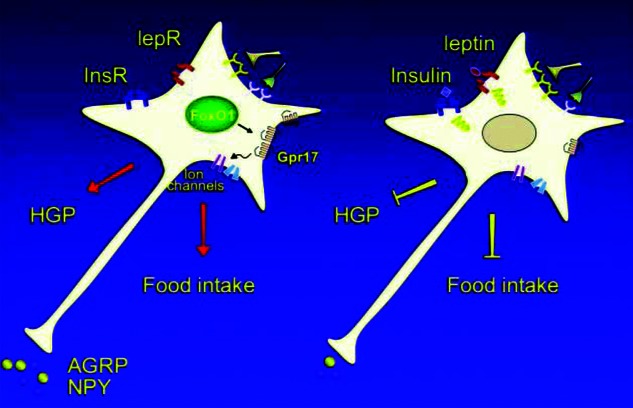
Model for regulation of food intake and hepatic glucose activity by FoxO1 and Gpr17. The G protein–coupled receptor Gpr17 is a FoxO1 target whose expression is regulated by nutritional status, and may play a role in mediating food intake. InsR, insulin receptor; lepR, leptin receptor; HGP, hepatic glucose production; NPY/AGRP, neuropeptide Y/Agouti-related peptide. Image courtesy of Domenico Accili.
Figure 6
Figure 6
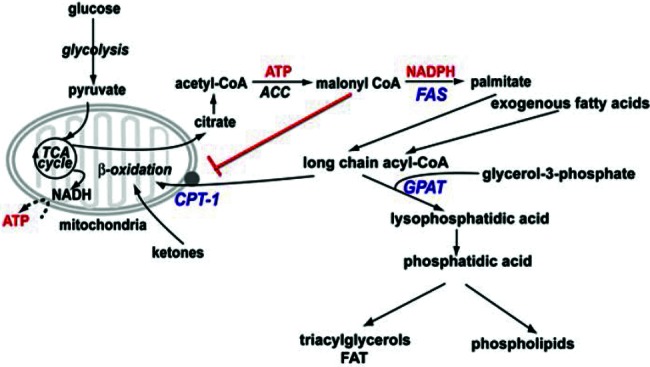
The role of fatty acid synthase (FAS), glycerol-3-phosphate acyltransferase (GPAT), and carnitine palmitoyl transferase 1 (CPT-1) in brain fatty acid metabolism. C75, an inhibitor of FAS and activator of CPT-1, FSG67, an inhibitor of GPAT, and C89b, an activator of CPT-1, all reduce food intake, increase energy expenditure, and enhance fatty acid oxidation to decrease adiposity and body weight. Image courtesy of Gabriele Ronnett.
Figure 7
Figure 7
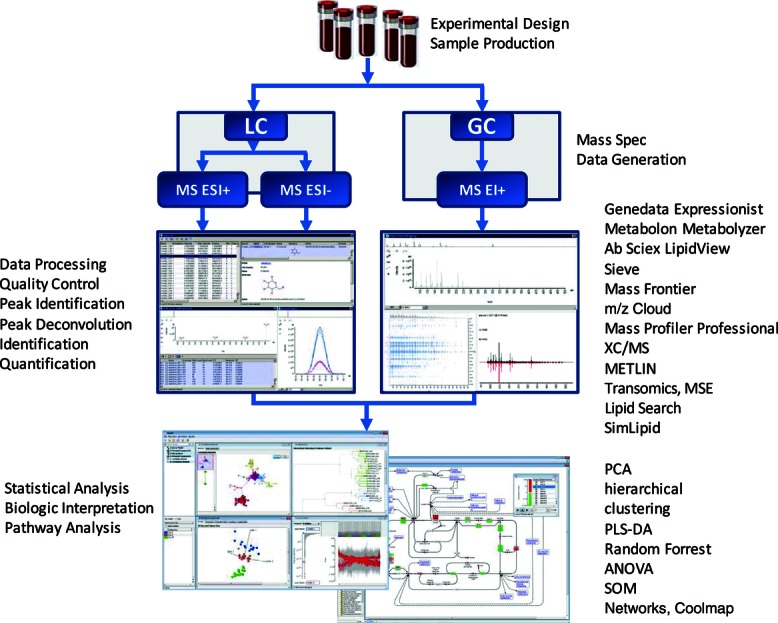
Overview of metabolomic data generation and data analysis. The flowchart used for metabolite extraction, data mining, and metabolite identification is detailed. This illustrates sample preparation, mass spectrometric analysis, peak extraction/identification and compound quantification, and statistical data analysis for biomarker identification and mapping of biomarkers to metabolic pathways. Samples, in general, can be divided into separate groups for gas chromatography/ mass spectrometry (GC/MS) and liquid chromatography/MS (LC/MS). LC/MS is further divided to examine both positively and negatively charged ions, first done with full scan for exact mass, and after with LC/MS/MS for identification with databases such as METLIN, SimLipid, LipidView, Lipid Search or Mass Frontier, or in the case of GC/MS, Fiehn and NIST libraries. Data preprocessing covers the software programs that process complex raw data to clean data. Data preprocessing programs (for example, Genedata Expressionist for Mass Spec, Transomics, XC/MS, Sieve, Metabolon Metabolyzer) are used to separate peaks from noise, and then database searching can be accomplished. Genedata Expressionist for Mass Spec, Transomics, and XC/MS are mass spectrometer platform–independent. A variety of techniques can be used for statistical analysis, including principal component analysis (PCA), partial least squares discriminant analysis (PLS-DA), analysis of variance (ANOVA), Random Forrest, self-organizing maps (SOM), and platform-independent software such as SIMCA-P, Transomics and Genedata and Expressionist for Mass Spec can be used for such analyses. An overview of such statistical methods can be found in Madsen et al. Image courtesy of Joe Shambaugh.

References

    1. Centers for Disease Control. Number of Americans with diabetes rises to nearly 26 million. More than a third of adults estimated to have prediabetes. 2011. January 26, 2011. Cited March 12. 2013. http://www.cdc.gov/media/releases/2011/p0126_diabetes.html.
    1. Kelley DE. Skeletal muscle fat oxidation: timing and flexibility are everything. J. Clin. Invest. 2005;115::1699–1702. - PMC - PubMed
    1. Galgani JE, Moro C, Ravussin E. Metabolic flexibility and insulin resistance. Am. J. Physiol. Endocrinol. Metab. 2008;295::E1009–1017. - PMC - PubMed
    1. Farag YM, Gaballa MR. Diabesity: an overview of a rising epidemic. Nephrol. Dial. Transplant. 2011;26::28–35. - PubMed
    1. Kaufman FR. The Obesity-Diabetes Epidemic That Threatens America—And What We Must Do to Stop It. 2005. Random House Digital.

Publication types

MeSH terms