


Energy loss and coronary flow simulation following hybrid stage I palliation: a hypoplastic left heart computational fluid dynamic model
- PMID: 23660734
- PMCID: PMC3715191
- DOI: 10.1093/icvts/ivt193
Energy loss and coronary flow simulation following hybrid stage I palliation: a hypoplastic left heart computational fluid dynamic model
Abstract
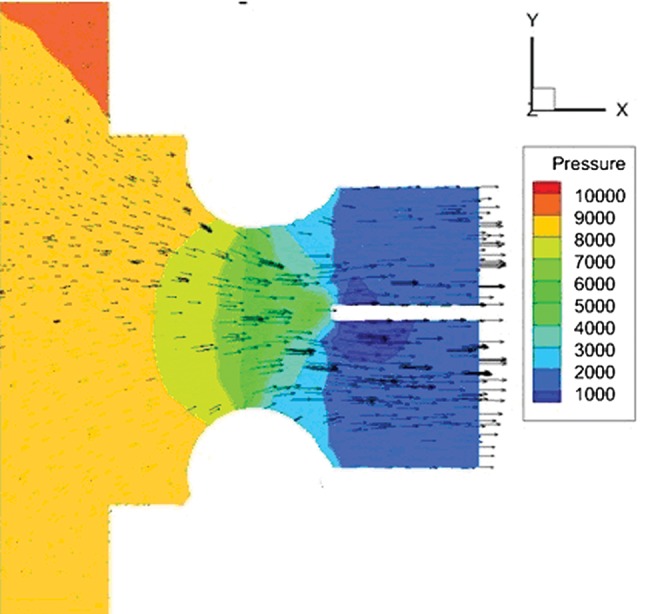
Objectives: The theoretical differences in energy losses as well as coronary flow with different band sizes for branch pulmonary arteries (PA) in hypoplastic left heart syndrome (HLHS) remain unknown. Our objective was to develop a computational fluid dynamic model (CFD) to determine the energy losses and pulmonary-to-systemic flow rates. This study was done for three different PA band sizes.
Methods: Three-dimensional computer models of the hybrid procedure were constructed using the standard commercial CFD softwares Fluent and Gambit. The computer models were controlled for bilateral PA reduction to 25% (restrictive), 50% (intermediate) and 75% (loose) of the native branch pulmonary artery diameter. Velocity and pressure data were calculated throughout the heart geometry using the finite volume numerical method. Coronary flow was measured simultaneously with each model. Wall shear stress and the ratio of pulmonary-to-systemic volume flow rates were calculated. Computer simulations were compared at fixed points utilizing echocardiographic and catheter-based metric dimensions.
Results: Restricting the PA band to a 25% diameter demonstrated the greatest energy loss. The 25% banding model produced an energy loss of 16.76% systolic and 24.91% diastolic vs loose banding at 7.36% systolic and 17.90% diastolic. Also, restrictive PA bands had greater coronary flow compared with loose PA bands (50.2 vs 41.9 ml/min). Shear stress ranged from 3.75 Pascals with restrictive PA banding to 2.84 Pascals with loose banding. Intermediate PA banding at 50% diameter achieved a Qp/Qs (closest to 1) at 1.46 systolic and 0.66 diastolic compared with loose or restrictive banding without excess energy loss.
Conclusions: CFD provides a unique platform to simulate pressure, shear stress as well as energy losses of the hybrid procedure. PA banding at 50% provided a balanced pulmonary and systemic circulation with adequate coronary flow but without extra energy losses incurred.
Keywords: Computational fluid dynamics; Haemodynamics; Hypoplastic left heart syndrome; Navier–Stokes equations; Simulations.
Figures



References
-
- Norwood WI, Lang P, Castaneda AR, Campbell DN. Experience with operations for hypoplastic left heart syndrome. J Thorac Cardiovasc Surg. 1981;85:511–9. - PubMed
-
- Ohye RG, Sleeper LA, Mahony L, Newburger JW, Pearson GD, Lu M Pediatric Heart Network Investigators. Comparison of shunt types in the Norwood procedure for single-ventricle lesions. N Engl J Med. 2010;362:1980–92. doi:10.1056/NEJMoa0912461. - DOI - PMC - PubMed
-
- Galantowicz M, Cheatham JP, Phillips A, Cua CL, Hoffman TM, Hill SL, et al. Hybrid approach for hypoplastic left heart syndrome: intermediate results after the learning curve. Ann Thorac Surg. 2008;85:2063–70. discussion 2070–1 doi:10.1016/j.athoracsur.2008.02.009. - DOI - PubMed
-
- Pigula FA, Vida V, Del Nido P, Bacha E. Contemporary results and current strategies in the management of hypoplastic left heart syndrome. Semin Thorac Cardiovasc Surg. 2007;19:238–44. doi:10.1053/j.semtcvs.2007.07.002. - DOI - PubMed
-
- De Leval MR, Kilner P, Gewillig M, Bull C. Total cavopulmonary connection: a logical alternative to atriopulmonary connection for complex Fontan operations. J Thorac Cardiovasc Surg. 1988;96:682–95. - PubMed
Publication types
MeSH terms
LinkOut - more resources
Full Text Sources
Other Literature Sources
Medical
Miscellaneous
