


Ledge and wedge: younger and older adults' perception of action possibilities
- PMID: 23660744
- PMCID: PMC3756555
- DOI: 10.1007/s00221-013-3550-0
Ledge and wedge: younger and older adults' perception of action possibilities
Abstract
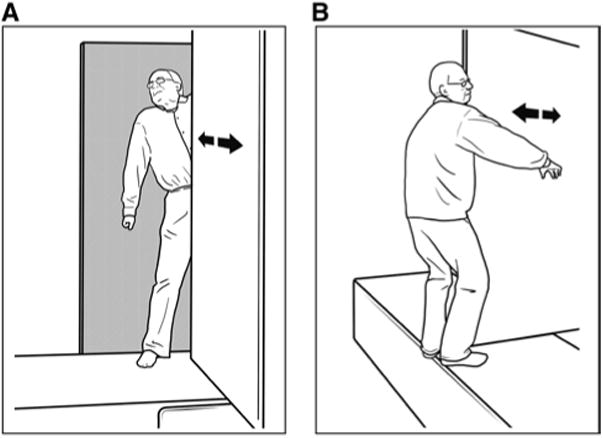
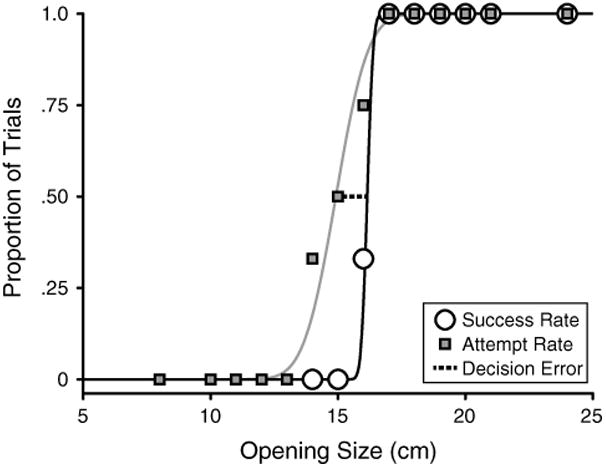
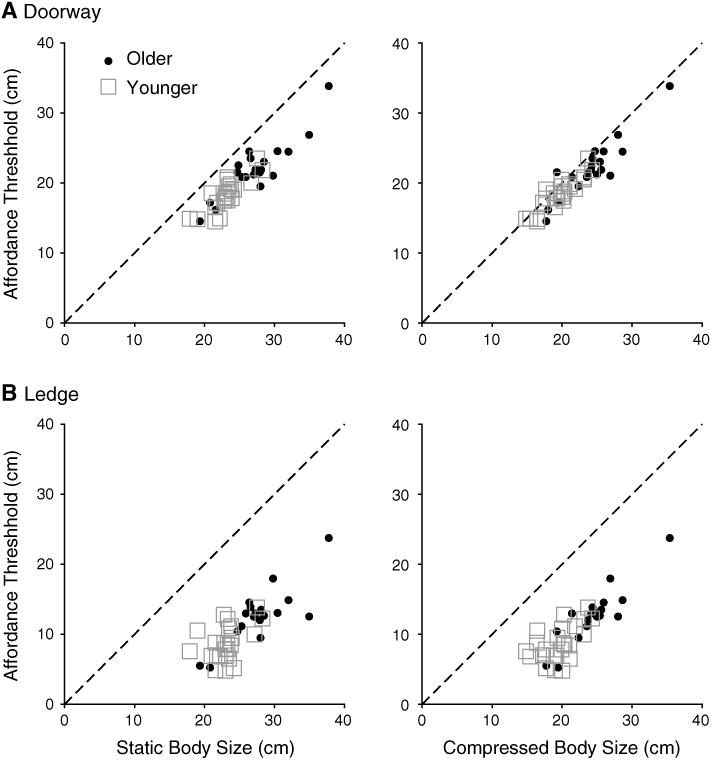
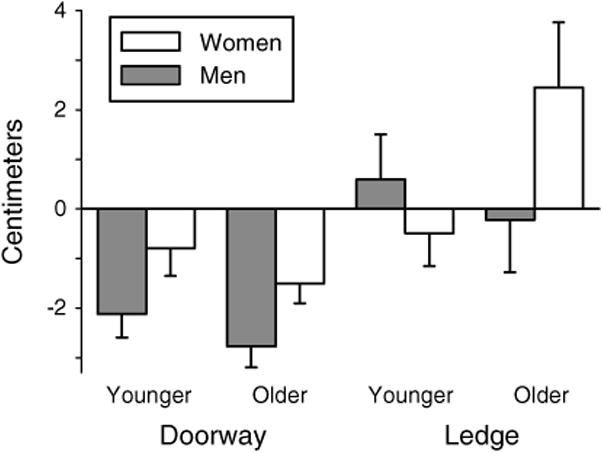
The current study investigated whether younger (college-age) and older adults (60+ years) differ in their ability to perceive safe and unsafe motor actions. Participants decided whether to walk through openings varying in width in two penalty conditions: In the doorway condition, if participants attempted to squeeze through impossibly narrow openings, the penalty for error was entrapment. In the ledge condition, if participants attempted to inch along impossibly narrow ledges, the penalty for error was falling. Results showed that across the lifespan, people consider falling to be a more severe penalty than getting stuck: Both younger and older adults made more conservative decisions when the penalty for error was falling, and older women were especially leery of falling. In both age groups, abilities and decisions were based on dynamic properties of the body, such as compressed body size in the doorway condition and balance in the ledge condition. Findings indicate that failure to perceive possibilities for action is unlikely to be the cause of the increased prevalence of falling in older adults.
Figures
References
-
- Adams P, Martinez M, Vickerie J, Kirzinger W. Summary health statistics for the US population: National Health Interview Survey, 2010. Vital Health Stat. 2011;10:1–117. - PubMed
-
- Butler A. Action and ageing (Doctoral thesis, University of New South Wales, Sydney, Australia) 2010
-
- Cesari P, Formenti F, Olivato P. A common perceptual parameter for stair climbing for children, young and old adults. Hum Mov Sci. 2003;22:111–124. - PubMed
-
- Cornsweet TN. The staircase-method in psychophysics. Am J Psychol. 1962;75:485–491. - PubMed
Publication types
MeSH terms
Grants and funding
LinkOut - more resources
Full Text Sources
Other Literature Sources
Medical
