


Review
doi: 10.1126/science.1233028.
Cellular self-defense: how cell-autonomous immunity protects against pathogens
Affiliations
- PMID: 23661752
- PMCID: PMC3863583
- DOI: 10.1126/science.1233028
Item in Clipboard
Review
Cellular self-defense: how cell-autonomous immunity protects against pathogens
Science.
.
Abstract
Our prevailing view of vertebrate host defense is strongly shaped by the notion of a specialized set of immune cells as sole guardians of antimicrobial resistance. Yet this view greatly underestimates a capacity for most cell lineages-the majority of which fall outside the traditional province of the immune system-to defend themselves against infection. This ancient and ubiquitous form of host protection is termed cell-autonomous immunity and operates across all three domains of life. Here, we discuss the organizing principles that govern cellular self-defense and how intracellular compartmentalization has shaped its activities to provide effective protection against a wide variety of microbial pathogens.
Figures

Eukaryotic cells are composed of compartments separated by selectively permeable borders that control their composition. Cell and compartment borders can physically prevent pathogen invasion, and they house sensors that are “tripped” as pathogens try to cross them. Pathogen-induced damage to borders alters compartment composition; the resulting mislocalization of host molecules can be perceived as a danger signal. Control over compartment composition allows potent antimicrobial effectors that otherwise might damage the cell to be safely sequestered. Finally, each cellular compartment represents its own microenvironment that can be made hostile to pathogens.

Membrane damage causes the translocation of extracellular molecules into the cytosol, which cells sense and interpret as a danger signal. Host glycans on burst phagosomes are detected by the cytosolic lectin galectin-8, whose accumulation provides an eat-me signal for the autophagy cargo receptor NDP52, causing LC3C-dependent autophagy and restriction of bacterial proliferation. Antibodies bound to bacteria and nonenveloped viruses are translocated into the cytosol upon release of pathogens from their internalized compartment. Cytosolic antibodies are detected by the E3 ligase and Fc receptor TRIM21, which targets virions for degradation by the proteasome and activates innate immune signaling.
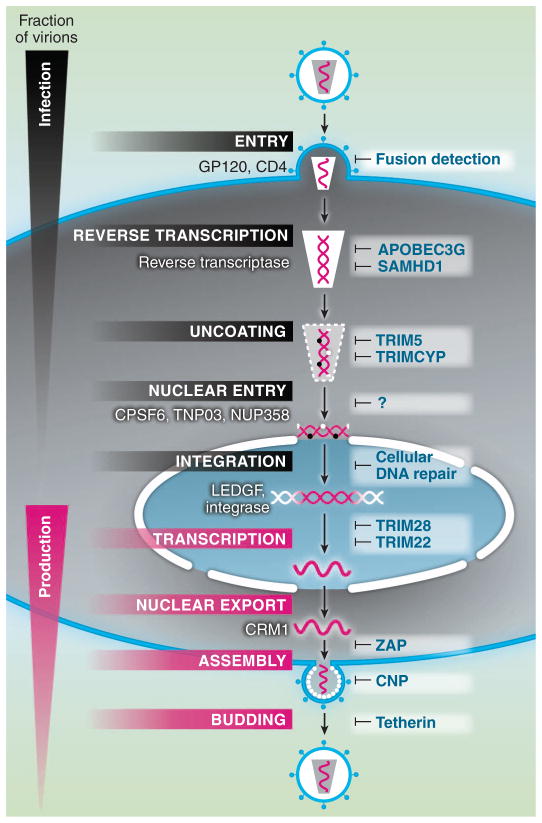
To infect cells and complete their life cycle, retro-viruses, such as HIV-1, must pass through multiple compartment borders and access distinct cellular compartments. Virions must recruit and retask cellular cofactors to negotiate their way through the cell and to replicate successfully. Meanwhile, antiviral factors adapted to specific cellular microenvironments target and inhibit specific steps of the viral life cycle. At each stage, only a fraction of virions are successful, which provides a highly synergistic defense system capable of inhibiting even quickly evolving pathogens. LEDGF, PC4 and SFRS1 interacting protein–1; ZAP, zinc finger CCCH-type antiviral protein–1.
References
Publication types
MeSH terms
Substances
Grants and funding
LinkOut - more resources
Full Text Sources
Other Literature Sources
