


Waning of maternal antibodies against measles, mumps, rubella, and varicella in communities with contrasting vaccination coverage
- PMID: 23661802
- PMCID: PMC4043230
- DOI: 10.1093/infdis/jit143
Waning of maternal antibodies against measles, mumps, rubella, and varicella in communities with contrasting vaccination coverage
Abstract
Background: The combined measles, mumps, and rubella (MMR) vaccine has been successfully administered for >20 years. Because of this, protection by maternal antibodies in infants born to vaccinated mothers might be negatively affected.
Methods: A large cross-sectional serologic survey was conducted in the Netherlands during 2006-2007. We compared the kinetics of antibody concentrations in children and women of childbearing age in the highly vaccinated general population with those in orthodox Protestant communities that were exposed to outbreaks.
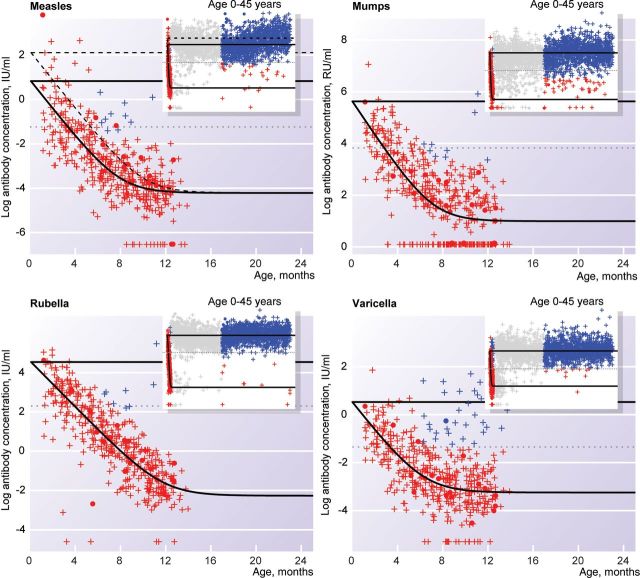
Results: The estimated duration of protection by maternal antibodies among infants in the general population, most of whom were born to vaccinated mothers, was short: 3.3 months for measles, 2.7 months for mumps, 3.9 months for rubella, and 3.4 months for varicella. The duration of protection against measles was 2 months longer for infants born in the orthodox communities, most of whom had unvaccinated mothers. For rubella, mothers in the orthodox communities had higher concentrations of antibodies as compared to the general population.
Conclusion: Children of mothers vaccinated against measles and, possibly, rubella have lower concentrations of maternal antibodies and lose protection by maternal antibodies at an earlier age than children of mothers in communities that oppose vaccination. This increases the risk of disease transmission in highly vaccinated populations.
Keywords: MMR vaccination; maternal antibodies; waning.
Figures
Comment in
-
Loss of passively acquired maternal antibodies in highly vaccinated populations: an emerging need to define the ontogeny of infant immune responses.J Infect Dis. 2013 Jul;208(1):1-3. doi: 10.1093/infdis/jit144. Epub 2013 May 8. J Infect Dis. 2013. PMID: 23661801 No abstract available.
References
-
- Davidkin I, Kontio M, Paunio M, Peltola H. MMR vaccination and disease elimination: the Finnish experience. Expert Rev Vaccines. 2010;9:1045–53. - PubMed
-
- Castillo-Solorzano C, Marsigli C, Danovaro-Holliday MC, Ruiz-Matus C, Tambini G, Andrus JK. Measles and rubella elimination initiatives in the Americas: lessons learned and best practices. J Infect Dis. 2011;204(Suppl 1):S279–83. - PubMed
-
- Redd SC, King GE, Heath JL, Forghani B, Bellini WJ, Markowitz LE. Comparison of vaccination with measles-mumps-rubella vaccine at 9, 12, and 15 months of age. J Infect Dis. 2004;189(Suppl 1):S116–22. - PubMed
-
- de Voer RM, van der Klis FR, Nooitgedagt JE, et al. Seroprevalence and placental transportation of maternal antibodies specific for Neisseria meningitidis serogroup C, Haemophilus influenzae type B, diphtheria, tetanus, and pertussis. Clin Infect Dis. 2009;49:58–64. - PubMed
-
- Kebede S, Nokes DJ, Cutts FT, Nigatu W, Sanderson F, Beyene H. Maternal rubella-specific antibody prevalence in Ethiopian infants. Trans R Soc Trop Med Hyg. 2000;94:333–40. - PubMed
Publication types
MeSH terms
Substances
LinkOut - more resources
Full Text Sources
Other Literature Sources
Medical
