. 2013 Jan;3(1):144-52.
doi: 10.4103/2045-8932.109960.

Metabolism and bioenergetics in the right ventricle and pulmonary vasculature in pulmonary hypertension

Affiliations

Metabolism and bioenergetics in the right ventricle and pulmonary vasculature in pulmonary hypertension

Stephen L Archer et al. Pulm Circ. 2013 Jan.

Abstract

Pulmonary arterial hypertension (PAH) is a syndrome in which pulmonary vascular cross sectional area and compliance are reduced by vasoconstriction, vascular remodeling, and inflammation. Vascular remodeling results in part from increased proliferation and impaired apoptosis of vascular cells. The resulting increase in afterload promotes right ventricular hypertrophy (RVH) and RV failure. Recently identified mitochondrial-metabolic abnormalities in PAH, notably pyruvate dehydrogenase kinase-mediated inhibition of pyruvate dehydrogenase (PDH), result in aerobic glycolysis in both the lung vasculature and RV. This glycolytic shift has diagnostic importance since it is detectable early in experimental PAH by increased lung and RV uptake of (18)F-fluorodeoxyglucose on positron emission tomography. The metabolic shift also has pathophysiologic and therapeutic relevance. In RV myocytes, the glycolytic switch reduces contractility while in the vasculature it renders cells hyperproliferative and apoptosis-resistant. Reactivation of PDH can be achieved directly by PDK inhibition (using dichloroacetate), or indirectly via activating the Randle cycle, using inhibitors of fatty acid oxidation (FAO), trimetazidine and ranolazine. In experimental PAH and RVH, PDK inhibition increases glucose oxidation, enhances RV function, regresses pulmonary vascular disease by reducing proliferation and enhancing apoptosis, and restores cardiac repolarization. FAO inhibition increases RV glucose oxidation and RV function in experimental RVH. The trigger for metabolic remodeling in the RV and lung differ. In the RV, metabolic remodeling is likely triggered by ischemia (due to microvascular rarefaction and/or reduced coronary perfusion pressure). In the vasculature, metabolic changes result from redox-mediated activation of transcription factors, including hypoxia-inducible factor 1α, as a consequence of epigenetic silencing of SOD2 and/or changes in mitochondrial fission/fusion. Randomized controlled trials are required to assess whether the benefits of enhancing glucose oxidation are realized in patients with PAH.

Keywords: aerobic glycolysis; fatty acid oxidation; pyruvate dehydrogenase kinase; right ventricular ischemia; the Randle cycle.


Conflict of interest statement

Conflict of Interest: None declared.

Figures

Figure 1
Figure 1
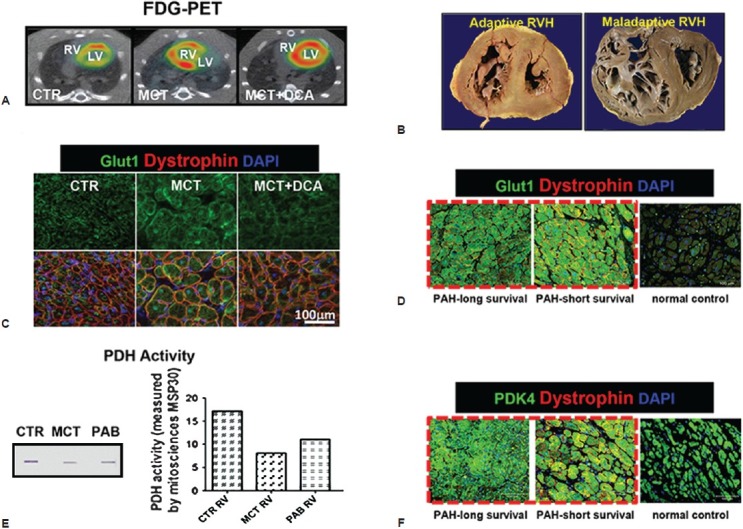
Increased glycolysis in the RV in experimental RVH in PAH patients. (A) Increased RV FDG-PET in MCT models is reduced by dichloroacetate (DCA). (B) Increased Glut1 expression in RV myocyte membranes in a monocrotaline (MCT) model is reduced by DCA. (C) RV PDH activity is reduced in MCT and PAB, especially in MCT model. (D) The cross sections of RVs from patients with adaptive versus maladaptive RVH. RV chambers are enlarged in both patients however adaptive RVH is concentric with less dilatation and fibrosis. (E and F) Immunostaining shows up-regulation of Glut1 and PDK4 expression in RV myocytes is less profound in the PAH patient with adaptive RVH. The figure is partially adapted from references 13 and 21, with permission.
Figure 2
Figure 2
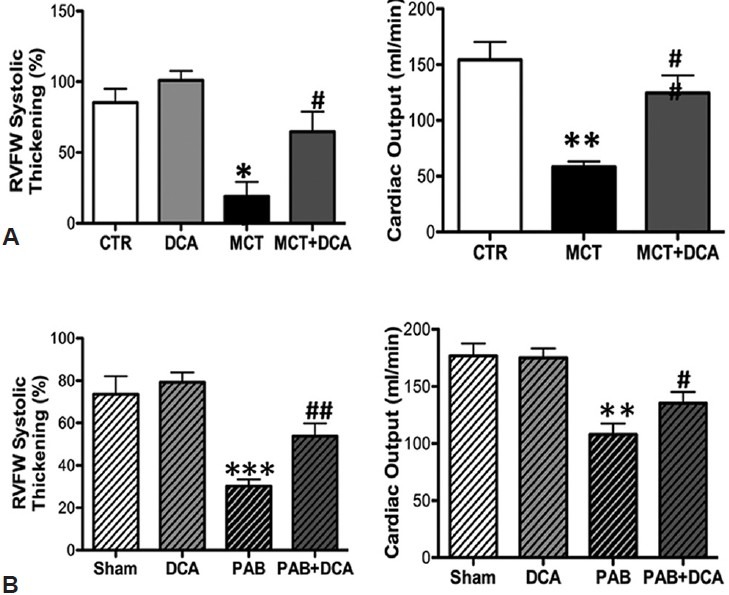
PDK inhibition by DCA improves RV function in experimental RVH. (A and B) Dichloroacetate increases RV free wall (RVFW) systolic thickening, measured by echocardiography, and CO (measured using thermodilution technique) in both MCT and PAB. The figure is adapted from reference 21, with permission.
Figure 3
Figure 3
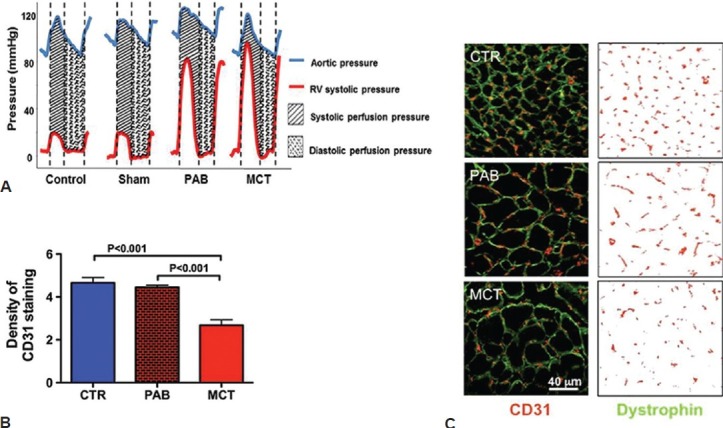
Possible mechanisms of RV Ischemia in rats. (A) Catheterization data shows simultaneous RV pressure and aortic pressure (AoP) in various rat RVH models. Despite similar coronary perfusion pressure (defined as the Δ Pressure Ao-RV) there is worse RV function and exercise capacity in MCT versus PAB (not shown). This argues against epicardial coronary perfusion pressure being the major cause of ischemia or impaired RV function in these models. (B and C) Evidence for capillary rarefaction in RVH: Representative images and mean data show a reduced density of RV capillaries (stained with CD31) in maladaptive RVH induced by MCT.
Figure 4
Figure 4
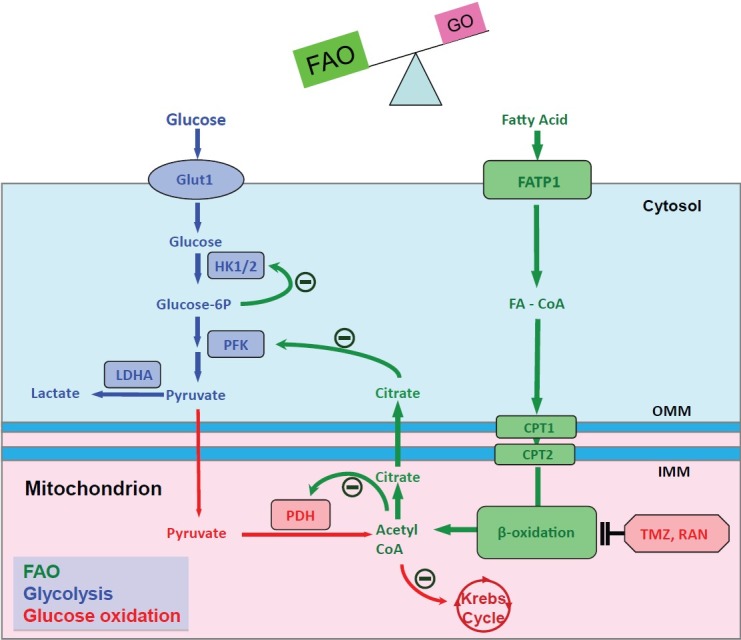
The Randle cycle in RVH. The reciprocal relationship between GO and FAO is referred to as Randle's cycle. The production of citrate and acetyl CoA from β-oxidation inhibits HK1/2, PFK and PDH, thereby inhibiting glucose oxidation. In PAB-induced RVH, increased FAO inhibits GO. Conversely, FAO inhibitors (TMZ and Ran) increase PDH activity and restore GO. FAO: fatty acid oxidation; GO: glucose oxidation; Glut1: glucose transporter 1; HK1/2: hexokinase1/2; PFK: phosphofructokinase; LDHA: lactate dehydrogenase A; PDH: pyruvate dehydrogenase; FATP1: fatty acid transport protein 1; FA-CoA: fatty acyl-CoA; OMM and IMM: outer and inner mitochondrial membrane; CPT1 and CPT2: carnitine palmitoyltransferase I and II; TMZ: trimetazidine; RAN: ranolazine. The diagram is adapted from reference 34, with permission.
Figure 5
Figure 5
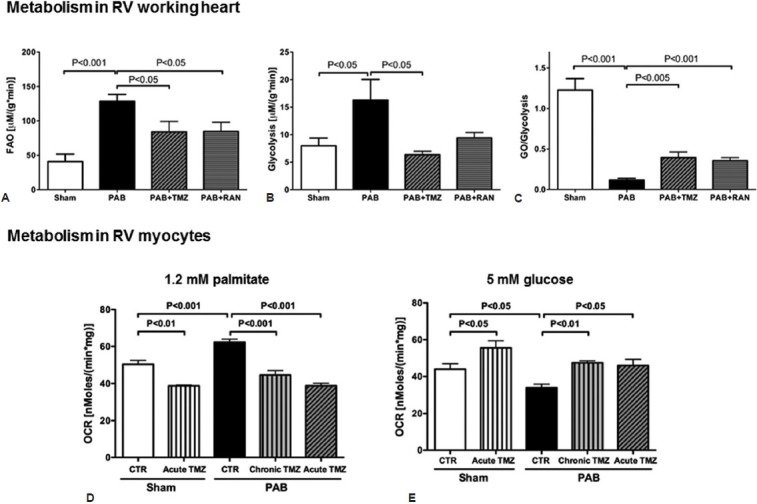
The metabolic changes in RV in PAB-induced RVH. (A-C) Metabolic measurement in the PAB RV working heart model, using the dual isotope technique, show that FAO and glycolysis are increased whereas GO is decreased. The inhibitors of b-oxidation, trimetazidine and ranolazine decrease FAO and increase GO. (D and E) Metabolic measurement in RV myocytes, using the Seahorse Extracellular Flux Analyzer, show that FAO is increased in RV myocytes in PAB model when 1.2 mM palmitate is the only substrate. GO is reduced when 5 mM glucose is the only substrate. Both acute treatment of trimetazidine (two hours incubation) and chronic treatment of trimetazidine (0.7 g/L in drinking water for 8 weeks) reduce FAO and improves GO. The figure is adapted from reference 34, with permission.

References

    1. Simonneau G, Robbins IM, Beghetti M, Channick RN, Delcroix M, Denton CP, et al. Updated clinical classification of pulmonary hypertension. J Am Coll Cardiol. 2009;54:S43–54. - PubMed
    1. Izumo S, Nadal-Ginard B, Mahdavi V. Protooncogene induction and reprogramming of cardiac gene expression produced by pressure overload. Proc Natl Acad Sci USA. 1988;85:339–43. - PMC - PubMed
    1. Vlahakes GJ, Turley K, Hoffman JI. The pathophysiology of failure in acute right ventricular hypertension: Hemodynamic and biochemical correlations. Circulation. 1981;63:87–95. - PubMed
    1. Bogaard HJ, Natarajan R, Henderson SC, Long CS, Kraskauskas D, Smithson L, et al. Chronic pulmonary artery pressure elevation is insufficient to explain right heart failure. Circulation. 2009;120:1951–60. - PubMed
    1. Torbicki A, Kurzyna M, Kuca P, Fijalkowska A, Sikora J, Florczyk M, et al. Detectable serum cardiac troponin t as a marker of poor prognosis among patients with chronic precapillary pulmonary hypertension. Circulation. 2003;108:844–8. - PubMed

LinkOut - more resources