


Management of external ear melanoma: the same or something different?
- PMID: 23664431
- PMCID: PMC4674429
- DOI: 10.1016/j.amjsurg.2012.10.038
Management of external ear melanoma: the same or something different?
Abstract
Background: The external ear represents a site with high ultraviolet exposure and thin skin overlying cartilage. The aim of this study was to determine if ear melanomas have different characteristics than cutaneous melanomas in other anatomic sites.
Methods: The evaluation of patients treated at a tertiary care center.
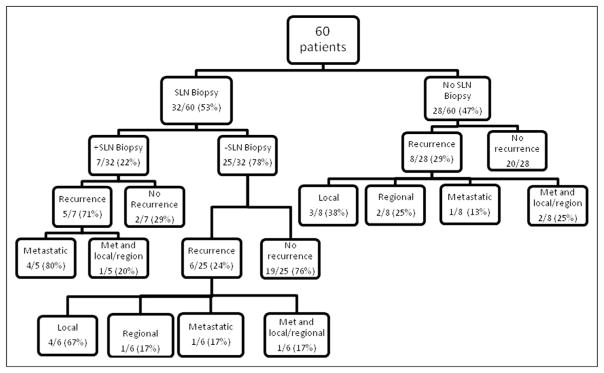
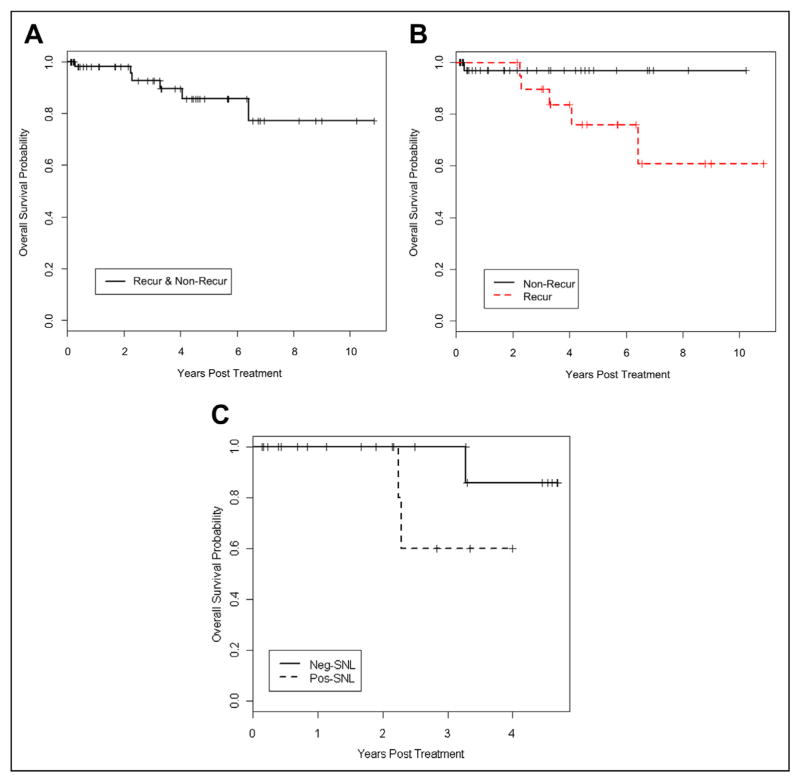
Results: Sixty patients were treated for ear melanoma (87% male, mean age = 56.7, mean thickness = 1.65 mm). Seven of thirty-two patients (22%) who underwent sentinel lymph node biopsy had positive nodes. Twenty (33%) patients had recurrence including 6 patients with negative sentinel lymph nodes (SLNs) and 5 patients with positive SLNs. Three of 10 patients (30%) treated with Mohs surgery had local recurrence.
Conclusions: The overall local and systemic recurrences are similar to those previously reported. There is a higher recurrence rate than expected in patients with a negative SLN and a high local recurrence rate after Mohs surgery. Our data suggest that SLN evaluation may be less accurate in ear melanomas and that Mohs surgery may be associated with a relatively high local recurrence rate.
Keywords: Ear; Melanoma; Recurrence; Sentinel lymph node.
Copyright © 2013 Elsevier Inc. All rights reserved.
Conflict of interest statement
The authors declare no conflict of interest.
Figures
References
-
- [Accessed May 15, 2011];American Cancer Society Facts and Figures. 2005 Available at: www.cancer.org.
-
- Jemal A, Siegel R, Xu J, et al. Cancer statistics 2010. CA Cancer J Clin. 2010;60:277–300. - PubMed
-
- Larson DL, Larson JD. Head and neck melanoma. Clin Plast Surg. 2010;37:73–7. - PubMed
-
- Pino Rivero V, González Palomino A, Pantoja Hernández CG, et al. Malignant melanoma of the pinna. Importance of its diagnosis, treatment and prognostic factors. An Otorrinolaringol Ibero Am. 2006;33:545–50. - PubMed
-
- Jahn V, Breuninger H, Garbe C, et al. Melanoma of the ear: prognostic factors and surgical strategies. Br J Dermatol. 2006;154:310–8. - PubMed
MeSH terms
Grants and funding
LinkOut - more resources
Full Text Sources
Other Literature Sources
Medical
