


Safety and immunogenicity of IMVAMUNE® smallpox vaccine using different strategies for a post event scenario
- PMID: 23664987
- PMCID: PMC3755481
- DOI: 10.1016/j.vaccine.2013.04.050
Safety and immunogenicity of IMVAMUNE® smallpox vaccine using different strategies for a post event scenario
Abstract
Introduction: Reintroduction of Variola major as an agent of bioterrorism remains a concern. A shortened dosing schedule of Bavarian Nordic's (BN) IMVAMUNE(®) (modified vaccinia Ankara vaccine against smallpox) was compared to the currently recommended 0- and 28-day schedule for non-inferiority by evaluating the magnitude and kinetics of the immune responses.
Methods: Subjects were assigned to receive IMVAMUNE or placebo administered subcutaneously on Days 0 and 7, Days 0 and 28, or Day 0. Blood was collected for antibody and cell-mediated immune assays. Subjects were followed for safety for 12 months after last vaccination.
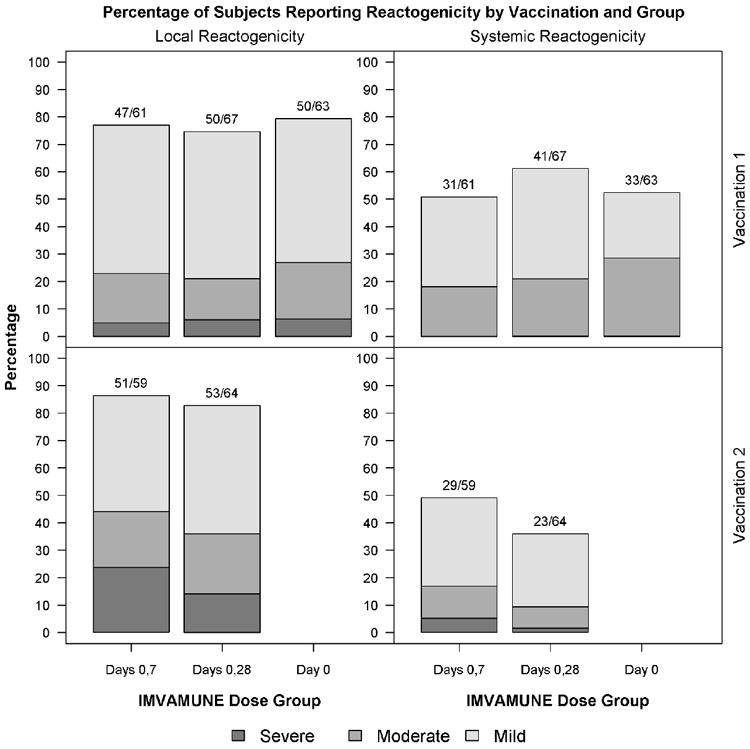
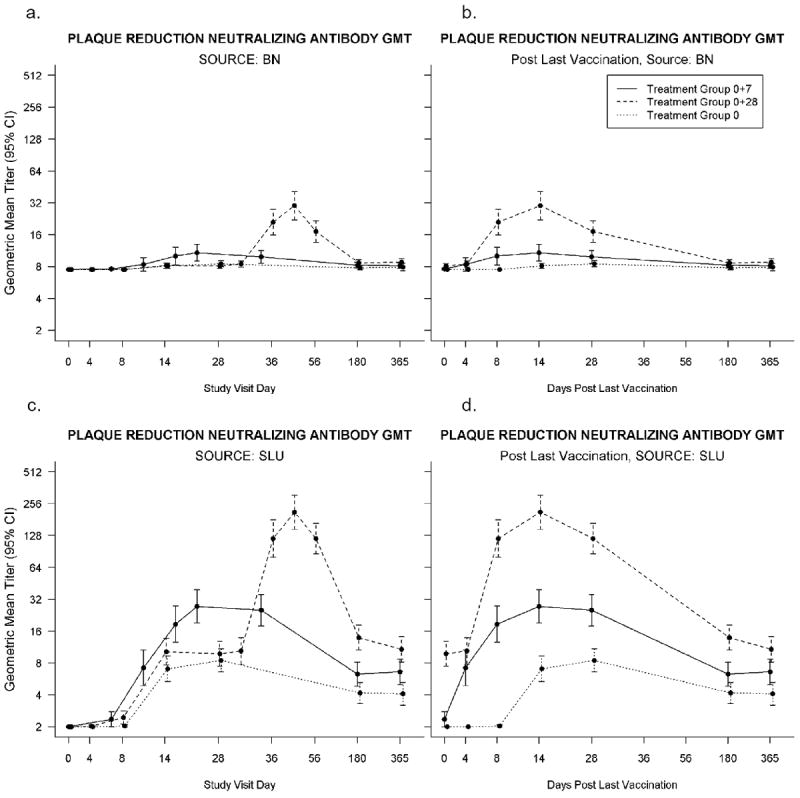
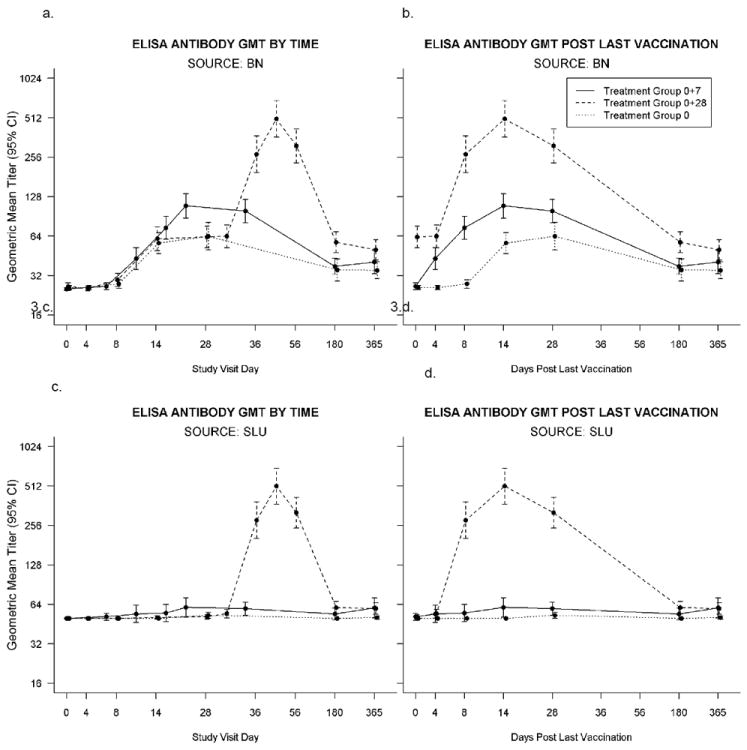
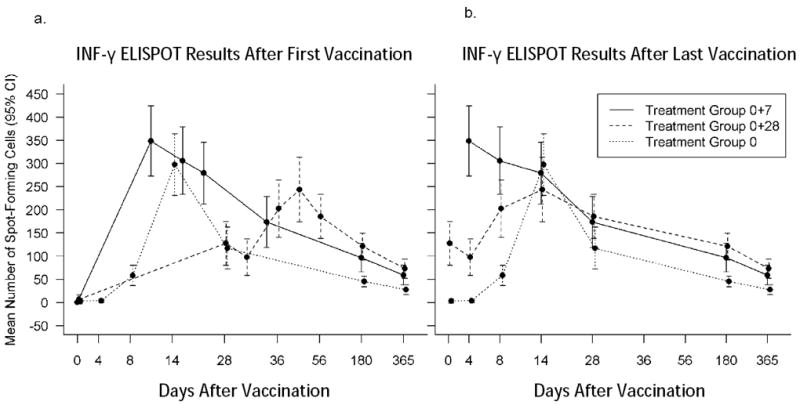
Results: The primary endpoint of this study was the geometric mean antibody titers (GMT) at 14 days post last vaccination. Of 208 subjects enrolled, 191 received vaccine (Group: 0+7, Group: 0+28 and Group: 0) and 17 received placebo. Moderate/severe systemic reactogenicity after any vaccination were reported by 31.1%, 25.4%, and 28.6% of the subjects for Group: 0+7, Group: 0+28, and Group: 0, respectively (Chi-square test, P=0.77). Based on BN's Plaque Reduction Assay GMTs, Group: 0+7 was non-inferior to Group: 0+28 at Day 4, 180, and 365 after the second vaccination. On Day 14, Group: 0+7 and Group: 0+28 GMT were 10.8 (CI: 9.0, 12.9) and 30.2 (CI: 22.1, 41.1), respectively. Based on BN's Enzyme-linked immunosorbent assay, the proportion of subjects with positive titers for Group: 0+28 was significantly greater than that for Group: 0+7 after second vaccination at Days 4 and 180. By Day 14 after the second dose, the IFN-γ enzyme-linked immunosorbent spot (ELISPOT) responses were similar for Group: 0+28 and Group: 0+7.
Conclusion: Overall, a standard dose of IMVAMUNE (0.5 mL of 1 x 10(8) TCID/mL) administered subcutaneously was safe and well tolerated. A second dose of IMVAMUNE at Day 28 compared to Day 7 provided greater antibody responses and the maximal number of responders. By Day 14 after the second dose, IFN-γ ELISPOT responses were similar for Group: 0+28 and Group: 0+7.
Trial registration: ClinicalTrials.gov NCT00437021.
Copyright © 2013 Elsevier Ltd. All rights reserved.
Figures
References
-
- Henderson DA. The looming threat of bioterrorism. Science. 1999(b);283:1279–82. - PubMed
-
- Artenstein AW, Johnson C, Marbury TC, Morrison D, Blum PS, Kemp T, Nichols R, et al. A novel, cell culture-derived smallpox vaccine in vaccinia-naïve adults. Vaccine. 2005;23:3301–9. - PubMed
-
- Frey SE, Newman FK, Kennedy JS, Ennis FA, Abate G, Hoft DF. Comparison of the safety and immunogenicity of ACAM1000, ACAM2000 and Dryvax® in healthy vaccinia-naïve adults. Vaccine. 2009;27:1637–44. - PubMed
Publication types
MeSH terms
Substances
Associated data
Grants and funding
- N01 AI040098/AI/NIAID NIH HHS/United States
- N01-AI-252160/AI/NIAID NIH HHS/United States
- N01-AI-400948/AI/NIAID NIH HHS/United States
- HHSN272200800057C/AI/NIAID NIH HHS/United States
- HHSN272200800008C/AI/NIAID NIH HHS/United States
- N01 AI040072/AI/NIAID NIH HHS/United States
- UL1 RR024128/RR/NCRR NIH HHS/United States
- HHSN272200800013C/AI/NIAID NIH HHS/United States
- N01-AI-25464/AI/NIAID NIH HHS/United States
- HHSN272200800003C/AI/NIAID NIH HHS/United States
- N01 AI025459/AI/NIAID NIH HHS/United States
- R43 AI080001/AI/NIAID NIH HHS/United States
- N01-AI-80008/AI/NIAID NIH HHS/United States
- N01 AI025464/AI/NIAID NIH HHS/United States
- UL1 RR024979/RR/NCRR NIH HHS/United States
- UL1RR024128/RR/NCRR NIH HHS/United States
- UL1RR024979/RR/NCRR NIH HHS/United States
LinkOut - more resources
Full Text Sources
Other Literature Sources
Medical
