


Modulation of cortical activity in response to visually induced postural perturbation: combined VR and EEG study
- PMID: 23665528
- PMCID: PMC3717359
- DOI: 10.1016/j.neulet.2013.05.001
Modulation of cortical activity in response to visually induced postural perturbation: combined VR and EEG study
Abstract
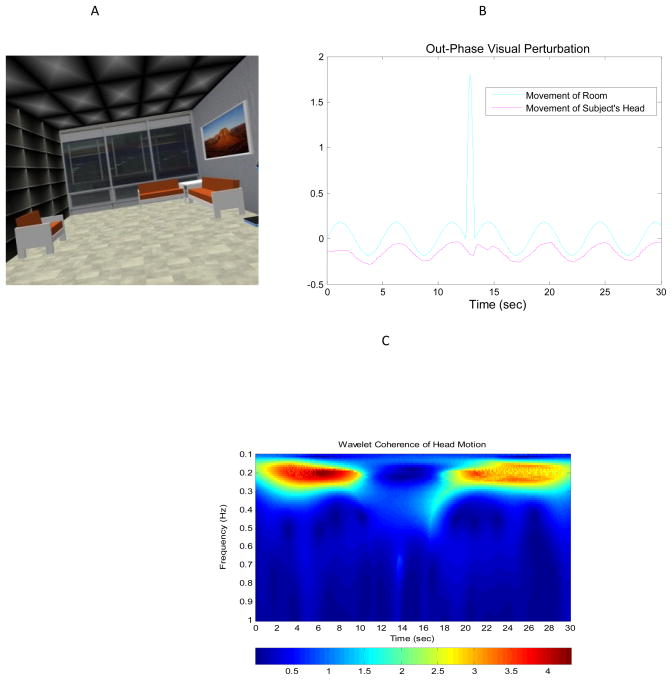
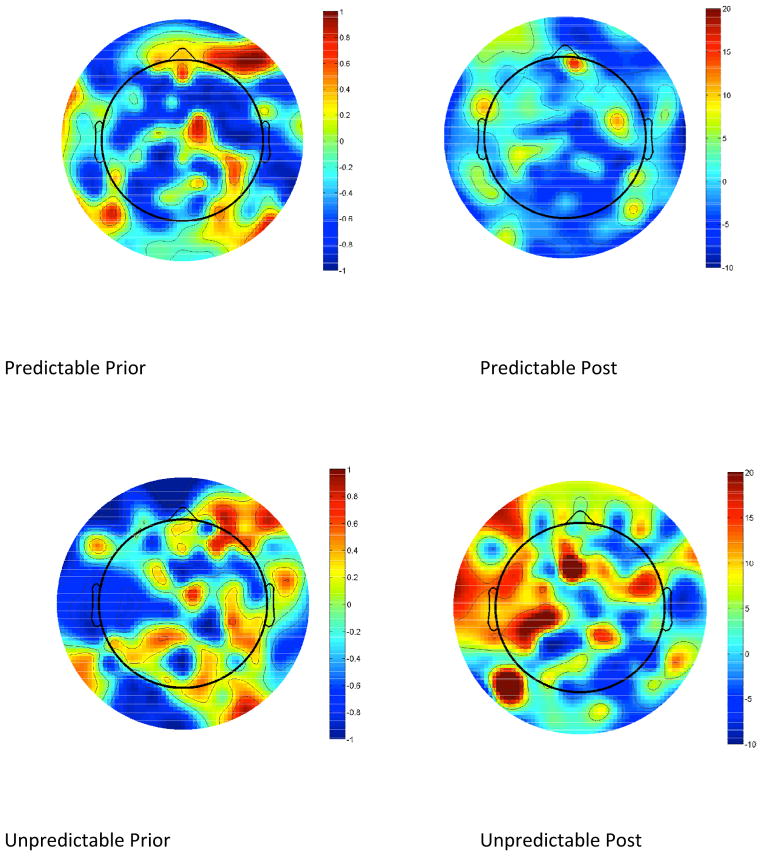
There is evidence from EEG studies that unexpected perturbations to standing posture induce a differential modulation of cortical activity compared to self-initiated and/or predictable conditions. However, the neural correlates of whole body postural response to visually induced perturbations on standing posture have not been examined. Here we employ a novel experimental paradigm via combined virtual reality (VR) and EEG measures to examine the effects of visually induced perturbations on the dynamics of postural responses. Twelve Penn State student-athletes without prior history of neurologic disorders and/or orthopaedic injuries participated in this study. There were no differences in response/reaction time measures between both spatially and temporally unpredictable and fully predictable conditions (p>.05). However, significantly stronger modulation of frontal-central EEG theta activity was present prior to onset of unpredictable postural perturbations (p<.05). It is postulated that enhanced EEG theta in unpredictable conditions reflects increased effort to recruit additional brain resources to meet the demands of the postural tasks.
Copyright © 2013 Elsevier Ireland Ltd. All rights reserved.
Figures
References
-
- Adkin AL, Quant S, Maki BE, McIlroy WE. Cortical responses associated with predictable and unpredictable compensatory balance reactions. Experimental Brain Research. 2006;172:85–93. - PubMed
-
- Ahmed AA, Ashton-Miller JA. On use of a nominal internal model to detect a loss of balance in a maximal forward reach. Journal of Neurophysiology. 2007;97:2439–2447. - PubMed
-
- van Asten WNJC, Gielen CCAM, Denier van der Gon JJ. Postural adjustments induced by simulated motion of differently structures environments. Experimental Brain Research. 1998;73(2):371–383. - PubMed
-
- Dijkstra TM, Schoner G, Gielen CC. Temporal stability of the action-perception cycle for postural control in a moving visual environment. Experimental Brain Research. 1994;97(3):477–486. - PubMed
Publication types
MeSH terms
Grants and funding
LinkOut - more resources
Full Text Sources
Other Literature Sources
Medical
