


Protein kinase cδ deficiency causes mendelian systemic lupus erythematosus with B cell-defective apoptosis and hyperproliferation
- PMID: 23666743
- PMCID: PMC4066615
- DOI: 10.1002/art.38008
Protein kinase cδ deficiency causes mendelian systemic lupus erythematosus with B cell-defective apoptosis and hyperproliferation
Abstract
Objective: Systemic lupus erythematosus (SLE) is a prototype autoimmune disease that is assumed to occur via a complex interplay of environmental and genetic factors. Rare causes of monogenic SLE have been described, providing unique insights into fundamental mechanisms of immune tolerance. The aim of this study was to identify the cause of an autosomal-recessive form of SLE.
Methods: We studied 3 siblings with juvenile-onset SLE from 1 consanguineous kindred and used next-generation sequencing to identify mutations in the disease-associated gene. We performed extensive biochemical, immunologic, and functional assays to assess the impact of the identified mutations on B cell biology.
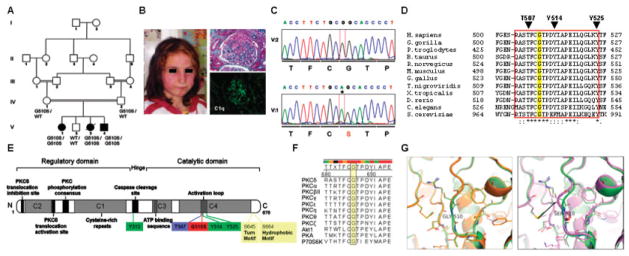
Results: We identified a homozygous missense mutation in PRKCD, encoding protein kinase δ (PKCδ), in all 3 affected siblings. Mutation of PRKCD resulted in reduced expression and activity of the encoded protein PKCδ (involved in the deletion of autoreactive B cells), leading to resistance to B cell receptor- and calcium-dependent apoptosis and increased B cell proliferation. Thus, as for mice deficient in PKCδ, which exhibit an SLE phenotype and B cell expansion, we observed an increased number of immature B cells in the affected family members and a developmental shift toward naive B cells with an immature phenotype.
Conclusion: Our findings indicate that PKCδ is crucial in regulating B cell tolerance and preventing self-reactivity in humans, and that PKCδ deficiency represents a novel genetic defect of apoptosis leading to SLE.
Copyright © 2013 by the American College of Rheumatology.
Figures


Comment in
-
Editorial: entering the age of whole-exome sequencing in rheumatic diseases: novel insights into disease pathogenicity.Arthritis Rheum. 2013 Aug;65(8):1975-9. doi: 10.1002/art.38011. Arthritis Rheum. 2013. PMID: 23666782 No abstract available.
-
Protein kinase Cδ mutations may contribute to lupus through effects on T cells: comment on the article by Belot et al.Arthritis Rheumatol. 2014 Jan;66(1):228-9. doi: 10.1002/art.38235. Arthritis Rheumatol. 2014. PMID: 24449588 No abstract available.
-
Reply: To PMID 23666743.Arthritis Rheumatol. 2014 Jan;66(1):229-30. doi: 10.1002/art.38234. Arthritis Rheumatol. 2014. PMID: 24449589 No abstract available.
References
-
- Rahman A, Isenberg DA. Systemic lupus erythematosus. N Engl J Med. 2008;358:929–39. - PubMed
-
- Brunner HI, Huggins J, Klein-Gitelman MS. Pediatric SLE: towards a comprehensive management plan. Nat Rev Rheumatol. 2011;7:225–33. - PubMed
-
- Crow YJ. Lupus: how much “complexity” is really (just) genetic heterogeneity? Arthritis Rheum. 2011;63:3661–4. - PubMed
Publication types
MeSH terms
Substances
Grants and funding
LinkOut - more resources
Full Text Sources
Other Literature Sources
Medical
Molecular Biology Databases
Miscellaneous
