. 2009 Dec:1:55-73.
doi: 10.1002/9780470559277.ch090167.

Target Identification by Diazirine Photo-Cross-linking and Click Chemistry

Affiliations

Target Identification by Diazirine Photo-Cross-linking and Click Chemistry

Andrew L Mackinnon et al. Curr Protoc Chem Biol. 2009 Dec.

Abstract

Target identification of biologically active small-molecules is often the rate-determining step in forward chemical genetics. Photo-affinity labeling (PAL) represents a useful biochemical strategy for target identification in complex protein mixtures. This unit describes the use of alkyl diazirine-based photo-affinity probes and Cu(I)-catalyzed click chemistry to covalently label and visualize the targets of biologically active small-molecules. A general method for affinity purification of probe-modified proteins, useful for identification of protein targets, is also described.

Keywords: affinity purification; click chemistry; diazirine; photo-affinity labeling; target identification.


Figures
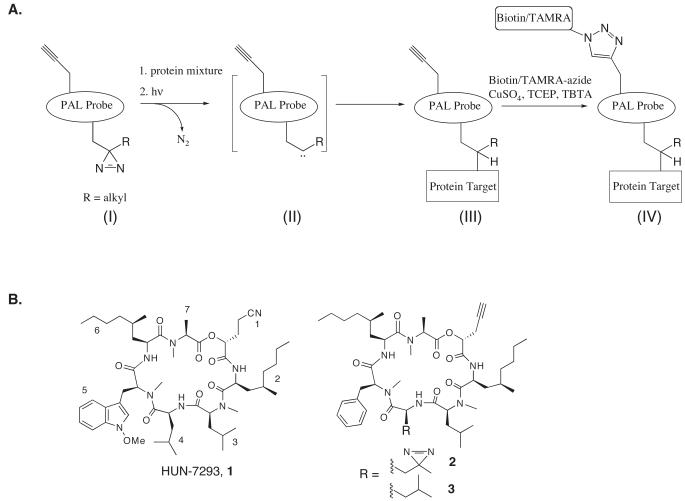
Figure 1
Figure 1
(A) Generalized scheme for photo-affinity labeling and detection using a diazirine and alkyne-containing photo-affinity probe (I). UV irradiation of the diazirine generates a carbene intermediate (II) that covalently crosslinks to the protein target (III). The adduct is then detected by conjugation with an azide-containing reporter group under click chemistry conditions (IV). (B) Structures of the natural product HUN7293 (1), photo-affinity probe (2), and the photo-stable control compound (3).
Figure 2
Figure 2
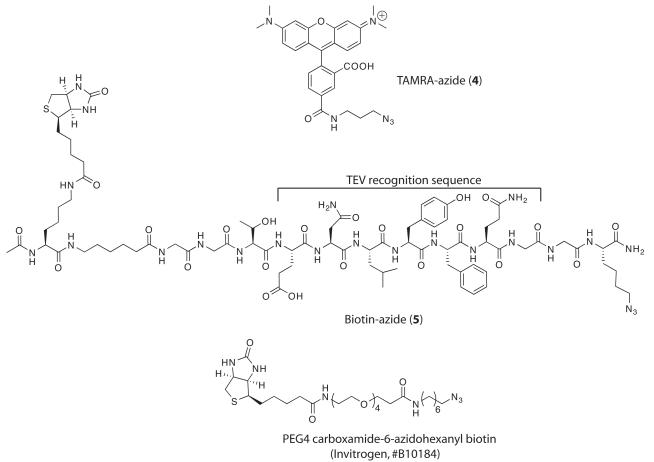
Structures of TAMRA-azide and Biotin-azide used in the protocol.
Figure 3
Figure 3
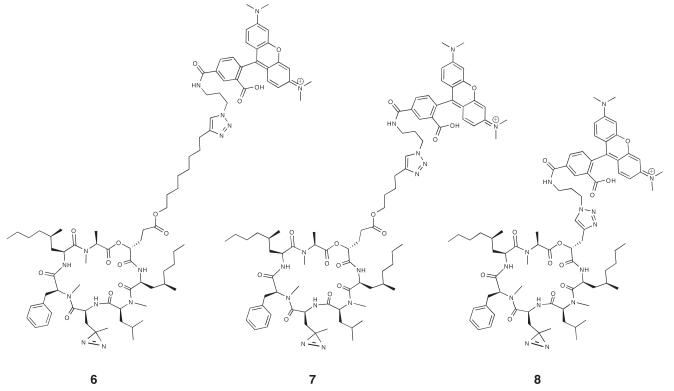
Structures of compounds 6, 7, and 8 which have a fluorescent reporter group (TAMRA) directly incorporated into the natural product scaffold.
Figure 4
Figure 4
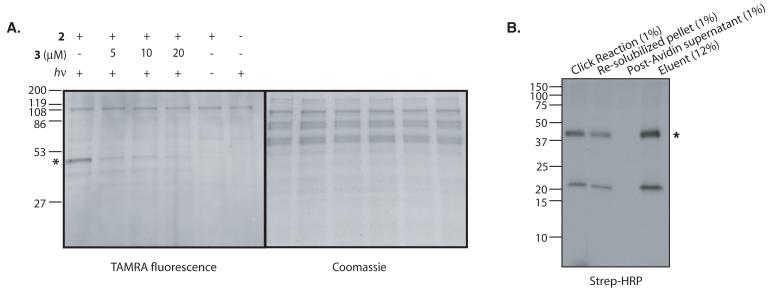
(A) Photo-crosslinking in ER microsomes with 2 followed by click chemistry with TAMRA-azide (4) as described in the Basic Protocol. Sec61α is marked with an asterisk (figure adapted with permission). (B) Photo-crosslinking in ER microsomes with 2 followed by click chemistry with Biotin-azide (5) and affinity purification using monomeric avidin as described in the Support Protocol. Samples representing the click reaction (Lane 1), the re-solubilized protein pellet following acetone precipitation (Lane 2), the post-monomeric avidin supernatant (Lane 3), and the eluent (Lane 4), were resolved by SDS-PAGE, transferred to nitrocellulose, and probed for biotinylated proteins with streptavidin-HRP (Strep-HRP). Percentages indicate the fraction of the total sample that was loaded in each lane. The position of Sec61α is marked with an asterisk. The biotinylated protein at ~21 kDa is a background band.

References

    1. Adam GC, Burbaum J, Kozarich JW, Patricelli MP, Cravatt BF. Mapping enzyme active sites in complex proteomes. J. Am. Chem. Soc. 2004;126:1363–1368. - PubMed
    1. Al-Mawsawi LQ, Fikkert V, Dayam R, Witvrouw M, Burke TR, Jr., Borchers CH, Neamati N. Discovery of a small-molecule HIV-1 integrase inhibitor-binding site. Proc. Natl. Acad. Sci. USA. 2006;103:10080–10085. - PMC - PubMed
    1. Best MD. Click chemistry and bioorthogonal reactions: unprecedented selectivity in the labeling of biological molecules. Biochemistry. 2009;48:6571–6584. - PubMed
    1. Bond MR, Zhang H, Vu PD, Kohler JJ. Photocrosslinking of glycoconjugates using metabolically incorporated diazirine-containing sugars. Nat. Protoc. 2009;4:1044–1063. - PubMed
    1. Brunner J. New photolabeling and crosslinking methods. Annu. Rev. Biochem. 1993;62:483–514. - PubMed

LinkOut - more resources