


Overview of atopic dermatitis
- PMID: 23667830
- PMCID: PMC3643056
- DOI: 10.5415/apallergy.2013.3.2.79
Overview of atopic dermatitis
Abstract
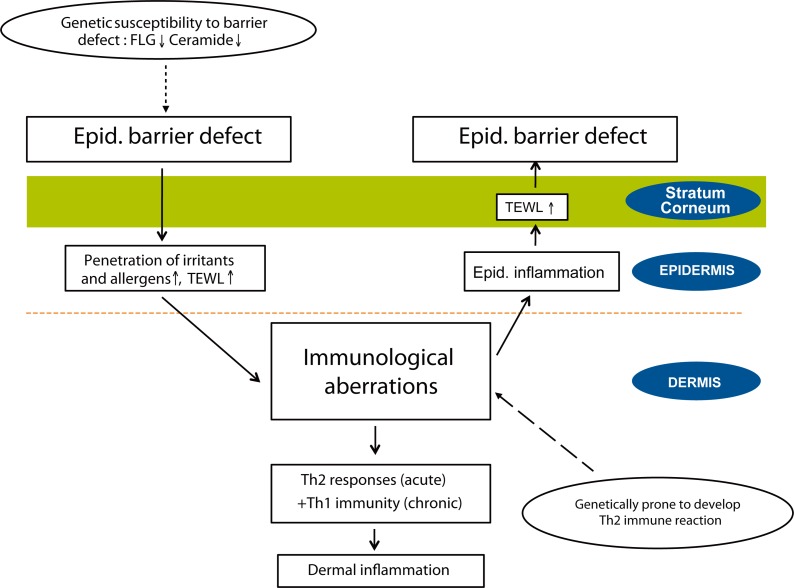
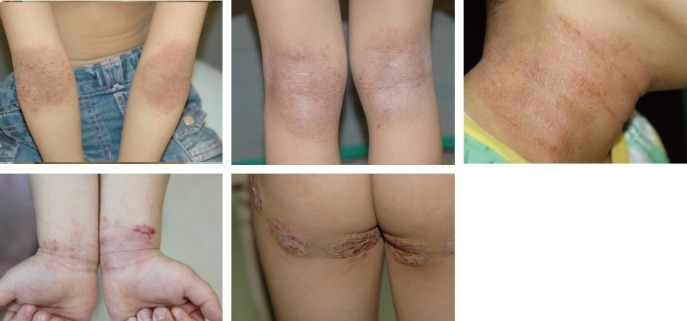
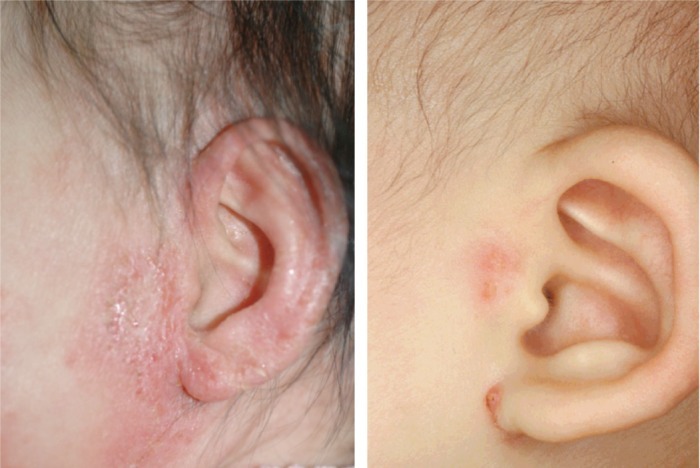
Atopic dermatitis (AD) is a very common chronic disease that reportedly affects 10%-20% of the general population. The prevalence of AD appears to be steadily increasing, at least in developing countries. Two pathogenetic mechanisms have been mentioned. Traditionally immunological aberrations are thought to be a primary event in the initial development of AD ("inside-to-outside hypothesis"). Another hypothesis assumes that there is an intrinsic defect in epidermal barrier. Due to this barrier defect, allergens or irritants can easily penetrate the epidermal barrier, and induce immunologic reaction secondarily ("outside-to-inside hypothesis"). These days the epidermal barrier defect seems to gain more support as a primary event than immunological aberrations in the early changes of AD since the filaggrin mutation was reported in AD patients. Clinically AD initially affects face, and with age, flexural areas are typically involved. AD has many different clinical features. Diagnostic criteria for AD in each country may be a little different, although based on the criteria proposed by Hanifin and Rajka. AD can be controlled effectively with topical and/or systemic treatments and fortunately spontaneously disappears with age. However, in some cases very resistant to conventional therapies, additional treatments such as immunosuppressive agents are needed.
Keywords: Atopic dermatitis; Epidermal barrier defect; Filaggrin mutation; Immunological aberrations; Prevalence.
Figures

References
-
- Hanifin JM, Rajka G. Diagnostic features of atopic dermatitis. Acta Derm Venereol Suppl (Stockh) 1980;59:44–47.
-
- Bieber T. Atopic dermatitis. N Engl J Med. 2008;358:1483–1494. - PubMed
-
- Choi WJ, Ko JY, Kim JW, Lee KH, Park CW, Kim KH, Kim MN, Lee AY, Cho SH, Park YL, Choi JH, Seo SJ, Lee YW, Roh JY, Park YM, Kim DJ, Ro YS. Prevalence and risk factors for atopic dermatitis: a cross-sectional study of 6,453 Korean preschool children. Acta Derm Venereol. 2012;92:467–471. - PubMed
-
- Palmer CN, Irvine AD, Terron-Kwiatkowski A, Zhao Y, Liao H, Lee SP, Goudie DR, Sandilands A, Campbell LE, Smith FJ, O'Regan GM, Watson RM, Cecil JE, Bale SJ, Compton JG, DiGiovanna JJ, Fleckman P, Lewis-Jones S, Arseculeratne G, Sergeant A, Munro CS, El Houate B, McElreavey K, Halkjaer LB, Bisgaard H, Mukhopadhyay S, McLean WH. Common loss-of-function variants of the epidermal barrier protein filaggrin are a major predisposing factor for atopic dermatitis. Nat Genet. 2006;38:441–446. - PubMed
-
- Cork MJ, Danby SG, Vasilopoulos Y, Hadgraft J, Lane ME, Moustafa M, Guy RH, Macgowan AL, Tazi-Ahnini R, Ward SJ. Epidermal barrier dysfunction in atopic dermatitis. J Invest Dermatol. 2009;129:1892–1908. - PubMed
LinkOut - more resources
Full Text Sources
Other Literature Sources