


P53 mutations in advanced cancers: clinical characteristics, outcomes, and correlation between progression-free survival and bevacizumab-containing therapy
- PMID: 23670029
- PMCID: PMC3742831
- DOI: 10.18632/oncotarget.974
P53 mutations in advanced cancers: clinical characteristics, outcomes, and correlation between progression-free survival and bevacizumab-containing therapy
Abstract
Background: Mutations in the p53 gene are amongst the most frequent aberrations seen in human cancer. Our objective was to characterize the clinical characteristics associated with p53 mutation in patients with advanced cancer.
Methods: We retrospectively reviewed and analyzed the clinical features and response to standard systemic therapy of 145 patients with documented tumor p53 mutational status (mutant-type [mtp53] vs. wild-type [wtp53]) referred to the Clinical Center for Targeted Therapy.
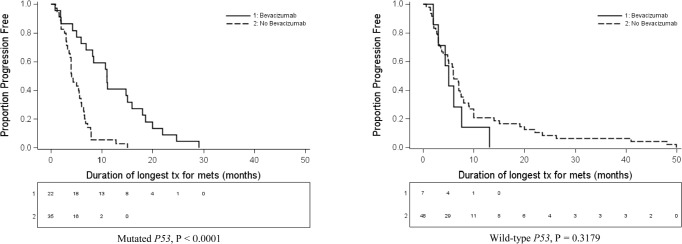
Results: Sixty-six (45.5%) patients had mtp53. Mutations in p53 occurred more frequently in older patients (p= 0.015) and in Caucasians (p=0.024). The incidence of liver metastases was 69.2% vs. 43%, p=0.002 in mtp53 and wtp53, respectively. PTEN loss by immunohistochemistry was found more frequently in mtp53-bearing tumors compared to wtp53 (33.3% vs. 10%, p=0.007). The best progression-free survival (PFS) on standard systemic therapy was significantly longer with bevacizumab-containing regimens as compared to non-bevacizumab containing regimen in patients with mtp53 (median 11.0 [95% CI 5.9-16.0], n=22 vs. 4.0 months [95% CI 3.6-5.7], n=35, p<0.0001) but not those with wtp53 (median 5.0 [95% CI 2.0-7.6] vs. 6.0 [95% CI 4.0-7.5] months, p=0.318. The median overall survival from diagnosis in patients with mtp53 and wtp53 was 7.4 [95% CI 6.3-9.8] vs. 11.8 [95% CI 2.9-21.5] years, respectively (p=0.365).
Conclusion: Patients with mtp53 tumors were older at diagnosis, had more incidence of liver metastasis, and more frequent PTEN loss. The best PFS on standard systemic therapy was significantly longer with bevacizumab-containing regimens in patients with mutant p53 tumors but not in those with wtp53.
Figures
References
-
- Hollstein M, Sidransky D, Vogelstein B, Harris C.C. p53 mutations in human cancers. Science. 1991;253:49–53. - PubMed
-
- Baker S.J, Fearon E.R, Nigro J.M, Hamilton S.R, Preisinger A.C, Jessup J.M, vanTuinen P, Ledbetter D.H, Barker D.F, Nakamura Y, et al. Chromosome 17 deletions and p53 gene mutations in colorectal carcinomas. Science. 1989;244:217–221. - PubMed
-
- Edlund K, Larsson O, Ameur A, Bunikis I, Gyllensten U, Leroy B, Sundstrom M, Micke P, Botling J, Soussi T. Data-driven unbiased curation of the TP53 tumor suppressor gene mutation database and validation by ultradeep sequencing of human tumors. Proc Natl Acad Sci U S A. 2012;109:9551–9556. - PMC - PubMed
-
- Pavletich N.P, Chambers K.A, Pabo C.O. The DNA-binding domain of p53 contains the four conserved regions and the major mutation hot spots. Genes & development. 1993;7:2556–2564. - PubMed
-
- Kastan M.B, Onyekwere O, Sidransky D, Vogelstein B, Craig R.W. Participation of p53 protein in the cellular response to DNA damage. Cancer research. 1991;51:6304–6311. - PubMed
MeSH terms
Substances
Grants and funding
LinkOut - more resources
Full Text Sources
Other Literature Sources
Medical
Research Materials
Miscellaneous
