. 2013 May 28;110(22):9084-9.
doi: 10.1073/pnas.1300595110. Epub 2013 May 13.

Systematic identification of conserved bacterial c-di-AMP receptor proteins

Affiliations

Systematic identification of conserved bacterial c-di-AMP receptor proteins

Rebecca M Corrigan et al. Proc Natl Acad Sci U S A. .

Abstract

Nucleotide signaling molecules are important messengers in key pathways that allow cellular responses to changing environments. Canonical secondary signaling molecules act through specific receptor proteins by direct binding to alter their activity. Cyclic diadenosine monophosphate (c-di-AMP) is an essential signaling molecule in bacteria that has only recently been discovered. Here we report on the identification of four Staphylococcus aureus c-di-AMP receptor proteins that are also widely distributed among other bacteria. Using an affinity pull-down assay we identified the potassium transporter-gating component KtrA as a c-di-AMP receptor protein, and it was further shown that this protein, together with c-di-AMP, enables S. aureus to grow in low potassium conditions. We defined the c-di-AMP binding activity within KtrA to the RCK_C (regulator of conductance of K(+)) domain. This domain is also found in a second S. aureus protein, a predicted cation/proton antiporter, CpaA, which as we show here also directly binds c-di-AMP. Because RCK_C domains are found in proteinaceous channels, transporters, and antiporters from all kingdoms of life, these findings have broad implications for the regulation of different pathways through nucleotide-dependent signaling. Using a genome-wide nucleotide protein interaction screen we further identified the histidine kinase protein KdpD that in many bacteria is also involved in the regulation of potassium transport and a PII-like signal transduction protein, which we renamed PstA, as c-di-AMP binding proteins. With the identification of these widely distributed c-di-AMP receptor proteins we link the c-di-AMP signaling network to a central metabolic process in bacteria.


Conflict of interest statement

The authors declare no conflict of interest.

Figures
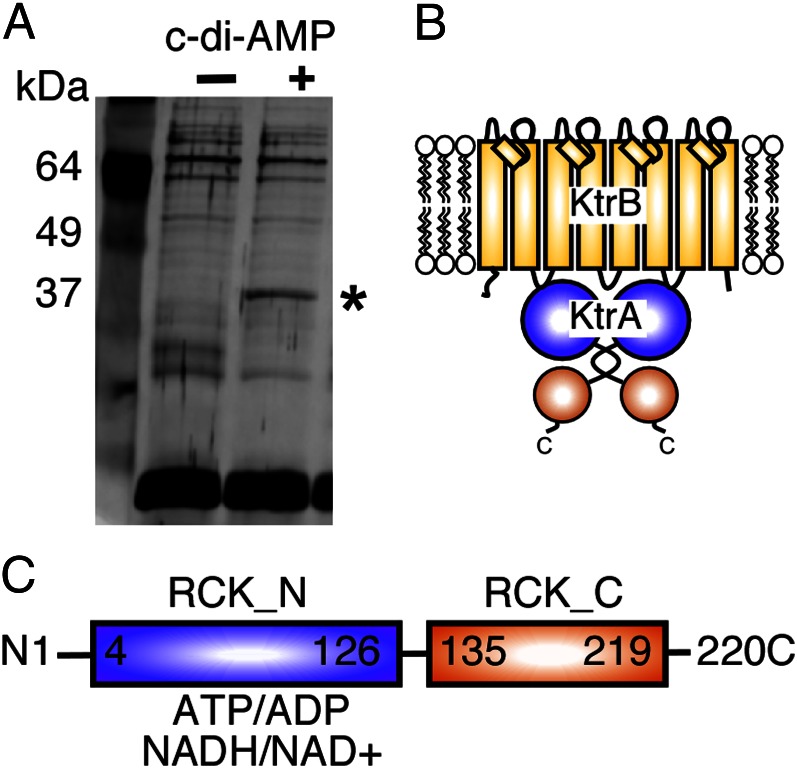
Fig. 1.
Fig. 1.
Identification of S. aureus KtrASA as a potential c-di-AMP binding protein. (A) Silver-stained polyacrylamide gel of cytoplasmic S. aureus proteins retained on c-di-AMP-coupled (+) or uncoupled (-) beads. The protein band enriched in the c-di-AMP lane (asterisk) was identified by mass spectrometry as S. aureus protein SAUSA300_0988 (KtrASA). (B) Illustration of Ktr-type potassium transport systems, which are composed of a KtrB-type membrane component and a cytoplasmic KtrA-type gating component. (C) Schematic representation of the KtrASA domain structure with the RCK_N domain (amino acids 4–126) indicated in blue and RCK_C domain (amino acids 135–219) shown in orange. The RCK_N domain of the B. subtilis KtrA homolog is known to bind to nucleotides including ATP, ADP, NAD+, and NADH.
Fig. 2.
Fig. 2.
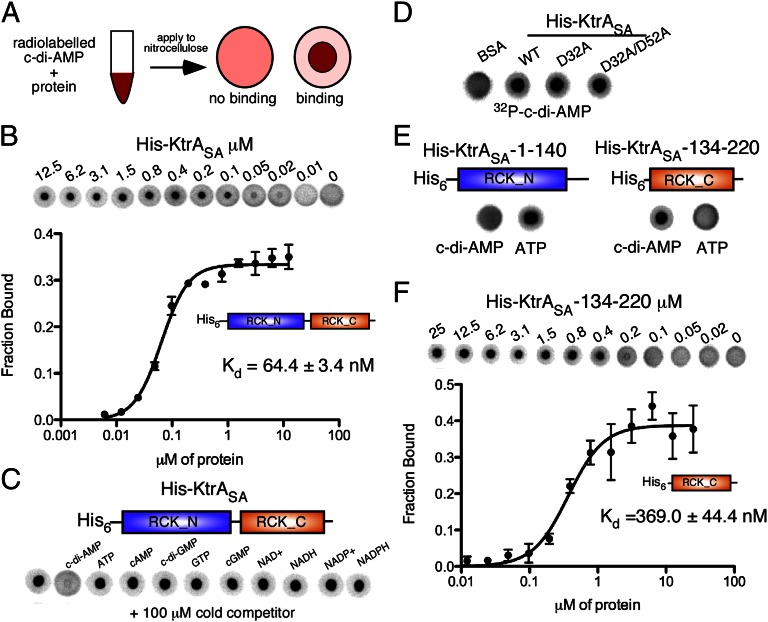
Characterization of the c-di-AMP/KtrASA interaction by DRaCALA. (A) Schematic representation of the DRaCALA to study c-di-AMP protein interactions. (B) Binding curve and Kd determination for c-di-AMP and purified His-KtrASA. Kd values were determined from the curve as previously described (27). (C) DRaCALAs with purified His-KtrASA protein and 32P-labeled c-di-AMP and an excess of cold competitor nucleotide as indicated above each spot. (D) DRaCALAs with purified His-KtrASA, His-KtrASA-D32A, or His-KtrASA-D32A/D52A and 32P-labeled c-di-AMP. (E) DRaCALAs with purified His-KtrASA-1-140 (RCK_N) or His-KtrASA-134-220 (RCK_C) and 32P-labeled c-di-AMP or 32P-labeled ATP as indicated below the spots. (F) Binding curves and Kd determination for c-di-AMP and purified His-KtrASA-134-220 protein containing only the RCK_C domain. The data were plotted, and the best-fit line was determined by nonlinear regression incorporating the hill equation using GraphPad Prism software.
Fig. 3.
Fig. 3.
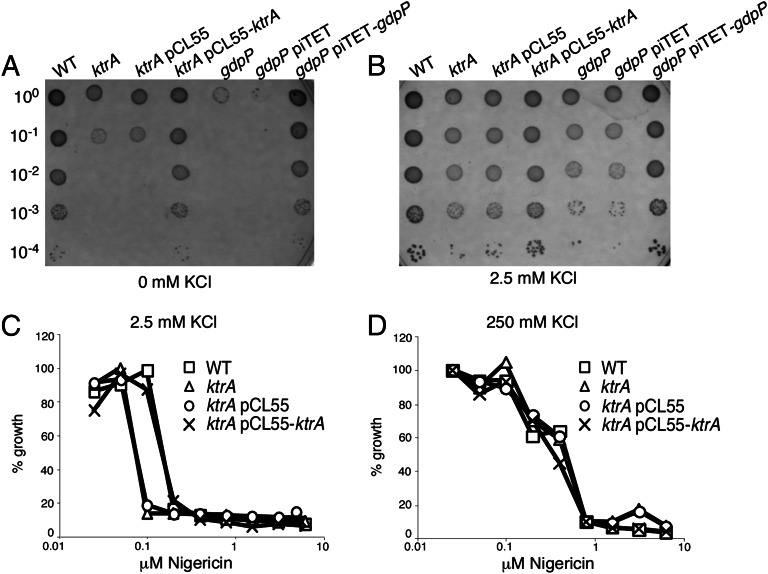
Effect of potassium on growth of wild-type, ktrA, and gdpP S. aureus strains. (A and B) The indicated S. aureus strains were grown overnight in CDM containing 2.5 mM KCl. Next day serial dilutions of washed cells were spotted onto CDM agar plates containing 0.75 M NaCl and containing either 0 mM or 2.5 mM potassium. (C and D) Nigericin sensitivity curves of wild-type, ktrA mutant, and complemented S. aureus strains. The different strains were grown in 96-well plates in CDM medium supplemented with 2.5 mM or 250 mM potassium and nigericin at the indicated concentration. OD600 readings were determined after 24 h growth and plotted as % growth compared with the growth in the absence of nigericin. Experiments were repeated a minimum of five times. When grown in 2.5 mM KCl the ktrA mutant consistently showed a twofold reduced MIC for each experiment. The MIC for all of the strains varied between experiments from 0.1 to 0.8 µM for the wild-type and complemented strain and 0.05–0.4 µM for the mutant strains.
Fig. 4.
Fig. 4.
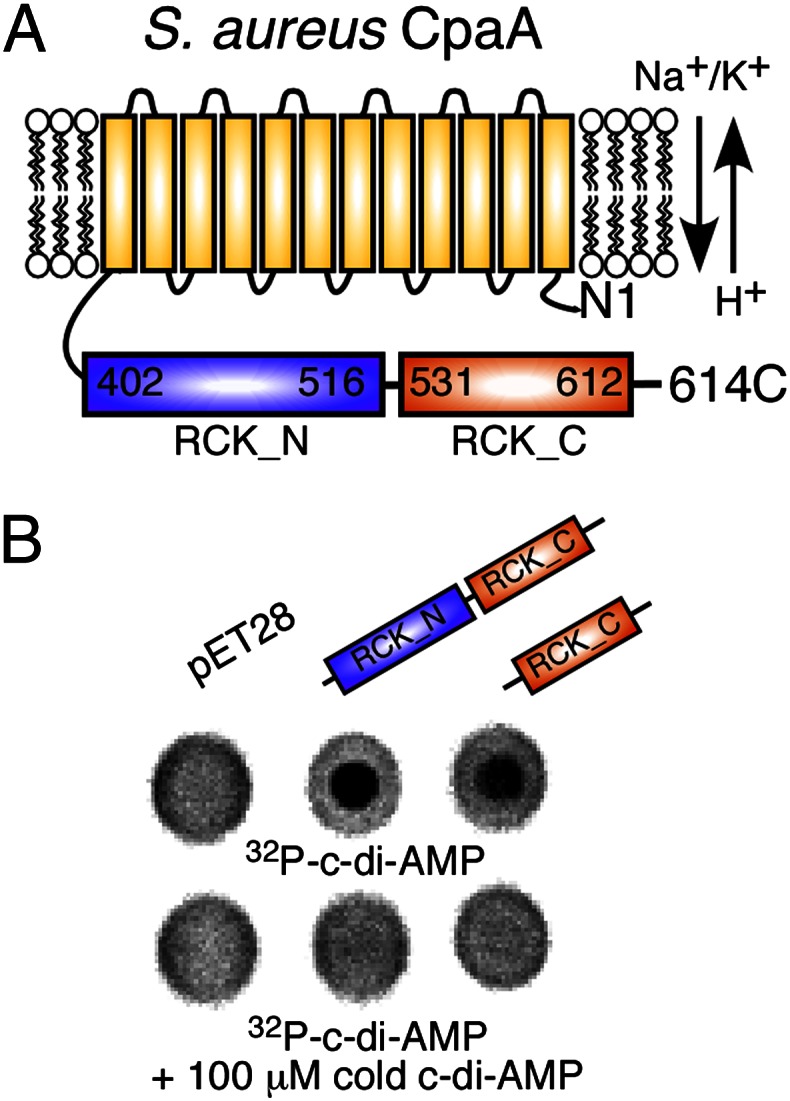
Identification of CpaA as an additional c-di-AMP target protein. (A) Schematic representation of the predicted K+ or Na+ antiporter CpaA (SAUSA300_0911), containing an N-terminal transmembrane (yellow) and cytoplasmically located RCK_N (blue) and RCK_C (orange) domains. (B) DRaCALAs with 32P-labeled c-di-AMP and E. coli extracts prepared from the vector control strain (pET28b) or strains overproducing His-CpaASA-402-614 (RCK_N and RCK_C) or His-CpaASA-513-614 (RCK_C). Cold c-di-AMP was added as a competitor where indicated.
Fig. 5.
Fig. 5.
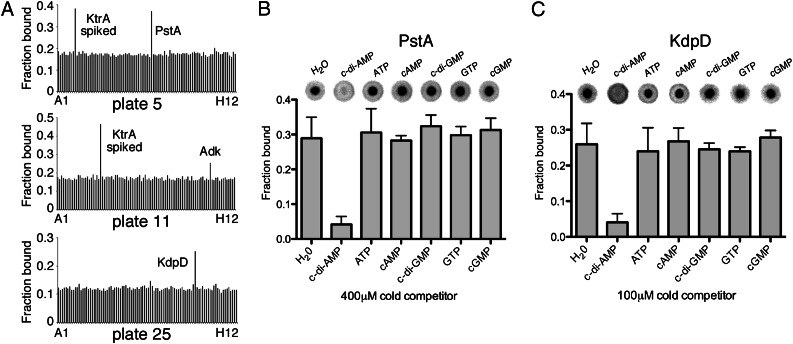
Identification of PstA and KdpD as specific c-di-AMP target proteins. (A) For the whole-genome DRaCALA screen, 32P-labeled c-di-AMP was dispensed into 96-well plates containing E. coli lysates, and aliquots were subsequently spotted in duplicate onto nitrocellulose membrane. The fraction of bound c-di-AMP was calculated for each well as described by Roelofs et al. (27) and the average values from the duplicate spots plotted. Plates 5, 11, and 25 with positive interactions are shown. The average fraction bound value for plate 5 was 0.178 ± 0.029. Well A10 was spiked with a KtrA lysate, and well E3 contained the PstA lysate, which had a fraction bound value of 0.370 (2× background). The average fraction bound value for plate 11 was 0.174 ± 0.032. Well B12 was spiked with a KtrA lysate, and well G11 contained the Adk lysate, which had a fraction bound value of 0.253 (1.45× background). The average fraction bound value for plate 25 was 0.122 ± 0.015. Well G2 contained the KdpD lysate, with a fraction bound value of 0.252 (2× background). (B and C) DRaCALAs were preformed with E. coli extracts prepared from strains overproducing His-PstA (B) or KdpD-His (C) and 32P-labeled c-di-AMP and an excess of cold competitor nucleotide as indicated above each spot. Fraction of bound nucleotide was determined as described by Roelofs et al. (27), and values from three independent experiments were plotted with SDs.

References

    1. McDonough KA, Rodriguez A. The myriad roles of cyclic AMP in microbial pathogens: From signal to sword. Nat Rev Microbiol. 2012;10(1):27–38. - PMC - PubMed
    1. Marden JN, Dong Q, Roychowdhury S, Berleman JE, Bauer CE. Cyclic GMP controls Rhodospirillum centenum cyst development. Mol Microbiol. 2011;79(3):600–615. - PMC - PubMed
    1. Dalebroux ZD, Swanson MS. ppGpp: Magic beyond RNA polymerase. Nat Rev Microbiol. 2012;10(3):203–212. - PubMed
    1. Witte G, Hartung S, Büttner K, Hopfner KP. Structural biochemistry of a bacterial checkpoint protein reveals diadenylate cyclase activity regulated by DNA recombination intermediates. Mol Cell. 2008;30(2):167–178. - PubMed
    1. Woodward JJ, Iavarone AT, Portnoy DA. c-di-AMP secreted by intracellular Listeria monocytogenes activates a host type I interferon response. Science. 2010;328(5986):1703–1705. - PMC - PubMed

Publication types

MeSH terms