


Clinical and pharmacologic aspects of blinatumomab in the treatment of B-cell acute lymphoblastic leukemia
- PMID: 23671399
- PMCID: PMC3650887
- DOI: 10.2147/CPAA.S42689
Clinical and pharmacologic aspects of blinatumomab in the treatment of B-cell acute lymphoblastic leukemia
Abstract
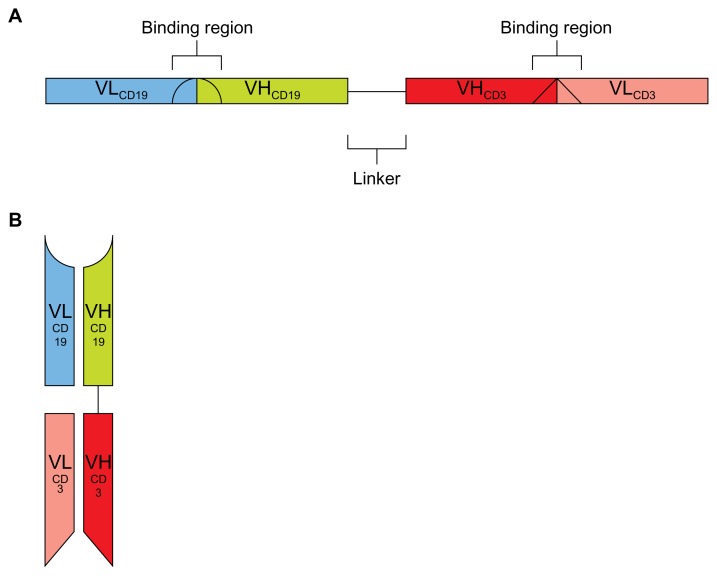
Acute lymphoblastic leukemia (ALL) in adults remains a challenging disease to treat, and novel therapies are needed. Precursor-B ALL comprises 80% of cases, and the CD19 antigen is expressed in nearly all precursor-B ALL patients. Bispecific T-cell-engaging antibodies are novel bioengineered proteins. The bispecific T-cell-engaging antibody blinatumomab engages polyclonal T cells to CD19-expressing B cells. By binding to both CD3 and CD19, blinatumomab physically brings these T cells in close proximity to malignant B cells and potentiates T-cell-induced cytotoxic cell kill. Blinatumomab requires continuous intravenous infusion due to its short half-life, the need for continuous exposure for the drug to exert sufficient efficacy, and lessened toxicity. A phase II trial of B-cell ALL patients with persistent or relapsed minimal residual disease demonstrated an 80% rate of complete molecular remission. Cytokine-release syndrome and central nervous system events, such as seizures and encephalopathy, are reversible toxicities. Promising results in B-cell ALL with minimal residual disease have led to further evaluation of this drug in newly diagnosed and relapsed B-cell ALL.
Keywords: B-cell acute lymphoblastic leukemia; BiTE antibodies; CD19; blinatumomab.
Figures
References
-
- Swerdlow S, Campo E, Harris NL, et al., editors. WHO Classification of Tumours of Haematopoietic and Lymphoid Tissue (IARC WHO Classification of Tumours) 4th ed. Geneva: World Health Organization; 2008.
-
- Brüggemann M, Raff T, Flohr T, et al. Clinical significance of minimal residual disease quantification in adult patients with standard-risk acute lymphoblastic leukemia. Blood. 2006;107(3):1116–1123. - PubMed
-
- Fielding AK, Richards SM, Chopra R, et al. Outcome of 609 adults after relapse of acute lymphoblastic leukemia (ALL); an MRC UKALL12/ ECOG 2993 study. Blood. 2007;109(3):944–950. - PubMed
LinkOut - more resources
Full Text Sources
Other Literature Sources
