A rare but serious complication of GreenLight HPS photoselective vaporization of the prostate: Prostatic capsular perforation with bilateral thigh urinomas and osteitis pubis
- PMID: 23671496
- PMCID: PMC3650794
- DOI: 10.5489/cuaj.230
A rare but serious complication of GreenLight HPS photoselective vaporization of the prostate: Prostatic capsular perforation with bilateral thigh urinomas and osteitis pubis
Abstract
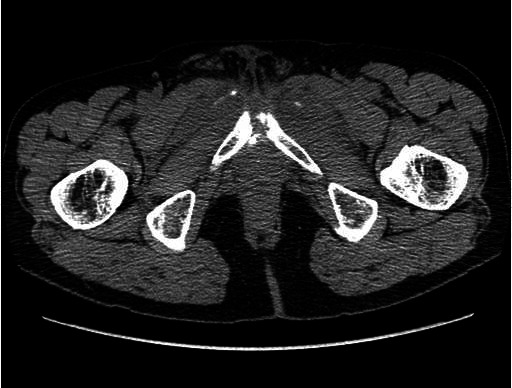
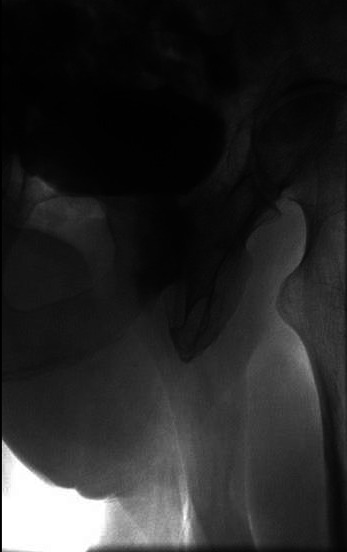
The use of lasers to perform photoselective vaporization of the prostate (PVP) has been widely accepted as a safe and effective treatment for benign prostatic hyperplasia with very few reported complications. To date, most of the published data report outcomes for the 80-W potassium-titanyl-phosphate laser. A more potent laser, the 120-W GreenLight HPS, was introduced in 2006 and provides more efficient vaporization of prostatic tissue and decreased operating times. Despite these benefits, the increased energy applied to the prostate evokes concerns of potential serious complications, including capsular perforation and injury to adjacent structures. A more powerful laser system, the 180-W GreenLight XPS laser (American Medical Systems, Minnetonka, MN) has recently become available. We report a rare but serious complication of GreenLight HPS PVP resulting in prostatic capsular perforation with urinary extravasation, presenting with bilateral thigh urinomas and osteitis pubis.
Figures
References
-
- Boucher-Hayes DM, Van Appleton S, Bugeja P, et al. A randomized trial of photoselective vaporization of the prostate using the 80-W potassium-titanyl-phosphate laser vs transurethral prostatectomy, with a 1-year follow-up. BJU Int. 2010;105:964–9. doi: 10.1111/j.1464-410X.2009.08961.x. - DOI - PubMed
-
- Ruszat R, Wyler S, Seitz M, et al. Comparison of potassium-titanyl-phosphate laser vaporization of the prostate and transurethral resection of the prostate: update of a prospective nonrandomized two-centre study. BJU Int. 2008;102:1438–9. - PubMed
LinkOut - more resources
Full Text Sources
Other Literature Sources