


Patient barriers to follow-up care for breast and cervical cancer abnormalities
- PMID: 23672296
- PMCID: PMC3678568
- DOI: 10.1089/jwh.2012.3590
Patient barriers to follow-up care for breast and cervical cancer abnormalities
Abstract
Background: Women with breast or cervical cancer abnormalities can experience barriers to timely follow-up care, resulting in delays in cancer diagnosis. Patient navigation programs that identify and remove barriers to ensure timely receipt of care are proliferating nationally. The study used a systematic framework to describe barriers, including differences between African American and Latina women; to determine recurrence of barriers; and to examine factors associated with barriers to follow-up care.
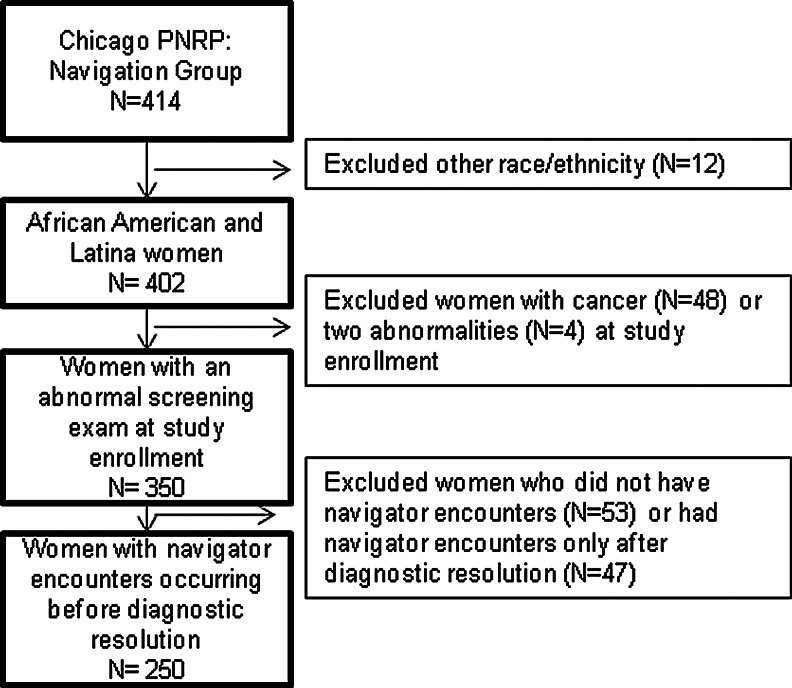
Methods: Data originated from 250 women in the intervention arm of the Chicago Patient Navigation Research Program (PNRP). The women had abnormal cancer screening findings and navigator encounters. Women were recruited from a community health center and a publicly owned medical center. After describing proportions of African American and Latina women experiencing particular barriers, logistic regression was used to explore associations between patient characteristics, such as race/ethnicity, and type of barriers.
Results: The most frequent barriers occurred at the intrapersonal level (e.g., insurance issues and fear), while institutional-level barriers such as system problems with scheduling care were the most commonly recurring over time (29%). The majority of barriers (58%) were reported in the first navigator encounter. Latinas (81%) reported barriers more often than African American women (19%). Differences in race/ethnicity and employment status were associated with types of barriers. Compared to African American women, Latinas were more likely to report an intrapersonal level barrier. Unemployed women were more likely to report an institutional level barrier.
Conclusion: In a sample of highly vulnerable women, there is no single characteristic (e.g., uninsured) that predicts what kinds of barriers a woman is likely to have. Nevertheless, navigators appear able to easily resolve intrapersonal-level barriers, but ongoing navigation is needed to address system-level barriers. Patient navigation programs can adopt the PNRP barriers framework to assist their efforts in assuring timely follow-up care.
Figures
References
-
- Lantz PM. Keeton K. Romano L. DeGroff A. Case management in public health screening programs: The experience of the National Breast and Cervical Cancer Early Detection Program. J Public Health Manag Pract. 2004;10:545–555. - PubMed
-
- Jemal A. Clegg LX. Ward E, et al. Annual report to the nation on the status of cancer, 1975–2001, with a special feature regarding survival. Cancer. 2004;101:3–27. - PubMed
-
- American Cancer Society. Cancer facts and figures for African Americans 2009–2010; Atlanta: 2009.
-
- Watson M. Saraiya M. Benard V, et al. Burden of cervical cancer in the United States, 1998–2003. Cancer. 2008;113:2855–2864. - PubMed
Publication types
MeSH terms
Grants and funding
LinkOut - more resources
Full Text Sources
Other Literature Sources
Medical
