Does bone compaction around the helical blade of a proximal femoral nail anti-rotation (PFNA) decrease the risk of cut-out?: A subject-specific computational study
- PMID: 23673407
- PMCID: PMC3670539
- DOI: 10.1302/2046-3758.25.2000150
Does bone compaction around the helical blade of a proximal femoral nail anti-rotation (PFNA) decrease the risk of cut-out?: A subject-specific computational study
Abstract
Objectives: Because of the contradictory body of evidence related to the potential benefits of helical blades in trochanteric fracture fixation, we studied the effect of bone compaction resulting from the insertion of a proximal femoral nail anti-rotation (PFNA).
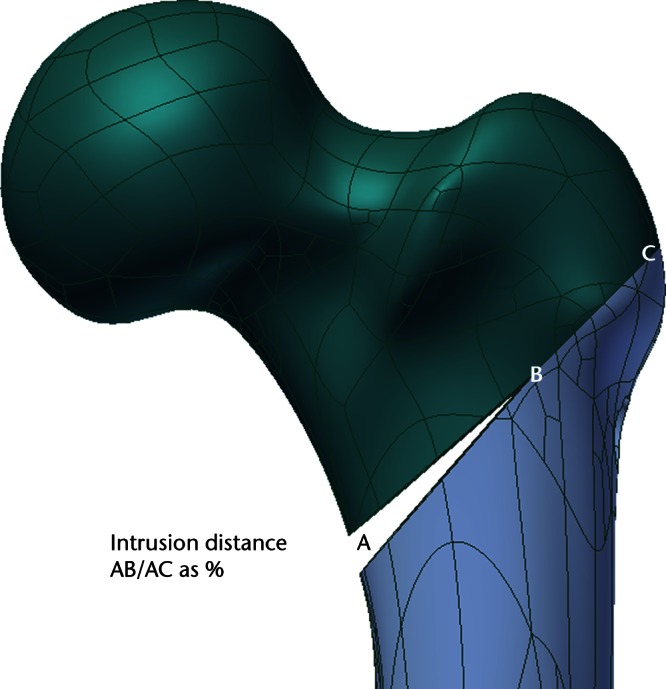
Methods: We developed a subject-specific computational model of a trochanteric fracture (31-A2 in the AO classification) with lack of medial support and varied the bone density to account for variability in bone properties among hip fracture patients.
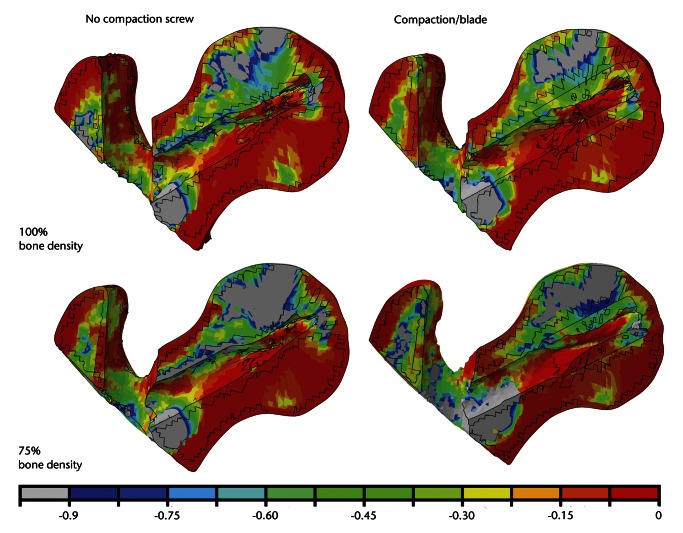
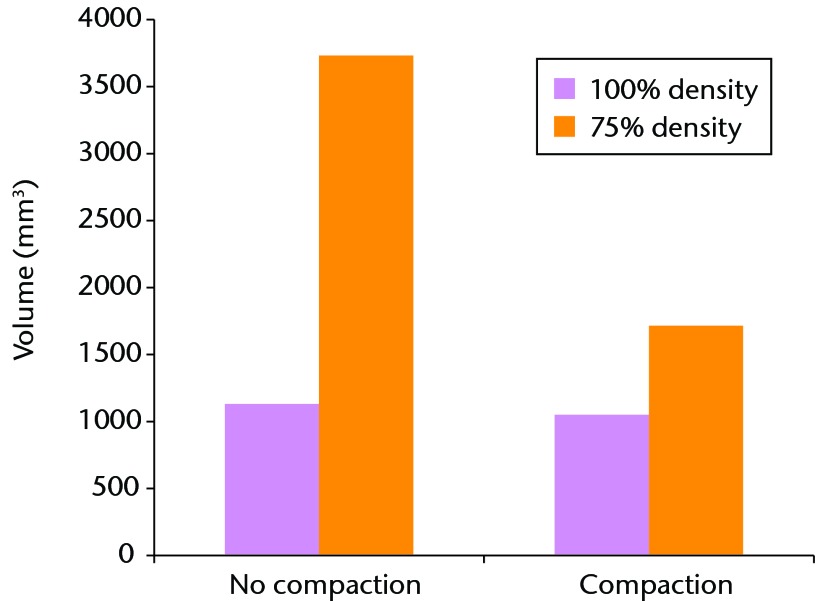
Results: We show that for a bone density corresponding to 100% of the bone density of the cadaveric femur, there does not seem to be any advantage in using a PFNA with respect to the risk of blade cut-out. On the other hand, in a more osteoporotic femoral head characterised by a density corresponding to 75% of the initial bone density, local bone compaction around the helical blade provides additional bone purchase, thereby decreasing the risk of cut-out, as quantified by the volume of bone susceptible to yielding.
Conclusions: Our findings indicate benefits of using a PFNA over an intramedullary nail with a conventional lag screw and suggest that any clinical trial reporting surgical outcomes regarding the use of helical blades should include a measure of the femoral head bone density as a covariable.
Keywords: Cadaveric bone; Cut-out; Finite element analysis; Osteosynthesis; PFNA; Trochanteric fracture.
Conflict of interest statement
Figures
References
-
- Lorich DG, Geller DS, Nielson JH. Osteoporotic pertrochanteric hip fractures: management and current controversies. Instr Course Lect 2004;53:441–454 - PubMed
-
- Windolf M, Muths R, Braunstein V, et al. Quantification of cancellous bone-compaction due to DHS Blade insertion and influence upon cut-out resistance. Clin Biomech (Bristol, Avon) 2009;24:53–58 - PubMed
-
- O’Neill F, Condon F, McGloughlin T, et al. Dynamic hip screw versus DHS blade: a biomechanical comparison of the fixation achieved by each implant in bone. J Bone Joint Surg [Br] 2011;93-B:616–621 - PubMed
-
- Wähnert D, Gudushauri P, Schiuma D, Richards G, Windolf M. Does cancellous bone compaction due to insertion of a blade implant influence the cut-out resistance?: a biomechanical study. Clin Biomech (Bristol, Avon) 2010;25:1053–1057 - PubMed
-
- Born CT, Karich B, Bauer C, von Oldenburg G, Augat P. Hip screw migration testing: first results for hip screws and helical blades utilizing a new oscillating test method. J Orthop Res 2011;29:760–766 - PubMed
LinkOut - more resources
Full Text Sources
Other Literature Sources