. 2013 Sep;33(9):1402-11.
doi: 10.1038/jcbfm.2013.74. Epub 2013 May 15.

Extra permeability is required to model dynamic oxygen measurements: evidence for functional recruitment?

Affiliations

Extra permeability is required to model dynamic oxygen measurements: evidence for functional recruitment?

Matthew J P Barrett et al. J Cereb Blood Flow Metab. 2013 Sep.

Abstract

Neural activation triggers a rapid, focal increase in blood flow and thus oxygen delivery. Local oxygen consumption also increases, although not to the same extent as oxygen delivery. This 'uncoupling' enables a number of widely-used functional neuroimaging techniques; however, the physiologic mechanisms that govern oxygen transport under these conditions remain unclear. Here, we explore this dynamic process using a new mathematical model. Motivated by experimental observations and previous modeling, we hypothesized that functional recruitment of capillaries has an important role during neural activation. Using conventional mechanisms alone, the model predictions were inconsistent with in vivo measurements of oxygen partial pressure. However, dynamically increasing net capillary permeability, a simple description of functional recruitment, led to predictions consistent with the data. Increasing permeability in all vessel types had the same effect, but two alternative mechanisms were unable to produce predictions consistent with the data. These results are further evidence that conventional models of oxygen transport are not sufficient to predict dynamic experimental data. The data and modeling suggest that it is necessary to include a mechanism that dynamically increases net vascular permeability. While the model cannot distinguish between the different possibilities, we speculate that functional recruitment could have this effect in vivo.


Figures
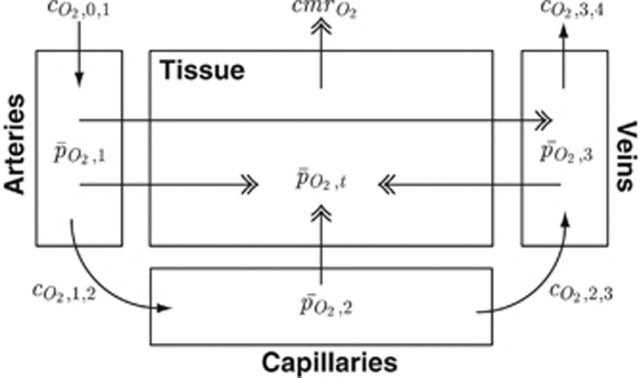
Figure 1
Figure 1
Schematic diagram of the oxygen transport model showing O2 concentrations (CO2), mean oxygen partial pressures (PO2), and cerebral metabolic rate of oxygen consumption (CMRO2). Subscripts 1, 2, 3 and t refer to arterial, capillary, venous, and tissue compartments, while subscripts 0 and 4 refer to notional larger arterial and venous compartments, respectively. Movement of O2 by convection (i.e., via blood flow) is shown with single arrowheads, while movement via diffusion is shown with double arrowheads. All mathematical notation is as per the equations in the Methods section.
Figure 2
Figure 2
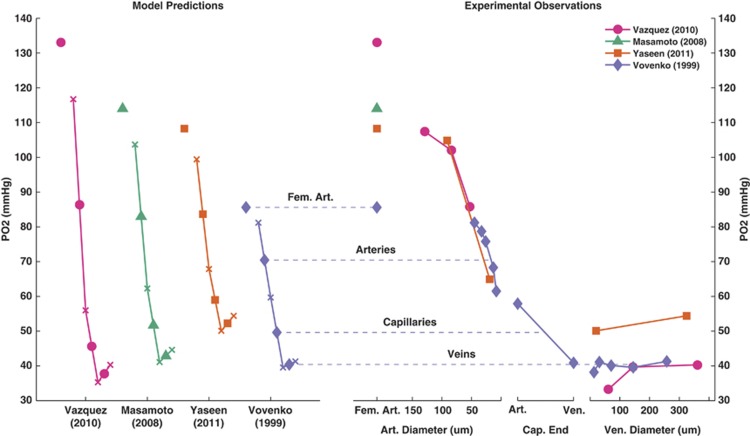
Model predictions (left) and experimental observations (right) of oxygen partial pressure (PO2) at baseline. Model predictions are shown with the femoral artery (Fem. Art.) and mean compartmental PO2 values in solid shapes, and the PO2 values into or out of compartments as ‘x'.
Figure 3
Figure 3
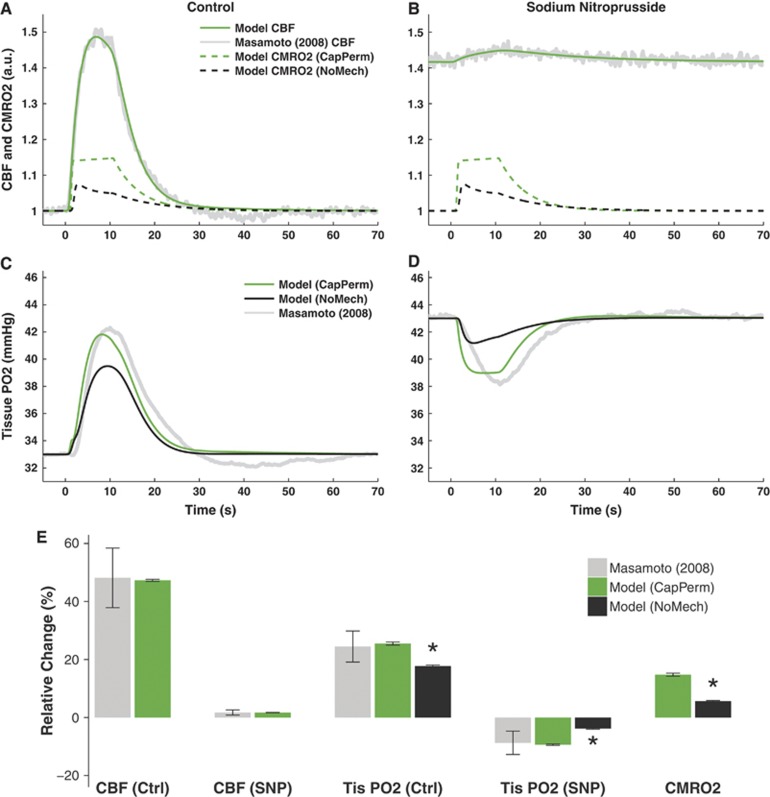
Model predictions of data from Masamoto et al in response to 10-second electrical forepaw stimulation. (AD) Optimal predictions of cerebral blood flow (CBF), cerebral metabolic rate of oxygen consumption (CMRO2), and tissue oxygen partial pressure (PO2) under control (Ctrl, panels A and C) and sodium nitroprusside (SNP) induced vasodilated conditions (panels B and D). (E) Changes from baseline CBF, tissue PO2, and CMRO2 induced by stimulation. Predictions show median±s.d. of n=29 simulations obtained by varying model parameters in the sensitivity analysis. Experiments show mean±s.e.m. of n=5 measurements. Predictions of CMRO2 and PO2 are shown with either increased capillary permeability (CapPerm, green) or without any additional mechanisms (NoMech, black). Asterisk (*) indicates P<0.05 versus CapPerm simulations. See Supplementary Figure 1 for results from remaining mechanisms.
Figure 4
Figure 4
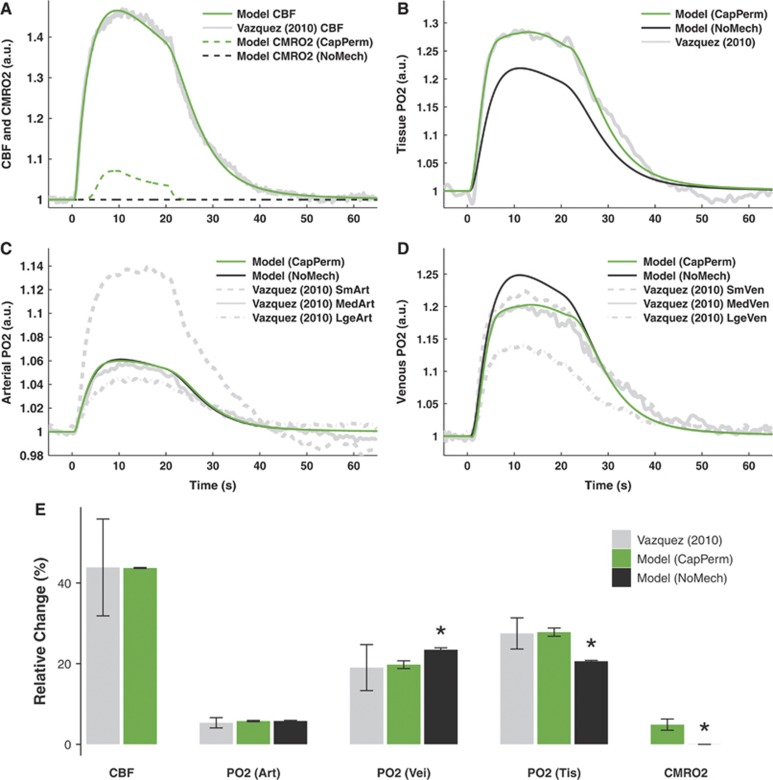
Model predictions of data from Vazquez et al in response to 20-second electrical forepaw stimulation. (A–D) Optimal predictions of cerebral blood flow (CBF) and cerebral metabolic rate of oxygen consumption (CMRO2, panel A), tissue oxygen partial pressure (PO2, panel B), arterial PO2 (panel C), and venous PO2 (panel D). (E) Changes from baseline induced by stimulation. Predictions show median±s.d. of n=35 simulations obtained by varying model parameters in the sensitivity analysis. Experiments show mean±s.e.m. of n=6 or 9 measurements. Predictions of CMRO2 and PO2 are shown either with increased capillary permeability (CapPerm, green) or without any additional mechanisms (NoMech, black), although these mechanisms overlap in panel C. Asterisk (*) indicates P<0.05 versus CapPerm simulations. See Supplementary Figure 2 for results from remaining mechanisms.
Figure 5
Figure 5
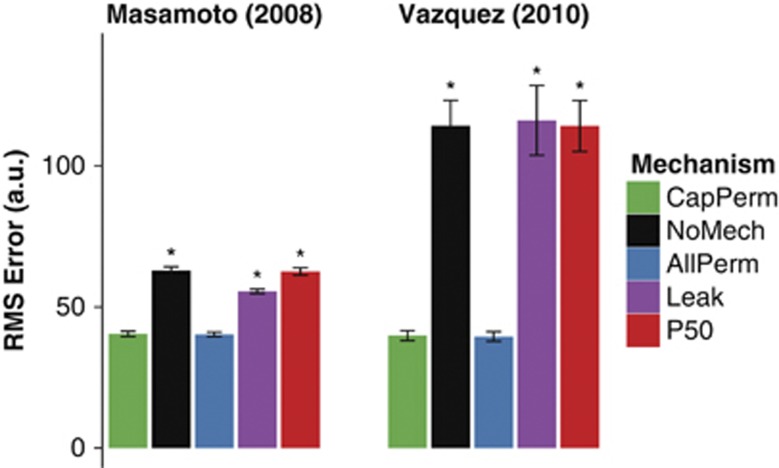
Root mean square (RMS) error associated with fitting the model to data for all of the mechanisms considered. Data shown as mean±standard error of means (s.e.m.); asterisk (*) indicates P<0.05 versus CapPerm simulations; n=29 simulations for data from Masamoto et al and n=35 simulations for data from Vazquez et al.

References

    1. Fox PT, Raichle ME. Focal physiological uncoupling of cerebral blood flow and oxidative metabolism during somatosensory stimulation in human subjects. Proc Natl Acad Sci USA. 1986;83:1140–1144. - PMC - PubMed
    1. Fox P, Raichle M, Mintun M, Dence C. Nonoxidative glucose consumption during focal physiologic neural activity. Science. 1988;241:462–464. - PubMed
    1. Devor A, Sakadžić S, Saisan PA, Yaseen MA, Roussakis E, Srinivasan VJ, et al. ‘Overshoot' of O2 is required to maintain baseline tissue oxygenation at locations distal to blood vessels. J Neurosci. 2011;31:13676–13681. - PMC - PubMed
    1. Leithner C, Royl G, Offenhauser N, Fuchtemeier M, Kohl-Bareis M, Villringer A, et al. Pharmacological uncoupling of activation induced increases in CBF and CMRO2. J Cereb Blood Flow Metab. 2010;30:311–322. - PMC - PubMed
    1. Buxton R. Interpreting oxygenation-based neuroimaging signals: the importance and the challenge of understanding brain oxygen metabolism. Front Neuroenergetics. 2010;2:8. - PMC - PubMed

LinkOut - more resources