


Experimental evidence that evolutionarily diverse assemblages result in higher productivity
- PMID: 23674676
- PMCID: PMC3670319
- DOI: 10.1073/pnas.1301685110
Experimental evidence that evolutionarily diverse assemblages result in higher productivity
Abstract
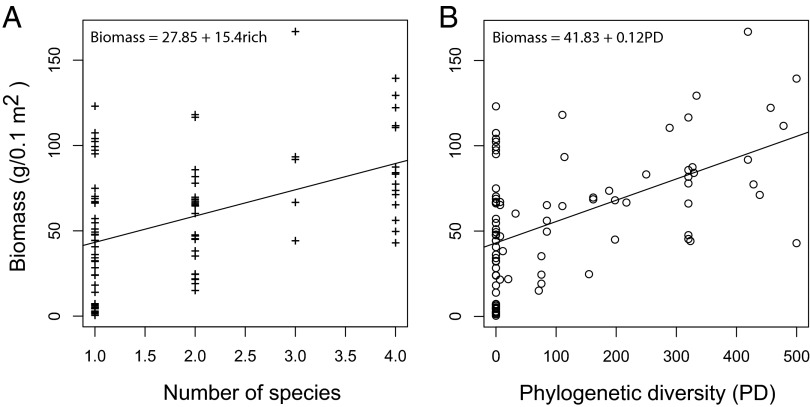
There now is ample experimental evidence that speciose assemblages are more productive and provide a greater amount of ecosystem services than depauperate ones. However, these experiments often conclude that there is a higher probability of including complementary species combinations in assemblages with more species and lack a priori prediction about which species combinations maximize function. Here, I report the results of an experiment manipulating the evolutionary relatedness of constituent plant species across a richness gradient. I show that assemblages with distantly related species contributed most to the higher biomass production in multispecies assemblages, through species complementarity. Species produced more biomass than predicted from their monocultures when they were in plots with distantly related species and produced the amount of biomass predicted from monoculture when sown with close relatives. This finding suggests that in the absence of any other information, combining distantly related species in restored or managed landscapes may serve to maximize biomass production and carbon sequestration, thus merging calls to conserve evolutionary history and maximize ecosystem function.
Keywords: biodiversity; phylogenetic diversity; transgressive overyielding.
Conflict of interest statement
The author declares no conflict of interest.
Figures


References
-
- Tilman D, et al. Diversity and productivity in a long-term grassland experiment. Science. 2001;294(5543):843–845. - PubMed
-
- Tilman D, Wedin D, Knops J. Productivity and sustainability influenced by biodiversity in grassland ecosystems. Nature. 1996;379:718–720.
-
- Cardinale BJ, et al. Effects of biodiversity on the functioning of trophic groups and ecosystems. Nature. 2006;443(7114):989–992. - PubMed
-
- Balvanera P, et al. Quantifying the evidence for biodiversity effects on ecosystem functioning and services. Ecol Lett. 2006;9(10):1146–1156. - PubMed
Publication types
MeSH terms
LinkOut - more resources
Full Text Sources
Other Literature Sources
