Obstructive sleep apnea after weight loss: a clinical trial comparing gastric bypass and intensive lifestyle intervention
- PMID: 23674932
- PMCID: PMC3629315
- DOI: 10.5664/jcsm.2656
Obstructive sleep apnea after weight loss: a clinical trial comparing gastric bypass and intensive lifestyle intervention
Abstract
Introduction: Few studies have compared the effect of surgical and conservative weight loss strategies on obstructive sleep apnea (OSA). We hypothesized that Roux-en-Y gastric bypass (RYGB) would be more effective than intensive lifestyle intervention (ILI) at reducing the prevalence and severity of OSA (apnea-hypopnea-index [AHI] ≥ 5 events/hour).
Methods: A total of 133 morbidly obese subjects (93 females) were treated with either a 1-year ILI-program (n = 59) or RYGB (n = 74) and underwent repeated sleep recordings with a portable somnograph (Embletta).
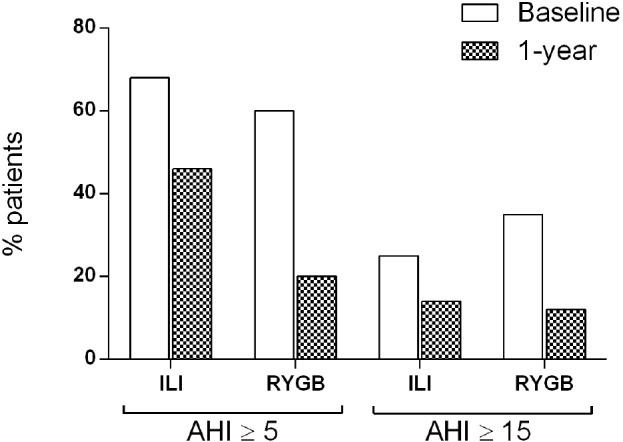
Results: Participants had a mean (SD) age of 44.7(10.8) years, BMI 45.1(5.7) kg/m(2), and AHI 17.1(21.4) events/hour. Eighty-four patients (63%) had OSA. The average weight loss was 8% in the ILI-group and 30% in the RYGB-group (p < 0.001). The mean (95%CI) AHI reduced in both treatment groups, although significantly more in the RYGB-group (AHI change -6.0 [ILI] vs -13.1 [RYGB]), between group difference 7.2 (1.3, 13.0), p = 0.017. Twenty-nine RYGB-patients (66%) had remission of OSA, compared to 16 ILI-patients (40%), p = 0.028. At follow-up, after adjusting for age, gender, and baseline AHI, the RYGB-patients had significantly lower adjusted odds for OSA than the ILI-patients-OR (95% CI) 0.33 (0.14, 0.81), p = 0.015. After further adjustment for BMI change, treatment group difference was no longer statistically significant-OR (95% CI) 1.31 (0.32, 5.35), p = 0.709.
Conclusion: Our study demonstrates that RYGB was more effective than ILI at reducing the prevalence and severity of OSA. However, our analysis also suggests that weight loss, rather than the surgical procedure per se, explains the beneficial effects.
Keywords: General; bariatric surgery; obstructive sleep apnea; weight loss.
Figures

References
-
- Shah N, Roux F. The relationship of obesity and obstructive sleep apnea. Clin Chest Med. 2009;30:455–65. vii. - PubMed
-
- McDaid C, Griffin S, Weatherly H, et al. Continuous positive airway pressure devices for the treatment of obstructive sleep apnoea-hypopnoea syndrome: a systematic review and economic analysis. Health Technol Assess. 2009;13:iii–xiv. 1. - PubMed
-
- Al Lawati NM, Patel SR, Ayas NT. Epidemiology, risk factors, and consequences of obstructive sleep apnea and short sleep duration. Prog Cardiovasc Dis. 2009;51:285–93. - PubMed
Publication types
MeSH terms
LinkOut - more resources
Full Text Sources
Other Literature Sources
Medical
Research Materials