


A Single Nucleotide Polymorphism in the Phospholipase D1 Gene is Associated with Risk of Non-Small Cell Lung Cancer
- PMID: 23675264
- PMCID: PMC3614861
A Single Nucleotide Polymorphism in the Phospholipase D1 Gene is Associated with Risk of Non-Small Cell Lung Cancer
Abstract
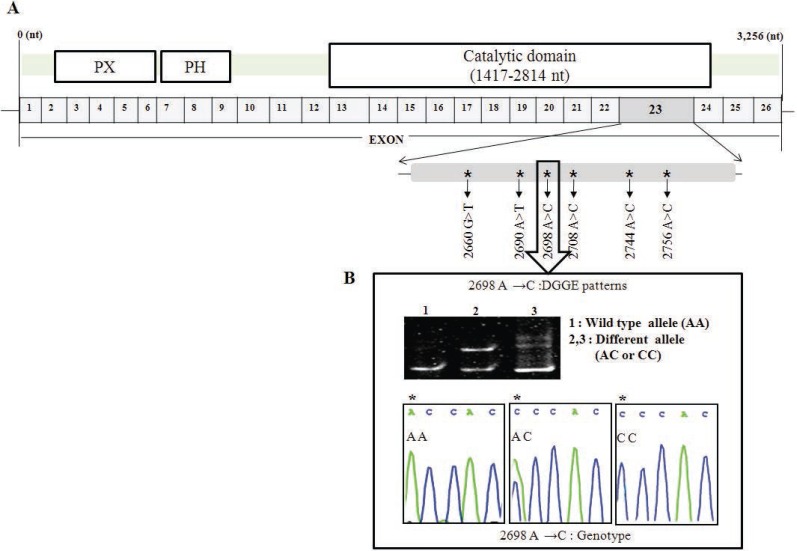
Phospholipase D (PLD) has an important role in various biological functions including vesicular transport, endocytosis, exocytosis, cell migration, and mitosis. These cellular biological processes are deregulated in the development of various human tumors. In order to explore the relationship between the PLD1 gene and risk of non-small cell lung cancer (NSCLC), single nucleotide polymorphisms (SNP) in the PLD1 exon region were surveyed in 211 NSCLC patients and 205 normal controls. In this study, we identified six SNPs at exon 23 in the PLD1 gene. Among the six SNPs, the most notable was a heterozygous A to C transition at nucleotide 2698 (A2698C, p<0.001). In addition, the genotype frequencies of A2744C (AC+CC) and A2756C (AC+CC) were associated with gender (female, A2744C and A2756C: p=0.071) in NSCLC patients. Interestingly, although the SNP A2698C did not cause change in amino acid, correlation between odd ratio of NSCLC patients and the SNP A2698C was observed to be statistically significant.
Keywords: DGGE; NSCLC; biomarker; lung cancer; phospholipase D; single nucleotide polymorphism.
Figures
References
-
- Cho JH, Hong SK, Kim EY, Park SY, et al. Overexpression of phospholipase D suppresses taxotere-induced cell death in stomach cancer cells. Biochim. Biophys. Acta. 2008;1783(5):912–923. - PubMed
-
- Park SY, Cho JH, Oh DY, Park JW, et al. House dust mite allergen Der f 2-induced phospholipase D1 activation is critical for the production of interleukin-13 through activating transcription factor-2 activation in human bronchial epithelial cells. J. Biol. Chem. 2009;284(30):20099–20110. - PMC - PubMed
-
- Uchida N, Okamura S, Kuwano H. Phospholipase D activity in human gastric carcinoma. Anticancer Res. 1999;19(1B):671–675. - PubMed
-
- Hsu YL, Hung JY, Ko YC, Hung CH, et al. Phospholipase D signaling pathway is involved in lung cancer-derived IL-8 increased osteoclastogenesis. Carcinogenesis. 2010;31(4):587–596. - PubMed
LinkOut - more resources
Full Text Sources