


The global burden of visual difficulty in low, middle, and high income countries
- PMID: 23675477
- PMCID: PMC3651198
- DOI: 10.1371/journal.pone.0063315
The global burden of visual difficulty in low, middle, and high income countries
Abstract
Purpose: Using a world-wide, population-based dataset of adults, we sought to determine the frequency of far visual difficulty and its associated risk factors.
Methods: The World Health Survey (WHS) was conducted in 70 countries throughout the world in 2003 using a random, multi-stage, stratified, cluster sampling design of adults ages 18 years and older. Far vision was assessed by asking "In the last 30 days, how much difficulty did you have in seeing and recognizing a person you know across the road (i.e. from a distance of about 20 meters)?". Responses included none, mild, moderate, severe, or extreme/unable. The income status of countries was estimated using gross national income per capita data from 2003 from the World Bank. Prevalence and regression estimates were adjusted to account for the complex sample design.
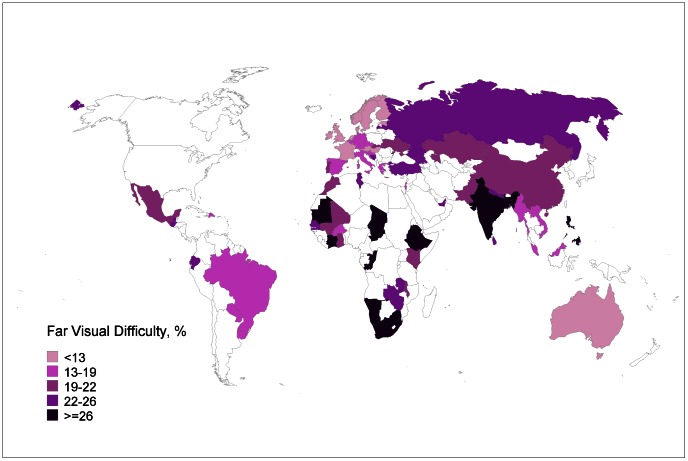
Results: 21% of adults reported any visual difficulty. The rate varied by the income status of the country with the percentage who had any visual difficulty being 24%, 23%, and 13% in low, middle, and high income countries, respectively. Five percent of people reported severe or extreme visual difficulty with rates in low, middle, and high income countries of 6%, 5%, and 2% respectively. Risk factors for visual difficulty included older age, female sex, poorer socioeconomic status, little to no formal education, and diabetes (P<0.05).
Conclusions: One out of five adults in the WHS reported some degree of far visual difficulty. Given the importance of vision to living an independent life, better access to quality eye care services and life course factors affecting vision health (e.g. repeated eye infections, diet lacking vitamin A) must receive adequate attention and resources, especially in low and middle income countries.
Conflict of interest statement
Figures
References
-
- Pascolini D, Mariotti SP (2012) Global estimates of visual impairment: 2010. Br J Ophthalmol 96: 614–618. - PubMed
-
- Lamoureux EL, Fenwick E, Pesudovs K, Tan D (2011) The impact of cataract surgery on quality of life. Curr Opin Ophthalmol 22: 19–27. - PubMed
-
- Janz NK, Wren PA, Lichter PR, Musch DC, Gillespie BW, et al.. (2001) Quality of life in newly diagnosed glaucoma patients: The Collaborative Initial Glaucoma Treatment Study. Ophthalmology 108: 887–897; discussion 898. - PubMed
-
- Freeman EE, Munoz B, West SK, Jampel HD, Friedman DS (2007) Glaucoma and Quality of Life The Salisbury Eye Evaluation. Ophthalmology. - PubMed
-
- Mangione CM, Berry S, Spritzer K, Janz NK, Klein R, et al. (1998) Identifying the content area for the 51-item National Eye Institute Visual Function Questionnaire: results from focus groups with visually impaired persons. Arch Ophthalmol 116: 227–233. - PubMed
Publication types
MeSH terms
Grants and funding
LinkOut - more resources
Full Text Sources
Other Literature Sources
Medical
