


Targeting self-renewal pathways in myeloid malignancies
- PMID: 23675967
- PMCID: PMC3665484
- DOI: 10.1186/1478-811X-11-33
Targeting self-renewal pathways in myeloid malignancies
Abstract
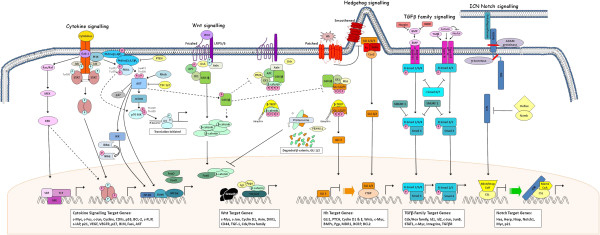
A fundamental property of hematopoietic stem cells (HSCs) is the ability to self-renew. This is a complex process involving multiple signal transduction cascades which control the fine balance between self-renewal and differentiation through transcriptional networks. Key activators/regulators of self-renewal include chemokines, cytokines and morphogens which are expressed in the bone marrow niche, either in a paracrine or autocrine fashion, and modulate stem cell behaviour. Increasing evidence suggests that the downstream signaling pathways induced by these ligands converge at multiple levels providing a degree of redundancy in steady state hematopoiesis. Here we will focus on how these pathways cross-talk to regulate HSC self-renewal highlighting potential therapeutic windows which could be targeted to prevent leukemic stem cell self-renewal in myeloid malignancies.
Figures
References
-
- Goardon N, Marchi E, Atzberger A, Quek L, Schuh A, Soneji S, Woll P, Mead A, Alford KA, Rout R, Chaudhury S, Gilkes A, Knapper S, Beldjord K, Begum S, Rose S, Geddes N, Griffiths M, Standen G, Sternberg A, Cavenagh J, Hunter H, Bowen D, Killick S, Robinson L, Price A, Macintyre E, Virgo P, Burnett A, Craddock C. Coexistence of LMPP-like and GMP-like leukemia stem cells in acute myeloid leukemia. Cancer Cell. 2011;19:138–152. doi: 10.1016/j.ccr.2010.12.012. - DOI - PubMed
Grants and funding
LinkOut - more resources
Full Text Sources
Other Literature Sources
