


Adoptively transferred TRAIL+ T cells suppress GVHD and augment antitumor activity
- PMID: 23676461
- PMCID: PMC3668849
- DOI: 10.1172/JCI66301
Adoptively transferred TRAIL+ T cells suppress GVHD and augment antitumor activity
Abstract
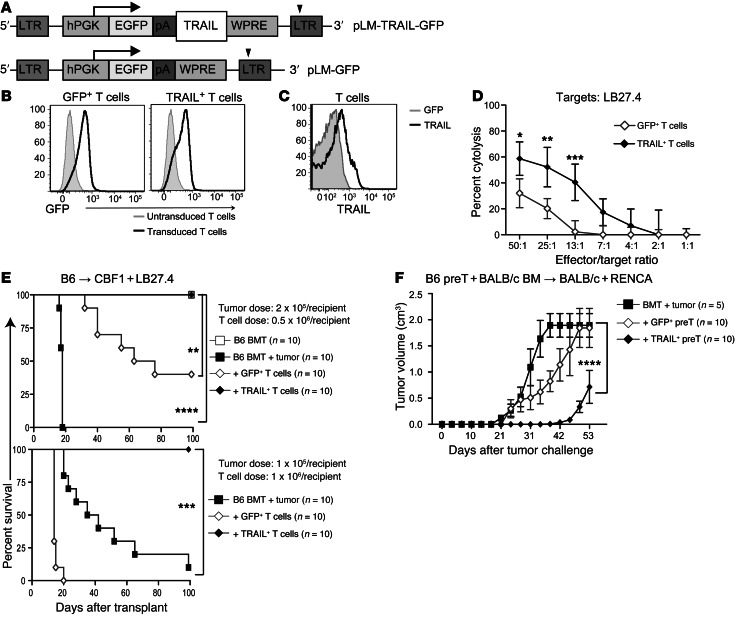
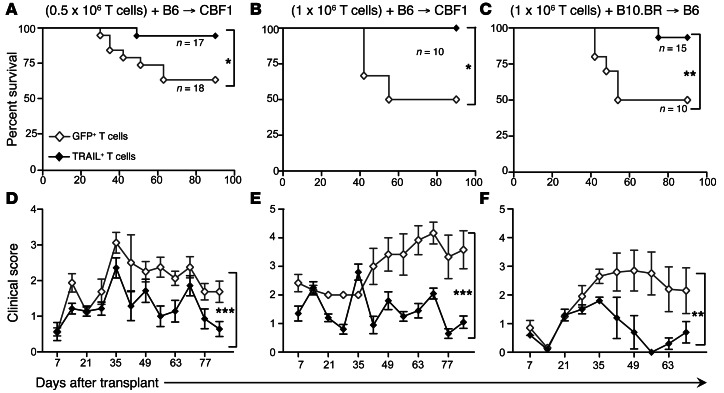
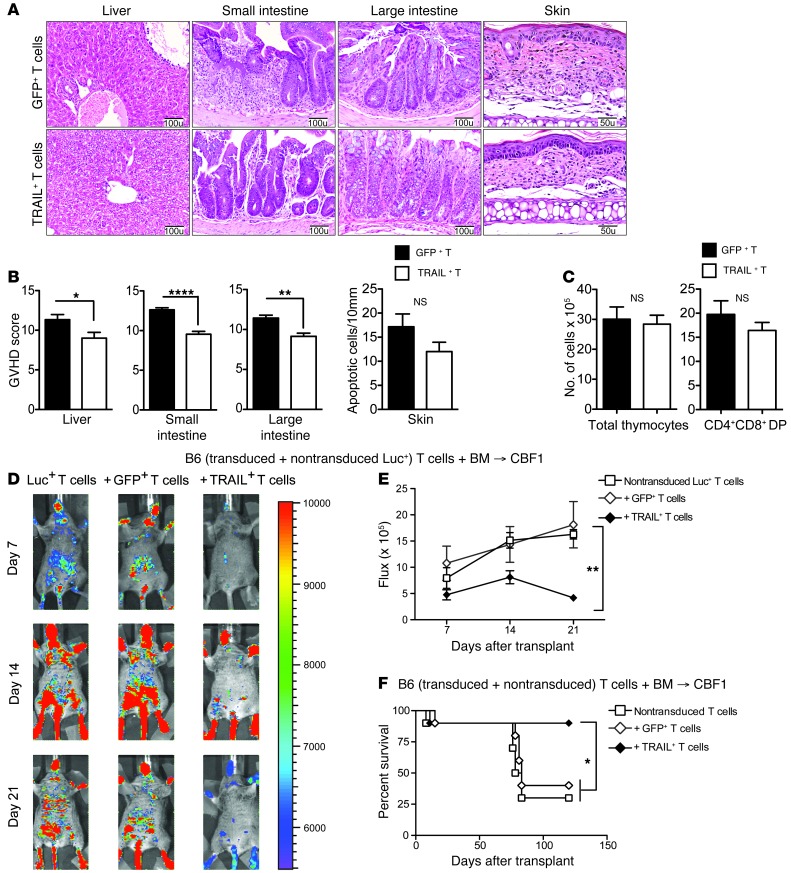
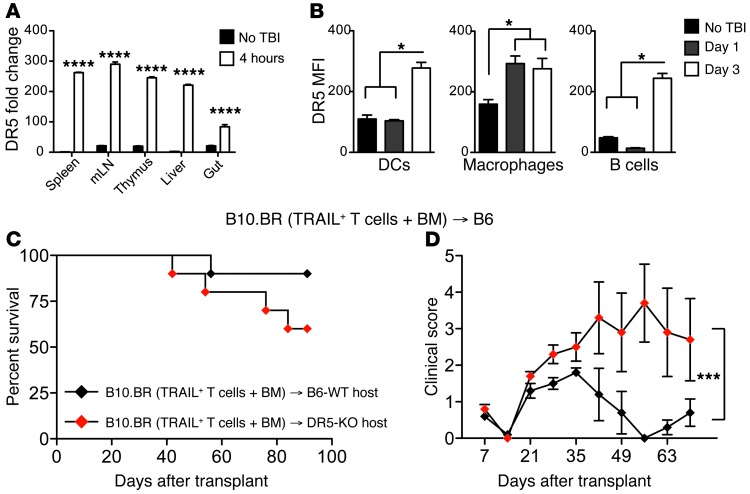
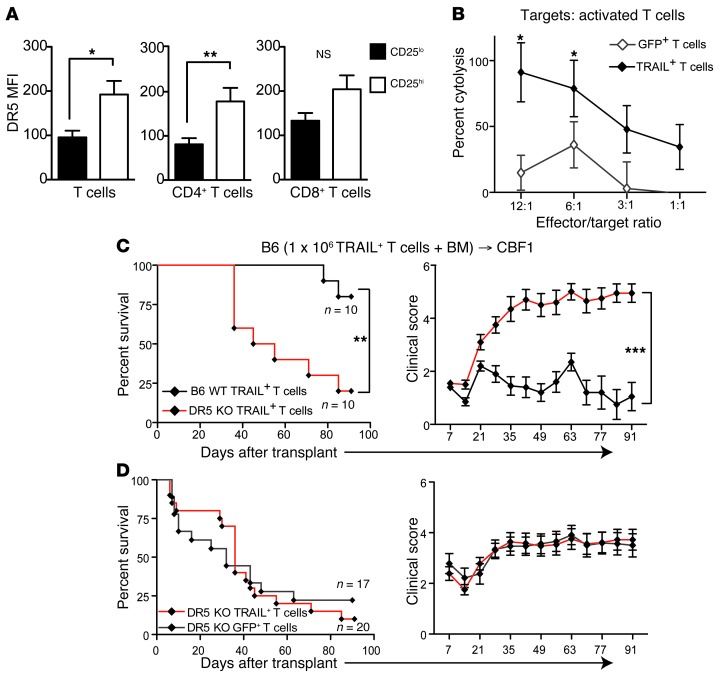
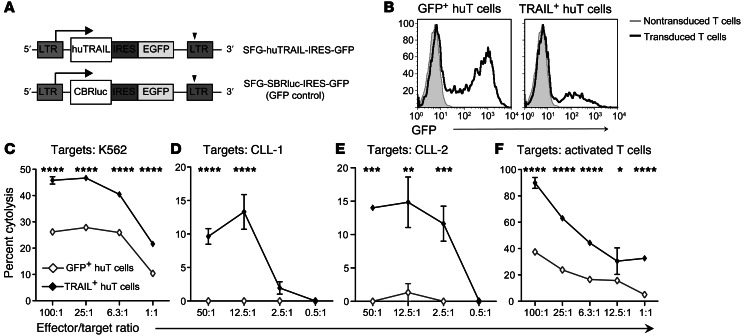
Current strategies to suppress graft-versus-host disease (GVHD) also compromise graft-versus-tumor (GVT) responses. Furthermore, most experimental strategies to separate GVHD and GVT responses merely spare GVT function without actually enhancing it. We have previously shown that endogenously expressed TNF-related apoptosis-inducing ligand (TRAIL) is required for optimal GVT activity against certain malignancies in recipients of allogeneic hematopoietic stem cell transplantation (allo-HSCT). In order to model a donor-derived cellular therapy, we genetically engineered T cells to overexpress TRAIL and adoptively transferred donor-type unsorted TRAIL+ T cells into mouse models of allo-HSCT. We found that murine TRAIL+ T cells induced apoptosis of alloreactive T cells, thereby reducing GVHD in a DR5-dependent manner. Furthermore, murine TRAIL+ T cells mediated enhanced in vitro and in vivo antilymphoma GVT response. Moreover, human TRAIL+ T cells mediated enhanced in vitro cytotoxicity against both human leukemia cell lines and against freshly isolated chronic lymphocytic leukemia (CLL) cells. Finally, as a model of off-the-shelf, donor-unrestricted antitumor cellular therapy, in vitro-generated TRAIL+ precursor T cells from third-party donors also mediated enhanced GVT response in the absence of GVHD. These data indicate that TRAIL-overexpressing donor T cells could potentially enhance the curative potential of allo-HSCT by increasing GVT response and suppressing GVHD.
Figures
Comment in
-
Blazing a new TRAIL in hematopoietic cell transplantation.J Clin Invest. 2013 Jun;123(6):2362-3. doi: 10.1172/JCI69909. Epub 2013 May 15. J Clin Invest. 2013. PMID: 23676458 Free PMC article.
References
-
- Doubrovina E, Carpenter T, Pankov D, Selvakumar A, Hasan A, O’Reilly RJ. Mapping of novel peptides of WT-1 and presenting HLA alleles that induce epitope-specific HLA-restricted-T-cells with cytotoxic activity against WT-1+ leukemias. . Blood. 2012;120(8):1633–1646. doi: 10.1182/blood-2011-11-394619. - DOI - PMC - PubMed
Publication types
MeSH terms
Substances
Grants and funding
- R01 HL069929/HL/NHLBI NIH HHS/United States
- R01 CA107096/CA/NCI NIH HHS/United States
- P01-CA33049/CA/NCI NIH HHS/United States
- R01-HL095075/HL/NHLBI NIH HHS/United States
- P30 CA008748/CA/NCI NIH HHS/United States
- R01-HL069929/HL/NHLBI NIH HHS/United States
- R01-AI080455/AI/NIAID NIH HHS/United States
- R01 HL095075/HL/NHLBI NIH HHS/United States
- P01 CA033049/CA/NCI NIH HHS/United States
- R01 AI080455/AI/NIAID NIH HHS/United States
- T32 AI007621/AI/NIAID NIH HHS/United States
- R01-CA107096/CA/NCI NIH HHS/United States
- R01 CA161138/CA/NCI NIH HHS/United States
LinkOut - more resources
Full Text Sources
Other Literature Sources
Molecular Biology Databases
