


Sarcomatoid lung carcinomas show high levels of programmed death ligand-1 (PD-L1)
- PMID: 23676558
- PMCID: PMC3703468
- DOI: 10.1097/JTO.0b013e318292be18
Sarcomatoid lung carcinomas show high levels of programmed death ligand-1 (PD-L1)
Abstract
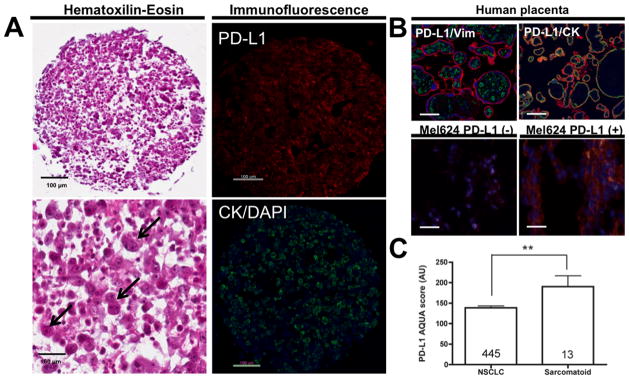
Programmed death-1 (PD-1) is a coinhibitory inducible receptor present on T-cells and macrophages. Tumor cells with increased programmed death ligand-1 (PD-L1) are believed to escape immunity through activation of PD-1/PD-L1 pathway and suppression of effector-immune responses. Recent strategies targeting the PD-1/PD-L1 axis have shown promising results in patients with several tumors types, including lung carcinomas. Preliminary data suggest that PD-L1 protein expression might have predictive response to such therapies. Sarcomatoid carcinomas (SCs) of the lung include rare subtypes of poorly differentiated non-small-cell lung carcinomas of high grade and aggressive behavior. The biology of these neoplasms is poorly understood and they frequently show increased local inflammatory and lymphocytic infiltration. Here, we report the expression of PD-L1 in 13 SCs from two large retrospective lung cancer cohorts. Using automated quantitative immunofluoresence and a mouse monoclonal antibody directed against the extracellular domain of PD-L1, we show that 9 of 13 patients (69.2%) with SCs are positive for PD-L1 and their levels are higher than in conventional non-small-cell lung carcinoma. These results provide rationale for the potential use of targeted immunotherapy in lung SCs.
Figures
References
-
- Zou W, Chen L. Inhibitory B7-family molecules in the tumour microenvironment. Nature reviews Immunology. 2008;8:467–477. - PubMed
-
- Topalian SL, Hodi FS, Brahmer JR, Gettinger SN, Smith DC, McDermott DF, Powderly JD, Carvajal RD, Sosman JA, Atkins MB, Leming PD, Spigel DR, Antonia SJ, Horn L, Drake CG, Pardoll DM, Chen L, Sharfman WH, Anders RA, Taube JM, McMiller TL, Xu H, Korman AJ, Jure-Kunkel M, Agrawal S, McDonald D, Kollia GD, Gupta A, Wigginton JM, Sznol M. Safety, activity, and immune correlates of anti-PD-1 antibody in cancer. The New England journal of medicine. 2012;366:2443–2454. - PMC - PubMed
-
- Brahmer JR, Tykodi SS, Chow LQ, Hwu WJ, Topalian SL, Hwu P, Drake CG, Camacho LH, Kauh J, Odunsi K, Pitot HC, Hamid O, Bhatia S, Martins R, Eaton K, Chen S, Salay TM, Alaparthy S, Grosso JF, Korman AJ, Parker SM, Agrawal S, Goldberg SM, Pardoll DM, Gupta A, Wigginton JM. Safety and activity of anti-PD-L1 antibody in patients with advanced cancer. The New England journal of medicine. 2012;366:2455–2465. - PMC - PubMed
-
- Beasley MB, Brambilla E, Travis WD. The 2004 World Health Organization classification of lung tumors. Semin Roentgenol. 2005;40:90–97. - PubMed
-
- Fishback NF, Travis WD, Moran CA, Guinee DG, Jr, McCarthy WF, Koss MN. Pleomorphic (spindle/giant cell) carcinoma of the lung. A clinicopathologic correlation of 78 cases. Cancer. 1994;73:2936–2945. - PubMed
MeSH terms
Substances
Grants and funding
LinkOut - more resources
Full Text Sources
Other Literature Sources
Medical
Research Materials
