. 2013 Nov;24(11):1623-33.
doi: 10.1007/s13361-013-0621-1. Epub 2013 May 16.

Activated ion ETD performed in a modified collision cell on a hybrid QLT-Oribtrap mass spectrometer

Affiliations

Activated ion ETD performed in a modified collision cell on a hybrid QLT-Oribtrap mass spectrometer

Aaron R Ledvina et al. J Am Soc Mass Spectrom. 2013 Nov.

Abstract

We describe the implementation and characterization of activated ion electron transfer dissociation (AI-ETD) on a hybrid QLT-Orbitrap mass spectrometer. AI-ETD was performed using a collision cell that was modified to enable ETD reactions, in addition to normal collisional activation. The instrument manifold was modified to enable irradiation of ions along the axis of this modified cell with IR photons from a CO2 laser. Laser power settings were optimized for both charge (z) and mass to charge (m/z) and the instrument control firmware was updated to allow for automated adjustments to the level of irradiation. This implementation of AI-ETD yielded 1.6-fold more unique identifications than ETD in an nLC-MS/MS analysis of tryptic yeast peptides. Furthermore, we investigated the application of AI-ETD on large scale analysis of phosphopeptides, where laser power aids ETD, but can produce b- and y-type ions because of the phosphoryl moiety's high IR adsorption. nLC-MS/MS analysis of phosphopeptides derived from human embryonic stem cells using AI-ETD yielded 2.4-fold more unique identifications than ETD alone, demonstrating a promising advance in ETD sequencing of PTM containing peptides.


Figures
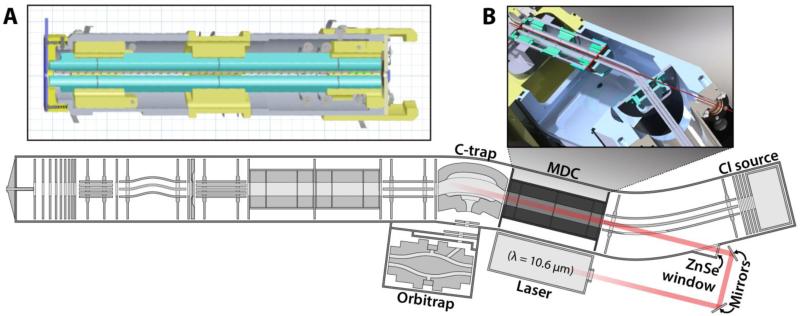
Figure 1
Figure 1. Modified LTQ-velos Orbitrap hybrid mass spectrometer
(A) Schematic of the modified collision cell (multi dissociation cell, MDC) capable of performing ETD which replaced the usual collision cell. (B) Adaptations that allow AI-ETD. In addition to the installation of the MDC, we have excavated a photon passage through the transfer multipole, which conducts anions from the chemical ionization (CI) source to forward sections of the mass spectrometer. Using external mirrors and a ZnSe window, we enable the irradiation of the trapping volume of the MDC with IR photons generated using an external laser.
Figure 2
Figure 2. AI-ETD of the peptide RPKPQQFFGLM
AI-ETD performed in the MDC (B) improves fragmentation of the peptide RPKPQQFFGLM as compared to MDC ETD alone (A). AI-ETD also reduces hydrogen abstraction which can inhibit manual and automated spectral interpretation (insets).
Figure 3
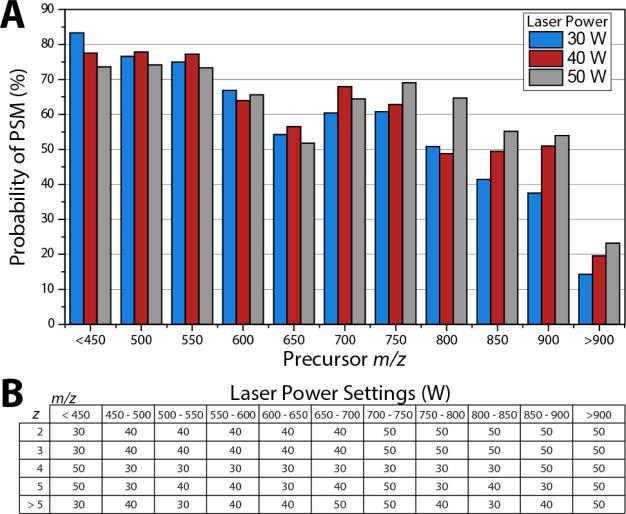
Figure 3. Construction of decision tree laser power settings
Precursors of varying charge state were interrogated by AI-ETD with laser powers at 30, 40, and 50 W. The probability of identification for 50 m/z bins for +3 precursors demonstrates the need for higher laser powers at higher m/z (A). Analysis identical to (A) was performed for charge states 2, 3, 4, 5, and >5 and plots were used to construct decision tree logic for AI-ETD laser power settings depending on precursor z and m/z (B). Here, the laser power setting that produced the highest probability of PSM was chosen as the value in the decision tree.
Figure 4
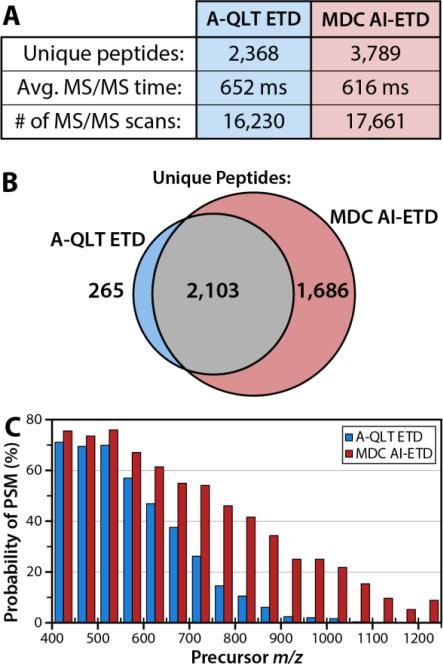
Figure 4. Comparison of A-QLT ETD and MDC AI-ETD
Use of the MDC augments our implementation of AI-ETD because the reduced reaction time and reagent accumulation time requirements result in a shorter MS/MS time and more MS/MS scans over the course of the LC-MS/MS analysis (A). The cumulative effect of the MDC and laser activation is a substantial improvement in unique peptide identifications over previous ETD implementation using the A-QLT (A). Analysis of the overlap of peptide identifications demonstrates AI-ETD identifies a large number of peptides not sequenced by A-QLT ETD. Using laser activation, the probability of producing a peptide spectral match (PSM) is greatly increased, particularly for peptide precursors having a high m/z value (C).
Figure 5
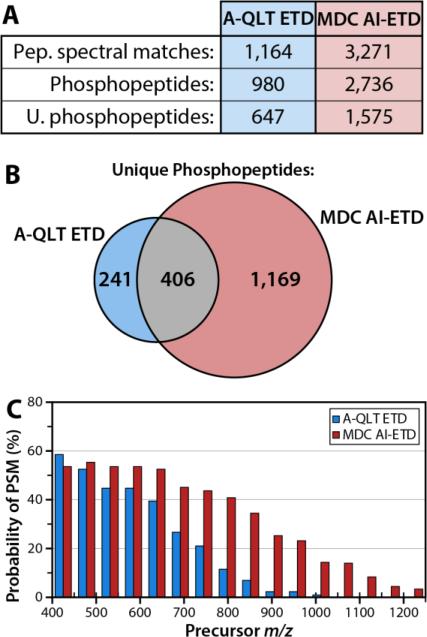
Figure 5. Comparison of A-QLT-based ETD and MDC-based AI-ETD for phosphopeptide analysis
Use of the MDC AI-ETD results in a greater number of PSMs, phosphopeptide PSMs, and unique phosphopeptides identified (A), while retaining a high proportion of the unique phosphopeptides obtainable using A-QLT-based ETD (B). This is largely due to greatly enhanced probability of PSM, particularly for high m/z precursors (C) afforded by the IR activation of precursors during ETD.

References

    1. Syka JEP, Coon JJ, Schroeder MJ, Shabanowitz J, Hunt DF. Peptide and protein sequence analysis by electron transfer dissociation mass spectrometry. (Translated from English) Proc. Natl. Acad. Sci. U. S. A. 2004;101(26):9528–9533. (in English) - PMC - PubMed
    1. Coon JJ, Syka JEP, Schwartz JC, Shabanowitz J, Hunt DF. Anion dependence in the partitioning between proton and electron transfer in ion/ion reactions. (Translated from English) Int. J. Mass Spectrom. 2004;236(1-3):33–42. (in English)
    1. Zubarev RA, Kelleher NL, McLafferty FW. Electron capture dissociation of multiply charged protein cations. A nonergodic process. (Translated from English) Journal of the American Chemical Society. 1998;120(13):3265–3266. (in English)
    1. Chalkley RJ, Thalhammer A, Schoepfer R, Burlingame AL. Identification of protein O GlcNAcylation sites using electron transfer dissociation mass spectrometry on native peptides. (Translated from English) Proc. Natl. Acad. Sci. U. S. A. 2009;106(22):8894–8899. (in English) - PMC - PubMed
    1. Khidekel N, Ficarro SB, Clark PM, Bryan MC, Swaney DL, Rexach JE, Sun YE, Coon JJ, Peters EC, Hsieh-Wilson LC. Probing the dynamics of O-GlcNAc glycosylation in the brain using quantitative proteomics. (Translated from English) Nat. Chem. Biol. 2007;3(6):339–348. (in English) - PubMed

Publication types

LinkOut - more resources