. 2013 Jul;162(3):1392-405.
doi: 10.1104/pp.113.217174. Epub 2013 May 15.

Localized induction of the ATP-binding cassette B19 auxin transporter enhances adventitious root formation in Arabidopsis

Affiliations

Localized induction of the ATP-binding cassette B19 auxin transporter enhances adventitious root formation in Arabidopsis

Poornima Sukumar et al. Plant Physiol. 2013 Jul.

Abstract

Adventitious roots emerge from aerial plant tissues, and the induction of these roots is essential for clonal propagation of agriculturally important plant species. This process has received extensive study in horticultural species but much less focus in genetically tractable model species. We have explored the role of auxin transport in this process in Arabidopsis (Arabidopsis thaliana) seedlings in which adventitious root initiation was induced by excising roots from low-light-grown hypocotyls. Inhibition of auxin transport from the shoot apex abolishes adventitious root formation under these conditions. Root excision was accompanied by a rapid increase in radioactive indole-3-acetic acid (IAA) transport and its accumulation in the hypocotyl above the point of excision where adventitious roots emerge. Local increases in auxin-responsive gene expression were also observed above the site of excision using three auxin-responsive reporters. These changes in auxin accumulation preceded cell division events, monitored by a cyclin B1 reporter (pCYCB1;1:GUS), and adventitious root initiation. We examined excision-induced adventitious root formation in auxin influx and efflux mutants, including auxin insensitive1, pin-formed1 (pin1), pin2, pin3, and pin7, with the most profound reductions observed in ATP-binding cassette B19 (ABCB19). An ABCB19 overexpression line forms more adventitious roots than the wild type in intact seedlings. Examination of transcriptional and translational fusions between ABCB19 and green fluorescent protein indicates that excision locally induced the accumulation of ABCB19 transcript and protein that is temporally and spatially linked to local IAA accumulation leading to adventitious root formation. These experiments are consistent with localized synthesis of ABCB19 protein after hypocotyl excision leads to enhanced IAA transport and local IAA accumulation driving adventitious root formation.


Figures
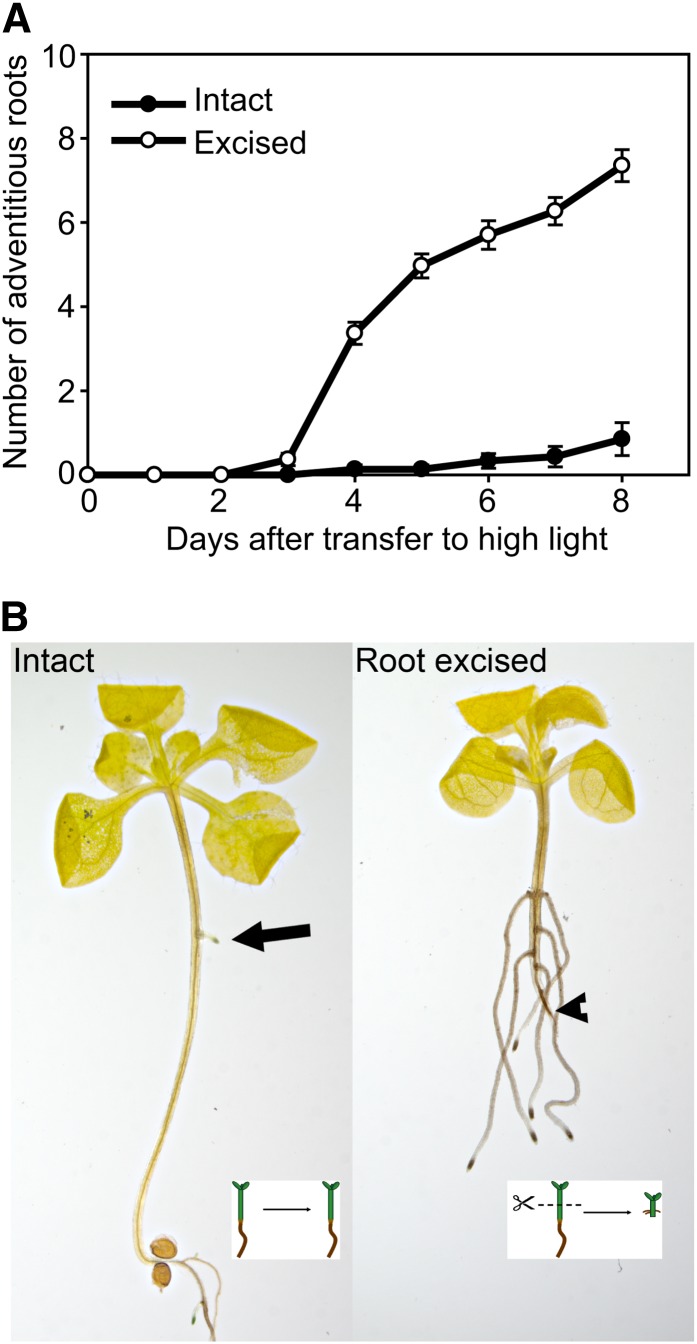
Figure 1.
Figure 1.
Root excision increases adventitious root formation in Arabidopsis. A, The number of adventitious roots was determined in the intact or root-excised hypocotyls (n = 20–30). B, Adventitious root formation on intact (left) and excised (right) cleared hypocotyls is shown after 7 d. Arrow points to an adventitious root in the intact hypocotyl, and arrowhead points to site of excision. Bar = 5 mm. [See online article for color version of this figure.]
Figure 2.
Figure 2.
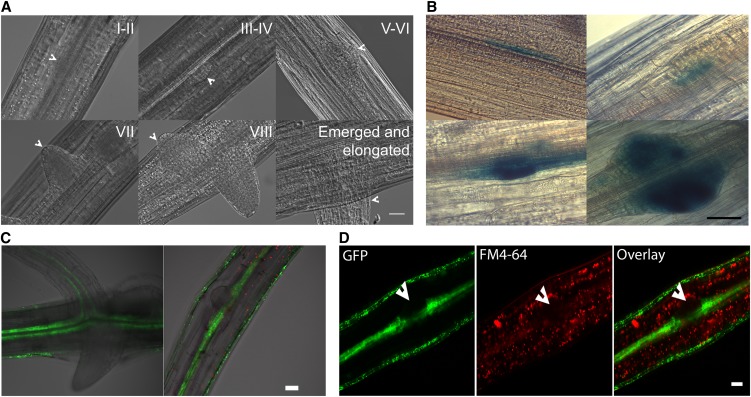
Adventitious roots emerge from pericycle tissues of the hypocotyl. DIC images of various stages of primordia development in: A, Cleared hypocotyls of the wild type at the developmental stage noted in Roman numerals; B, AtCYCB1;1:GUS transgenic hypocotyls; C, LSCM image of pericycle marker J0121:GFP in emerging adventitious roots; and D, LSCM images of pericycle marker J0121:GFP and FM4-64 staining in adventitious root primordia. The arrowhead notes a primordium from which most FM4-64 stain is excluded. Bars = 50 µm (A, C, and D) and 30 µm (B).
Figure 3.
Figure 3.
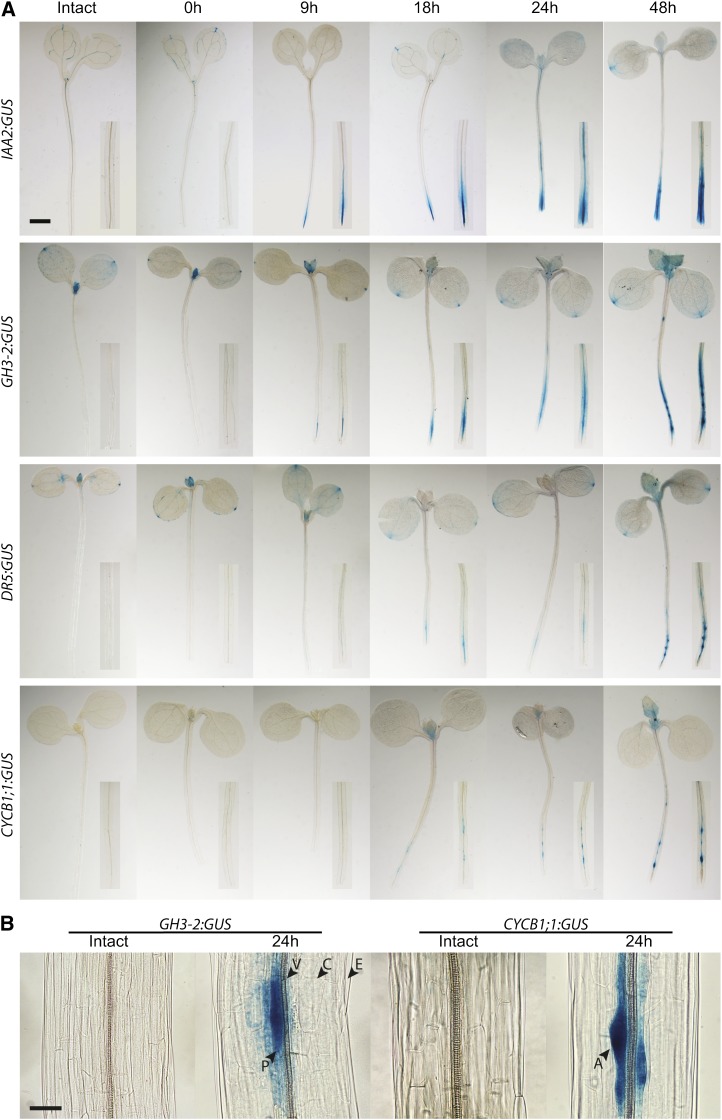
Excision increases local expression of auxin-responsive and cell division reporters in adventitious roots developing from pericycle cells. A, Intact or root-excised hypocotyls of pIAA2:GUS, pGH3-2:GUS, pDR5:GUS, and AtCYCB1;1:GUS were stained at the indicated time after excision. Insets show a 2.5× view of the hypocotyl base or the equivalent region in intact seedlings. Bar = 1 mm. B, Higher magnification images of intact or root-excised hypocotyls of AtGH3-2:GUS and AtCYCB1;1:GUS were stained 24 h after excision or in time-matched intact controls. Bar = 50 µm. Labels correspond to different cell files. P, Pericycle; V, vascular bundle; C, cortex; E, epidermis; A, adventitious root primordia.
Figure 4.
Figure 4.
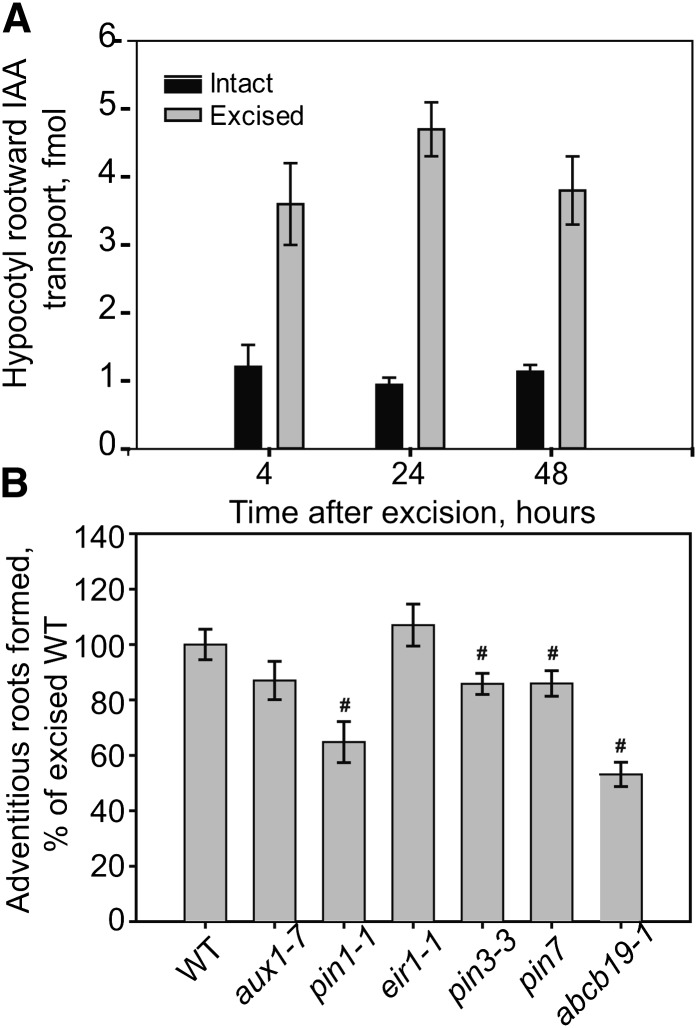
Excision induces IAA transport, and auxin transport mutants show less adventitious root formation. A, Tritiated IAA transport from the shoot apex toward the root (rootward transport) was measured in hypocotyls at the times after excision compared with intact hypocotyls. The average and se are reported, and all samples showed significant induction by excision (P < 0.001). B, The effect of mutations in genes encoding auxin transport proteins on adventitious roots 7 d after excision (n = 10–31). Number sign indicates P ≤ 0.05 between indicated genotypes compared with the wild type (WT).
Figure 5.
Figure 5.
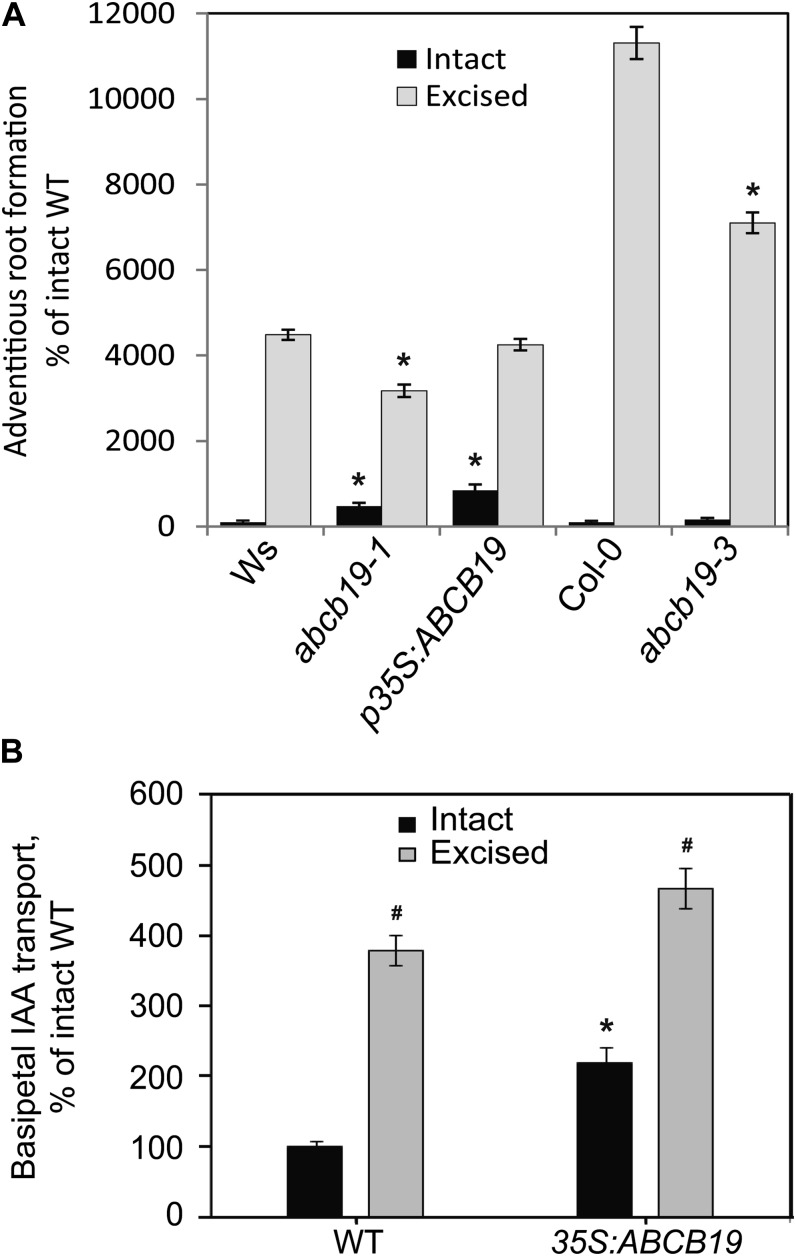
ABCB19 expression levels are linked to excision-induced adventitious root formation and auxin transport. A, The formation of adventitious roots in intact and excised hypocotyls is reported relative to intact seedlings of the parental genotypes (Ws for abcb19-1 and 35S:ABCB19; Col for abcb19-3). n = 41\x{2013}60. Asterisk indicates P ≤ 0.05 in excised or intact hypocotyls between genotypes. In all genotypes, excision significantly increases root formation over intact samples (P ≤ 0.001), so this is not noted on the graph. B, The effect of root excision and p35S:ABCB19 on auxin transport 2 d after excision. The average and SE are reported. Asterisk indicates P ≤ 0.05 between genotypes as compared to wild type. Number sign indicates P ≤ 0.05 between intact and excised samples within genotypes. WT, Wild type.
Figure 6.
Figure 6.
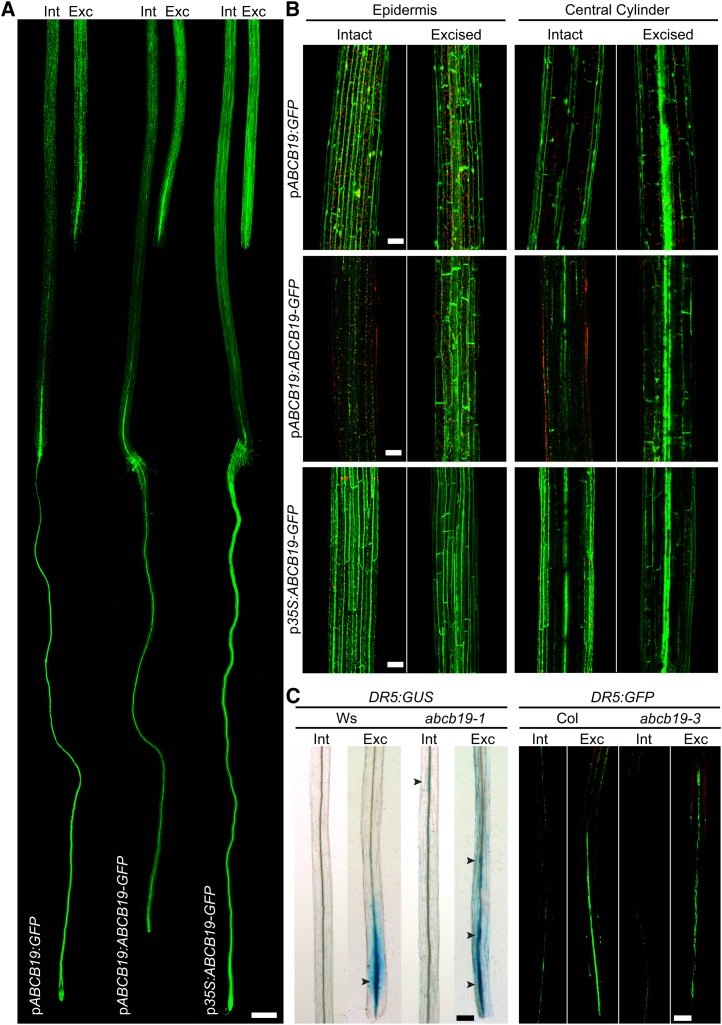
Local ABCB19 transcription and pABCB19:ABCB19-GFP protein accumulations are enhanced with excision. A, LSCM tile scan images of root-excised pABCB19:ABCB19-GFP, pABCB19:GFP, and p35S:ABCB19-GFP taken 6 h post excision. Bar = 400 µm. B, Comparison of intact and root-excised hypocotyls of pABCB19:ABCB19-GFP, pABCB19:GFP, and p35S:ABCB19-GFP examined by LSCM tile scans 6 h post excision. Bars = 100 µm. C, Higher magnification LSCM images of DR5:GUS and DR5:GFP upon root excision in abcb19-1 and abcb19-3 mutant hypocotyls, respectively. Bars = 200 µm.
Figure 7.
Figure 7.
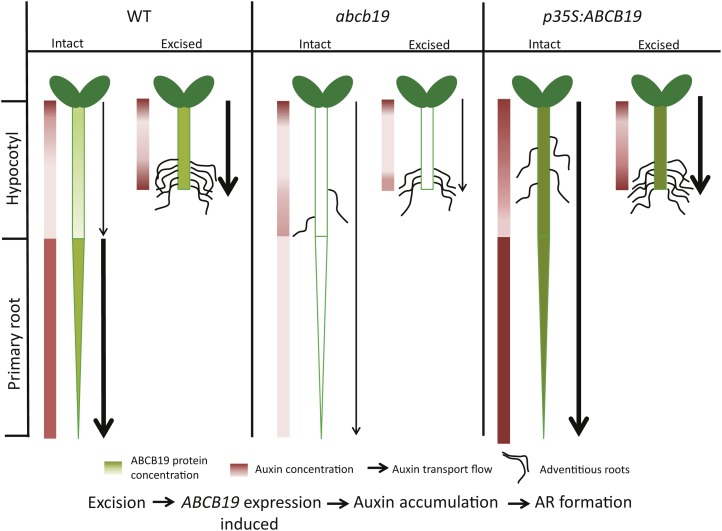
Model describing the proposed mechanisms by which excision enhances ABCB19 synthesis and auxin transport leading to localized auxin accumulation that drives adventitious root formation. The levels of ABCB19 protein are illustrated in green shading with darkness of shades proportional to expression levels, based on ABCB19:GFP reporter expression. The resulting levels of IAA in hypocotyls and roots are noted in shades of red to the left of each seedling, with darker red indicating higher IAA concentration. The amount of auxin transport is indicated by the width of the arrows, a thicker line denoting greater transport levels. The frequency of adventitious root formation is noted, although lateral root formation is omitted for simplicity. The flowchart at the bottom of the figure illustrates the temporal order of events occurring in the model. WT, Wild type.

References

    1. Abarca D, Díaz-Sala C. (2009) Reprogramming adult cells during organ regeneration in forest species. Plant Signal Behav 4: 793–795 - PMC - PubMed
    1. Barkawi LS, Tam YY, Tillman JA, Pederson B, Calio J, Al-Amier H, Emerick M, Normanly J, Cohen JD. (2008) A high-throughput method for the quantitative analysis of indole-3-acetic acid and other auxins from plant tissue. Anal Biochem 372: 177–188 - PubMed
    1. Benková E, Michniewicz M, Sauer M, Teichmann T, Seifertová D, Jürgens G, Friml J. (2003) Local, efflux-dependent auxin gradients as a common module for plant organ formation. Cell 115: 591–602 - PubMed
    1. Boerjan W, Cervera MT, Delarue M, Beeckman T, Dewitte W, Bellini C, Caboche M, Van Onckelen H, Van Montagu M, Inzé D. (1995) Superroot, a recessive mutation in Arabidopsis, confers auxin overproduction. Plant Cell 7: 1405–1419 - PMC - PubMed
    1. Celenza JL, Jr, Grisafi PL, Fink GR. (1995) A pathway for lateral root formation in Arabidopsis thaliana. Genes Dev 9: 2131–2142 - PubMed

Publication types

MeSH terms

LinkOut - more resources