The decline and rise of coronary heart disease: understanding public health catastrophism
- PMID: 23678895
- PMCID: PMC3682614
- DOI: 10.2105/AJPH.2013.301226
The decline and rise of coronary heart disease: understanding public health catastrophism
Abstract
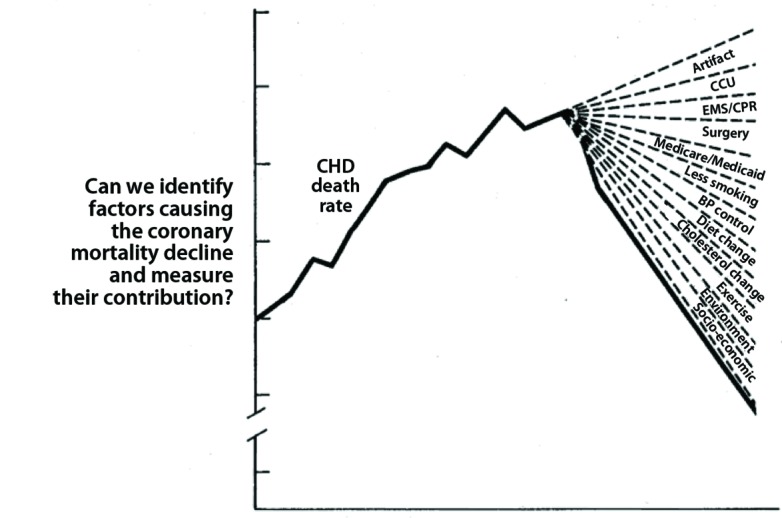
The decline of coronary heart disease mortality in the United States and Western Europe is one of the great accomplishments of modern public health and medicine. Cardiologists and cardiovascular epidemiologists have devoted significant effort to disease surveillance and epidemiological modeling to understand its causes. One unanticipated outcome of these efforts has been the detection of early warnings that the decline had slowed, plateaued, or even reversed. These subtle signs have been interpreted as evidence of an impending public health catastrophe. This article traces the history of research on coronary heart disease decline and resurgence and situates it in broader narratives of public health catastrophism. Juxtaposing the coronary heart disease literature alongside the narratives of emerging and reemerging infectious disease helps to identify patterns in how public health researchers create data and craft them into powerful narratives of progress or pessimism. These narratives, in turn, shape public health policy.
Figures
References
-
- D. S. Jones and J. A. Greene, “The Contributions of Prevention and Treatment to the Decline in Cardiovascular Mortality: Lessons From a Forty-Year Debate,” Health Affairs (Millwood) 31, no. 10 (2012): 2250–2258. - PubMed
-
- D. Brown, “Life Expectancy in the US Varies Widely by Region, in Some Places is Decreasing,” Washington Post, June 15, 2011, http://www.washingtonpost.com/national/life-expectancy-in-the-us-va…on-a... (accessed June 18, 2012); Sabrina Tavernise, “Life Expectancy Shrinks for Less-Educated Whites in U.S.,” New York Times, September 20, 2012, http://www.nytimes.com/2012/09/21/us/life-expectancy-for-less-educated-w... (accessed September 20, 2012).
-
- R. H. Moser, “Signs of Spring?” JAMA 227, no. 9 (1974): 1049; W. J. Walker, “Coronary Mortality: What Is Going On?” JAMA 227, no. 9 (1974): 1045–1046. Walker, a member of JAMA’s editorial board, had published widely in cardiology since the 1950s, but this was his first foray into cardiovascular epidemiology. He followed up with a scathing indictment of Congress. He harangued Congress for subsidizing the tobacco industry even as it spent billions of dollars caring for tobacco’s victims. Even though Congress knew the exact size of the tobacco subsidy, it underfunded the National Center for Health Statistics and had no up-to-date estimates of tobacco-related mortality. See W. J. Walker, “Government Subsidized Death and Disability, Journal of the American Medical Association 230, no. 11 (1974): 1529–1530. - PubMed
-
- P. Leaverton, “Oral History,” interview by Henry Blackburn, February 21, 2002, http://www.epi.umn.edu/cvdepi/interview.asp?id=43 (accessed November 28, 2011).
Publication types
MeSH terms
LinkOut - more resources
Full Text Sources
Other Literature Sources
Medical