


Episodic memory in former professional football players with a history of concussion: an event-related functional neuroimaging study
- PMID: 23679098
- PMCID: PMC3840476
- DOI: 10.1089/neu.2012.2535
Episodic memory in former professional football players with a history of concussion: an event-related functional neuroimaging study
Abstract
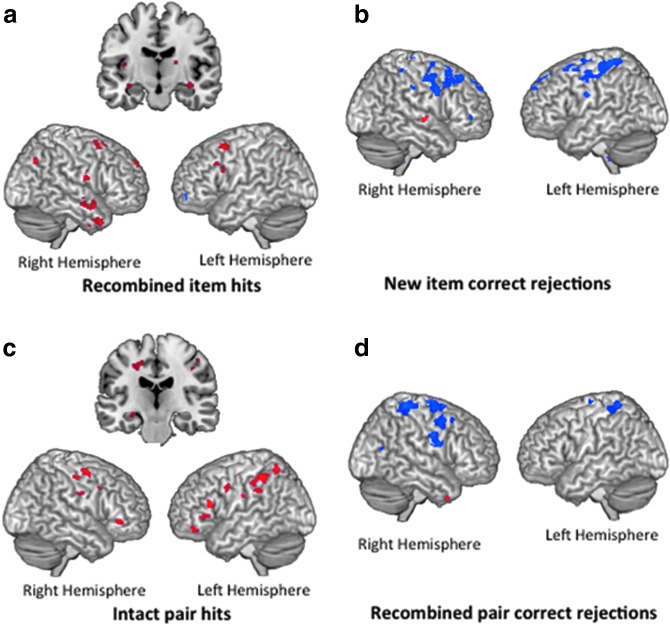
Previous research has demonstrated that sport-related concussions can have short-term effects on cognitive processes, but the long-term consequences are less understood and warrant more research. This study was the first to use event-related functional magnetic resonance imaging (fMRI) to examine long-term differences in neural activity during memory tasks in former athletes who have sustained multiple sport-related concussions. In an event-related fMRI study, former football players reporting multiple sport-related concussions (i.e., three or more) were compared with players who reported fewer than three concussions during a memory paradigm examining item memory (i.e., memory for the particular elements of an event) and relational memory (i.e., memory for the relationships between elements). Behaviorally, we observed that concussion history did not significantly affect behavioral performance, because persons in the low and high concussion groups had equivalent performance on both memory tasks, and in addition, that concussion history was not associated with any behavioral memory measures. Despite demonstrating equivalent behavioral performance, the two groups of former players demonstrated different neural recruitment patterns during relational memory retrieval, suggesting that multiple concussions may be associated with functional inefficiencies in the relational memory network. In addition, the number of previous concussions significantly correlated with functional activity in a number of brain regions, including the medial temporal lobe and inferior parietal lobe. Our results provide important insights in understanding the long-term functional consequences of sustaining multiple sports-related concussions.
Figures
References
-
- Pellman E. J. Powell J.W. Viano D.C. Casson I.R. Tucker A.M. Feuer H. Lovell M. Waeckerkle J.F. Robertson D.W. Concussion in professional football: epidemiological features of game injuries and review of the literature—Part 3. Neurosurgery. 2004;54:81–96. - PubMed
-
- McCrea M. Hammeke T. Olsen G. Leo P. Guskiewicz K. Unreported concussion in high school football players: implications for prevention. Clin. J. Sport Med. 2004;14:13–17. - PubMed
-
- Centers for Disease Control and Prevention, Atlanta. Nonfatal traumatic brain injuries from sports and recreational activities—United States 2001–2005. MMWR Morb. Mortal Wkly. Rep. 2007;56:733–737. - PubMed
-
- Guskiewicz K.M. McCrea M. Marshall S.W. Cantu R.C. Randolph C. Barr W. Onate J.A. Kelly J.P. Cumulative effects associated with recurrent concussion in collegiate football players: the NCAA Concussion Study. JAMA. 2003;290:2549–2555. - PubMed
Publication types
MeSH terms
Grants and funding
LinkOut - more resources
Full Text Sources
Other Literature Sources
Medical
