Meta-Analysis
. 2013 May 16:13:140.
doi: 10.1186/1471-244X-13-140.

Antidepressants in the treatment of depression/depressive symptoms in cancer patients: a systematic review and meta-analysis

Affiliations
Meta-Analysis

Antidepressants in the treatment of depression/depressive symptoms in cancer patients: a systematic review and meta-analysis

Zacharias G Laoutidis et al. BMC Psychiatry. .

Abstract

Background: Over the past thirty years a number of studies have suggested that antidepressants can be effective in the treatment of depressive symptoms in patients with cancer. The aim of this paper was to review randomized controlled trials (RCTs) and to perform a meta-analysis in order to quantify their overall effect.

Methods: Pubmed and the Cochrane libraries were searched for the time period between 1980 and 2010.

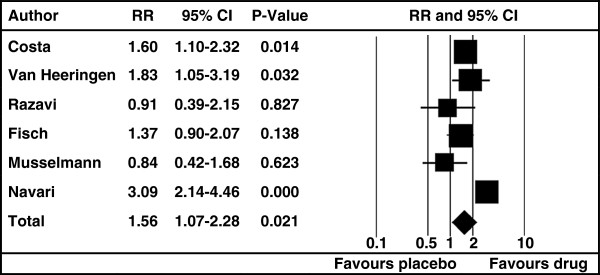
Results: Nine RCTs were identified and reviewed. Six of them (with a total of 563 patients) fulfilled the criteria for meta-analysis, but exhibited an unclear risk for bias. The estimated effect size was 1.56 with 95% CI: 1.07- 2.28 (p= 0.021). There were no differences in discontinuation rates between antidepressants and placebo groups (RR= 0.86 with 95% CI 0.47- 1.56, p=0.62).

Conclusions: This meta-analysis suggests that antidepressants can be effective in treating depressive symptoms beside clinical depression. When considering the risk of side effects and interactions and the heterogeneity among the mostly small studies, a general recommendation cannot be made until well-controlled studies are conducted.


Figures
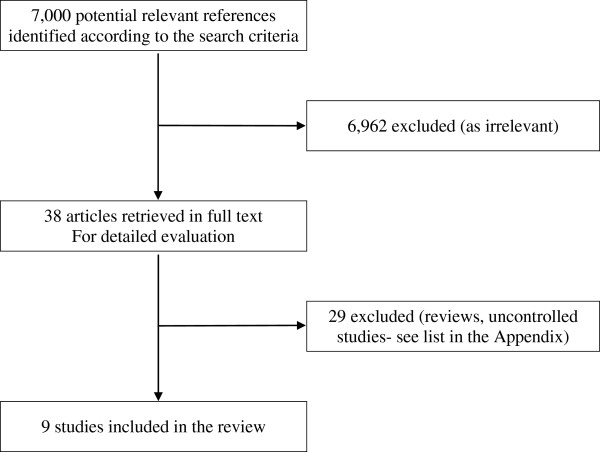
Figure 1
Figure 1
Flow diagram of the study. The electronic searches provided a total of 7000 references from MEDLINE and from the Cochrane Library. After the initial scanning of the abstracts a total of 38 reports remained. These reports were further screened and assessed for eligibility and 29 of them were rejected. The remaining 9 RCTs fulfilled the inclusion criteria for the review and six of them fulfilled the criteria for the meta-analysis.
Figure 2
Figure 2
Forest plot of RR with CI for all studies and overall. The overall effect size in the analysis is RR=1.56 with 95%-CI: 1.07- 2.28 (p=0.021). This means that the effect of antidepressants in this population is significant better than the placebo effect. Four studies found a positive effect of the antidepressants on depressed cancer patients. In two studies the antidepressant was not better than the placebo. The 95%-CIs of these two studies were wider than the ones of the other four studies, which is indicative of low precision. RR: relative risk; CI: confidence intervals.
Figure 3
Figure 3
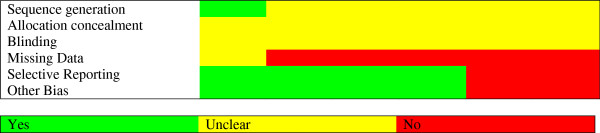
Risk of bias graph. The semaphore colors provide a visual impression of the quality of the study reports for meta-analysis; green: condition is fulfilled; yellow: condition is questionable and; red: condition is not fulfilled and risk of bias is present. The allover quality is unclear and indications for risk of bias can be derived. Therefore the meta-analysis cannot provide a high degree of level of evidence.
Figure 4
Figure 4
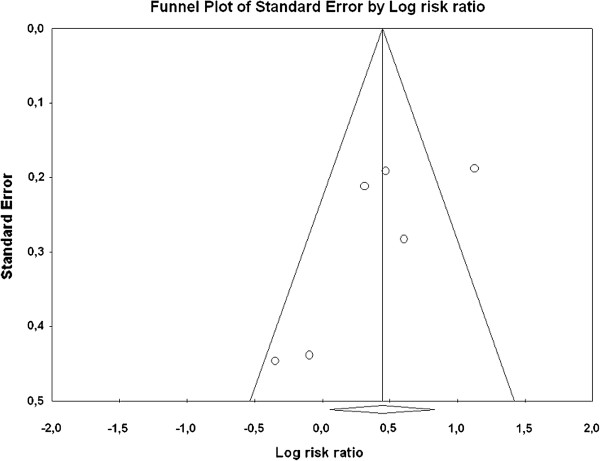
Funnel plot. The funnel plot reveals no gap on the left bottom size as an indicative for selective reporting of positive findings in studies with larger error and few participants. On the contrary there is a gap on the right size towards the bottom. Conceivably this is a random effect because of the small number of studies.
Figure 5
Figure 5
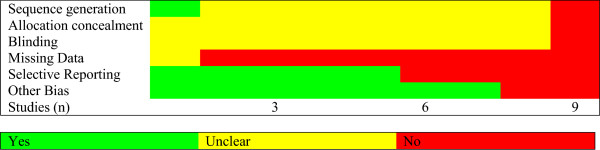
Risk of bias graph for all 9 studies reviewed. Most studies did not describe the methods used to generate and conceal the allocation sequence. All studies were defined as double blind, but the exact blinding method was not described in any of them. No study used an appropriate method to address the issue of missing data. As one can see the studies were relative uniform as far as the issue of risk of bias is concerned.

References

    1. Ruttley A, Reid S. Depression in physical illness. Clin Med. 2006;6:533–536. doi: 10.7861/clinmedicine.6-6-533. - DOI - PMC - PubMed
    1. Kroenke K, Theobald D, Wu J, Loza JK, Carpenter JS, Tu W. The association of depression and pain with health-related quality of life, disability, and health care use in cancer patients. J Pain Symp Manag. 2010;40:327–341. doi: 10.1016/j.jpainsymman.2009.12.023. - DOI - PMC - PubMed
    1. Brown LF, Kroenke K, Theobald D, Wu J, Carpenter JS, Tu W. The association of depression and anxiety with health-related quality of life in cancer patients with depression and/or pain. Psychooncology. 2010;19:734–741. - PMC - PubMed
    1. House A. Mood disorders in the physically ill–problems of definition and measurement. J Psychosom Res. 1988;32:345–353. doi: 10.1016/0022-3999(88)90017-7. - DOI - PubMed
    1. Mitchel AJ, Chan M, Bhatti H, Halton M, Grassi L, Johannen C, Meader N. Prevalence of depression, anxiety, and adjustment disorder in oncological, haematological, and palliative care settings: a meta-analysis of 94 interview-based studies. Lancet Oncol. 2011;12:160–174. doi: 10.1016/S1470-2045(11)70002-X. - DOI - PubMed

Publication types

MeSH terms

Substances