


Neck circumference as an independent predictive contributor to cardio-metabolic syndrome
- PMID: 23680280
- PMCID: PMC3661343
- DOI: 10.1186/1475-2840-12-76
Neck circumference as an independent predictive contributor to cardio-metabolic syndrome
Abstract
Background: The predictive potentials of neck circumference (NC) for cardio-metabolic risks remain uncertain. The aim of this study was to investigate whether NC independently contributes to the prediction of cardio-metabolic risks beyond body mass index (BMI), waist circumference (WC) and waist to hip ratio (WHpR) in a large Chinese population.
Methods: A total of 4201 participants (2508 men and 1693 women) aged 20-85 were recruited from the Health Examination Centre between May 2009 and April 2010, anthropometric indices, biochemical and clinical parameters were measured. Receiver operating characteristic, partial correlation and logistic regression analyses were employed to evaluate the association of the anthropometric indices to cardio-metabolic risks separately by gender.
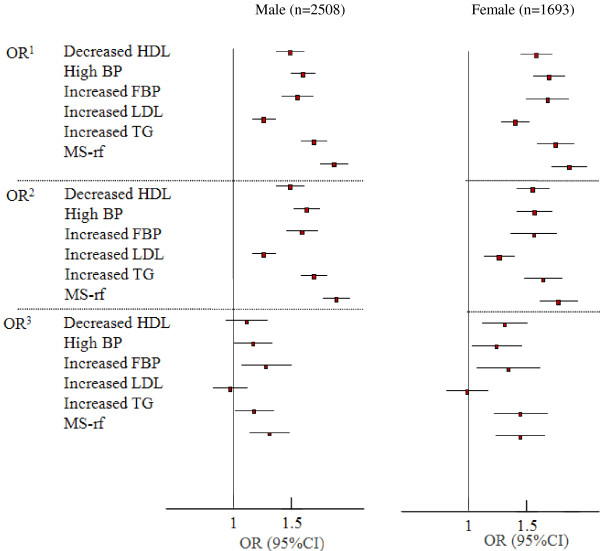
Results: Neck circumference was positively correlated with SBP and DBP (r=0.250 and 0.261), fasting blood glucose (FBP) (r=0.177), TG (r=0.240), TC (r=0.143) and LDL-C (r=0.088) and negatively correlated with HDL-C (r=-0.202) in males (all P<0.01). Similar results were found in females with the exception of TC. The AUCs of NC for metabolic abnormalities ranged from 0.558 (Increased LDL-C) to 0.683 (MS-rf) in men and 0.596 (Increased LDL-C) to 0.703 (MS-rf) in women (P<0.01). The NC of ≥37 cm for men and ≥33 cm for women were the best cut-off points for metabolic syndrome. The adjusted ORs (95% CIs) of NC in men and women respectively were 1.29 (1.12-1.48) and 1.44 (1.20-1.72) for metabolic syndrome risk factors (MS-rf), 1.15 (1.01-1.32) and 1.22 (1.03-1.46) for high BP, 1.16 (1.02-1.33) and 1.42 (1.18-1.71) for increased TG, and 1.26 (1.06-1.50) and 1.32 (1.06-1.65) for increased FBP; the adjusted OR of NC in women for decreased HDL-C was 1.29 (1.10-1.51).
Conclusions: Neck circumference was significantly associated with cardio-metabolic risk factors and independently contributed to the prediction of cardio-metabolic risks beyond the classical anthropometric indices in adults of China.
Figures
References
-
- Alberti KGMM, Zimmet P, Shaw J. Metabolic syndrome–a new world-wide definition. A consensus statement from the International Diabetes Federation. Diabet Med. 2006;23:469–480. - PubMed
-
- Vague J. The degree of masculine differentiation of obesities: A factor determining predisposition to diabetes, atherosclerosis, gout, and uric calculous disease. Am J Clin Nutr. 1956;4:20–34. - PubMed
Publication types
MeSH terms
Substances
LinkOut - more resources
Full Text Sources
Other Literature Sources
Medical
Miscellaneous
