


Deubiquitinases in skeletal muscle atrophy
- PMID: 23680672
- PMCID: PMC5734930
- DOI: 10.1016/j.biocel.2013.05.002
Deubiquitinases in skeletal muscle atrophy
Abstract
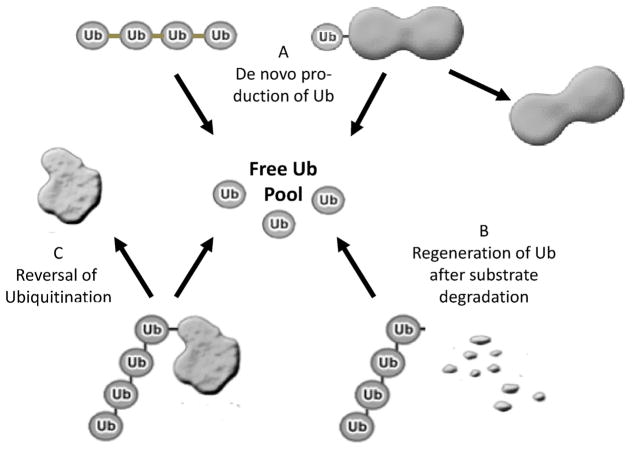
The ubiquitin proteasome system plays a critical role in skeletal muscle atrophy. A large body of research has revealed that many ubiquitin ligases are induced and play an important role in mediating the wasting. However, relatively little is known about the roles of deubiquitinases in this process. Although it might be expected that deubiquitinases would be downregulated in atrophying muscles to promote ubiquitination and degradation of muscle proteins, this has not to date been demonstrated. Instead several deubiquitinases are induced in atrophying muscle, in particular USP19 and USP14. USP19, USP2 and A20 are also implicated in myogenesis. USP19 has been most studied to date. Its expression is increased in both systemic and disuse forms of atrophy and can be regulated through a p38 MAP kinase signaling pathway. In cultured muscle cells, it decreases the expression of myofibrillar proteins by apparently suppressing their transcription indicating that the ubiquitin proteasome system may be activated in skeletal muscle to not only increase protein degradation, but also to suppress protein synthesis. Deubiquitinases may be upregulated in atrophy in order to maintain the pool of free ubiquitin required for the increased overall conjugation and degradation of muscle proteins as well as to regulate the stability and function of proteins that are essential in mediating the wasting. Although deubiquitinases are not well studied, these early insights indicate that some of these enzymes play important roles and may be therapeutic targets for the prevention and treatment of muscle atrophy. This article is part of a Directed Issue entitled: Molecular basis of muscle wasting.
Keywords: Cachexia; Deubiquitination; Myofibrillar proteins; Skeletal muscle; Ubiquitin.
Copyright © 2013 Elsevier Ltd. All rights reserved.
Figures
References
-
- Adegoke OA, Bedard N, Roest HP, Wing SS. Ubiquitin-conjugating enzyme E214k/HR6B is dispensable for increased protein catabolism in muscle of fasted mice. American Journal of Physiology Endocrinology and Metabolism. 2002;283:E482–9. - PubMed
-
- Bodine SC, Latres E, Baumhueter S, Lai VK, Nunez L, Clarke BA, et al. Identification of ubiquitin ligases required for skeletal muscle atrophy. Science. 2001;294:1704–8. - PubMed
-
- Burnett B, Li F, Pittman RN. The polyglutamine neurodegenerative protein ataxin-3 binds polyubiquitylated proteins and has ubiquitin protease activity. Human Molecular Genetics. 2003;12:3195–205. - PubMed
Publication types
MeSH terms
Substances
Grants and funding
LinkOut - more resources
Full Text Sources
Other Literature Sources
