Review
. 2013;16(2):69-113.
doi: 10.1080/10937404.2013.775048.

Environmental contaminant exposures and preterm birth: a comprehensive review

Affiliations
Review

Environmental contaminant exposures and preterm birth: a comprehensive review

Kelly K Ferguson et al. J Toxicol Environ Health B Crit Rev. 2013.

Abstract

Preterm birth is a significant public health concern, as it is associated with high risk of infant mortality, various morbidities in both the neonatal period and later in life, and a significant societal economic burden. As many cases are of unknown etiology, identification of the contribution of environmental contaminant exposures is a priority in the study of preterm birth. This is a comprehensive review of all known studies published from 1992 through August 2012 linking maternal exposure to environmental chemicals during pregnancy with preterm birth. Using PubMed searches, studies were identified that examined associations between preterm birth and exposure to five categories of environmental toxicants, including persistent organic pollutants, drinking-water contaminants, atmospheric pollutants, metals and metalloids, and other environmental contaminants. Individual studies were summarized and specific suggestions were made for future work in regard to exposure and outcome assessment methods as well as study design, with the recommendation of focusing on potential mediating toxicological mechanisms. In conclusion, no consistent evidence was found for positive associations between individual chemical exposures and preterm birth. By identifying limitations and addressing the gaps that may have impeded the ability to identify true associations thus far, this review can guide future epidemiologic studies of environmental exposures and preterm birth.


Figures
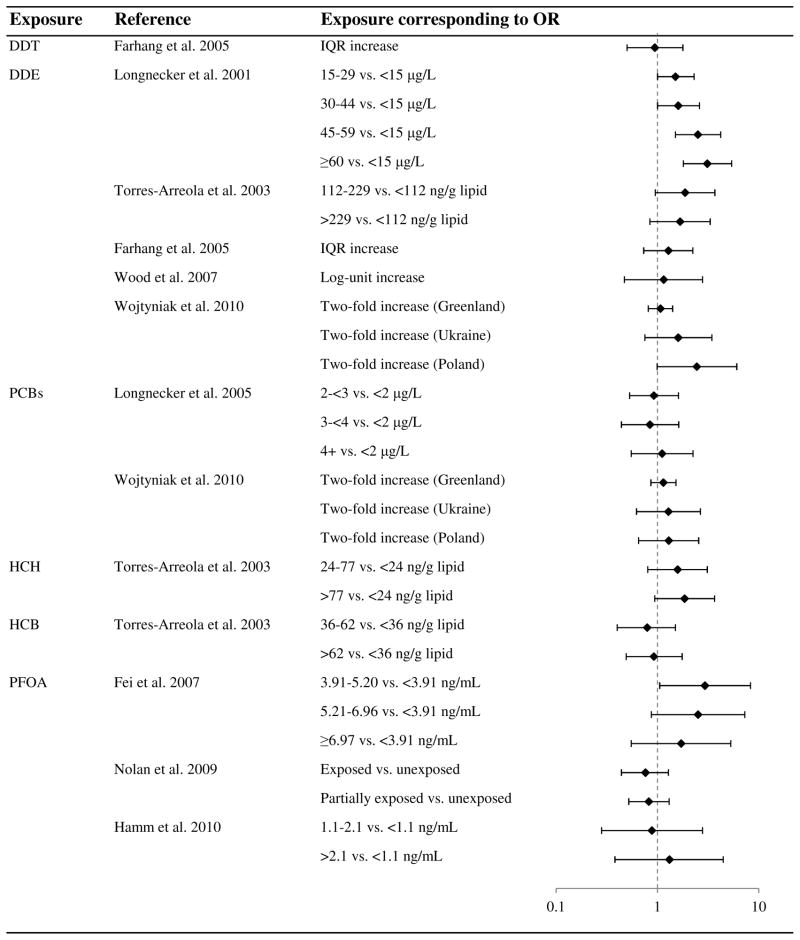
Figure 1
Figure 1
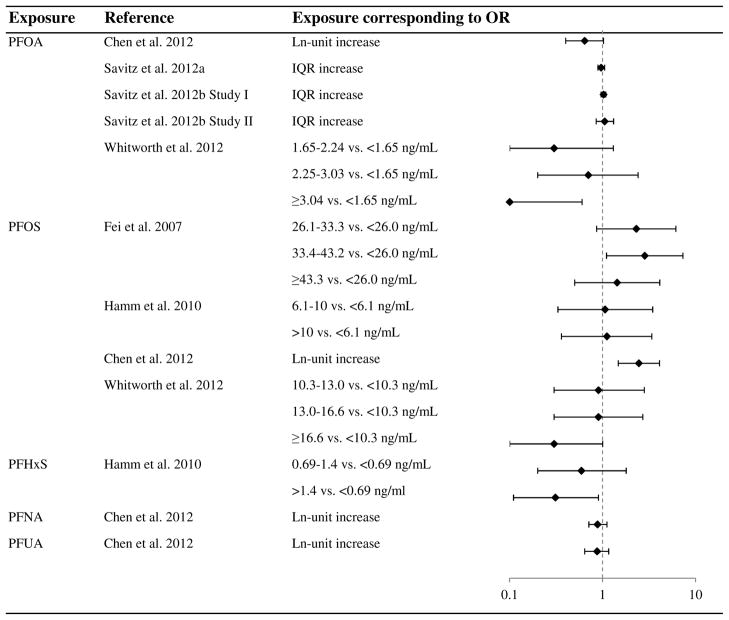
Odds ratios and 95% confidence intervals for studies of persistent organic pollutants in relation to preterm birth Note. Adjusted odds ratios are presented where available. Results for Hamm et al. 2010 are risk ratios. For Longnecker et al. 2005 OR are for summed PCB. For Wojtyniak et al. 2010 OR are for PCB-153. Abbreviations: Dichlorodiphenyltrichloroethane (DDT); dichlorodiphenyldichloroethylene (DDE); polychlorinated biphenyls (PCBs); hexachlorobenzene (HCB); hexachlorohexane (HCH); perfluorooctanoic acid (PFOA); perfluorooctane sulfonic acid (PFOS); perfluorohexane sulfonate (PFHxS); perfluorononanoic acid (PFNA); perfluoroundecanoic acid (PFUA); interquartile range (IQR).
Figure 1
Figure 1
Odds ratios and 95% confidence intervals for studies of persistent organic pollutants in relation to preterm birth Note. Adjusted odds ratios are presented where available. Results for Hamm et al. 2010 are risk ratios. For Longnecker et al. 2005 OR are for summed PCB. For Wojtyniak et al. 2010 OR are for PCB-153. Abbreviations: Dichlorodiphenyltrichloroethane (DDT); dichlorodiphenyldichloroethylene (DDE); polychlorinated biphenyls (PCBs); hexachlorobenzene (HCB); hexachlorohexane (HCH); perfluorooctanoic acid (PFOA); perfluorooctane sulfonic acid (PFOS); perfluorohexane sulfonate (PFHxS); perfluorononanoic acid (PFNA); perfluoroundecanoic acid (PFUA); interquartile range (IQR).
Figure 2
Figure 2
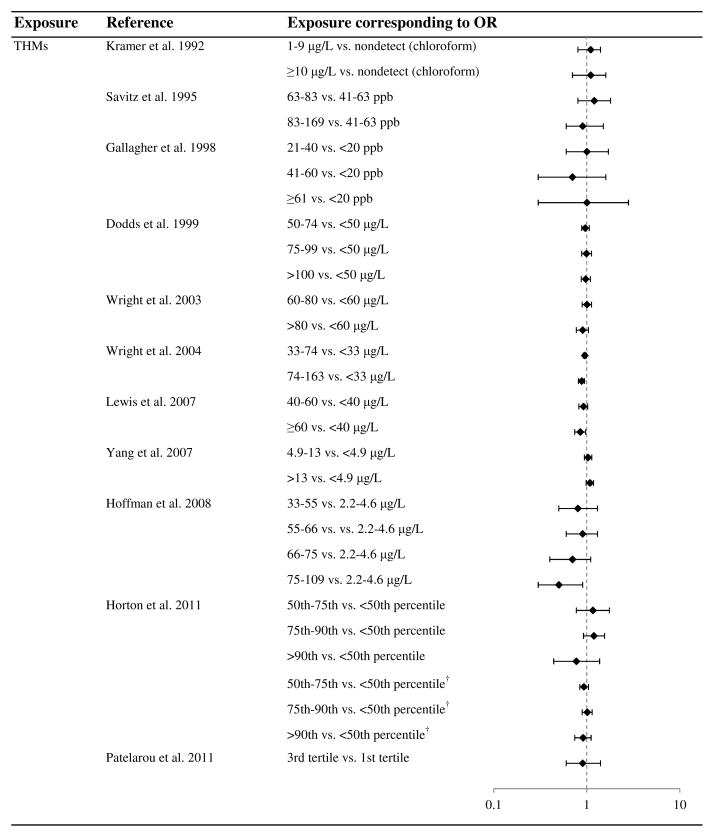
Odds ratios and 95% confidence intervals for studies of drinking water contaminants in relation to preterm birth Note. Adjusted odds ratios are presented where available. Results for Dodds et al. (1999), Hoffman et al. (2008), and Forand et al. (2011) are risk ratios. Results for Lewis et al. (2007) are hazard ratios. Results for Horton et al. 2011 are presented for both brominated and chlorinated (†) contamination sites. When OR were given for more than one window of exposure, average exposure across duration of pregnancy was preferentially presented. Abbreviations: Trihalomethanes (THMs); haloacetic acids (HAAs); trichloroacetic acid (TCAA); total organic halides (TOX); trichloroethylene (TCE); tetrachloroethylene (PCE).
Figure 2
Figure 2
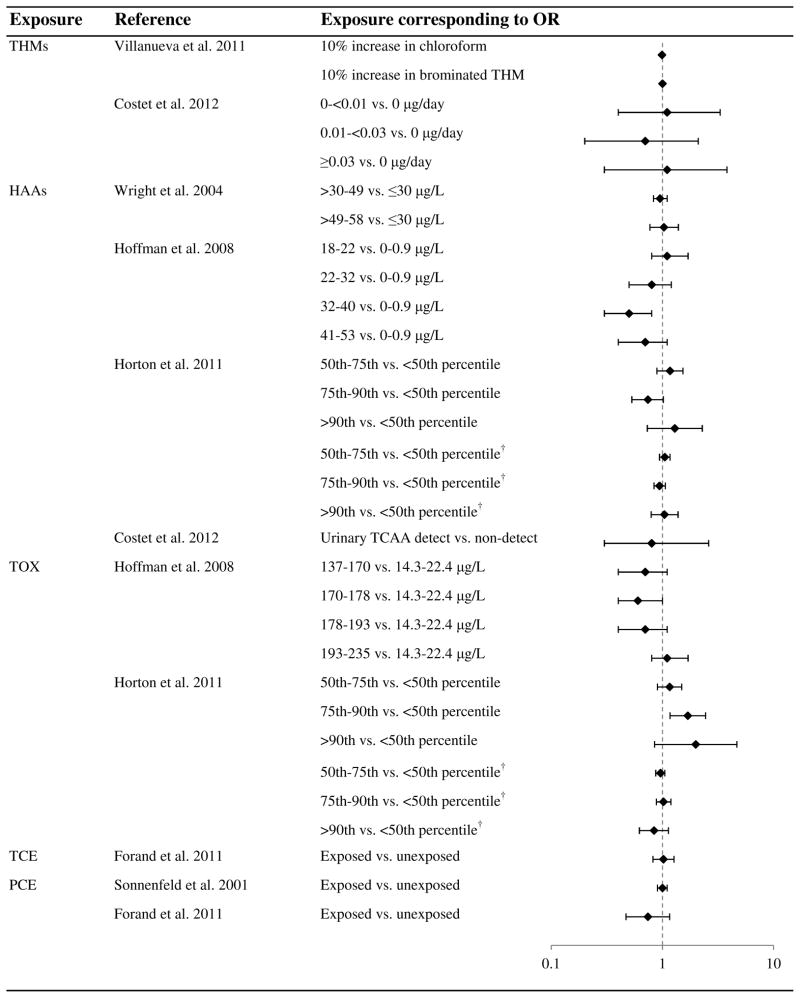
Odds ratios and 95% confidence intervals for studies of drinking water contaminants in relation to preterm birth Note. Adjusted odds ratios are presented where available. Results for Dodds et al. (1999), Hoffman et al. (2008), and Forand et al. (2011) are risk ratios. Results for Lewis et al. (2007) are hazard ratios. Results for Horton et al. 2011 are presented for both brominated and chlorinated (†) contamination sites. When OR were given for more than one window of exposure, average exposure across duration of pregnancy was preferentially presented. Abbreviations: Trihalomethanes (THMs); haloacetic acids (HAAs); trichloroacetic acid (TCAA); total organic halides (TOX); trichloroethylene (TCE); tetrachloroethylene (PCE).
Figure 3
Figure 3
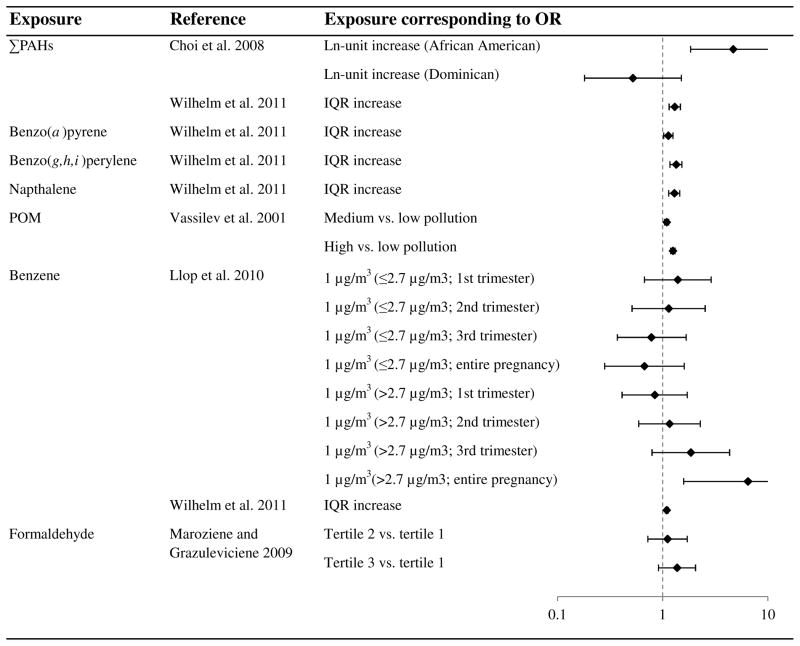
Odds ratios and 95% confidence intervals for studies of atmospheric pollutants in relation to preterm birth Note. Abbreviations: Polycyclic aromatic hydrocarbons (PAHs);interquartile range (IQR).
Figure 4
Figure 4
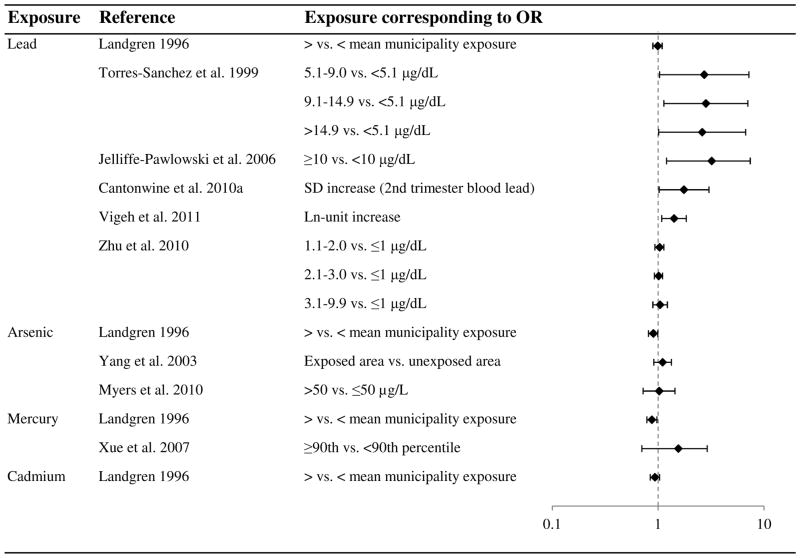
Odds ratios and 95% confidence intervals for studies of metals and metalloids in relation to preterm birth
Figure 5
Figure 5
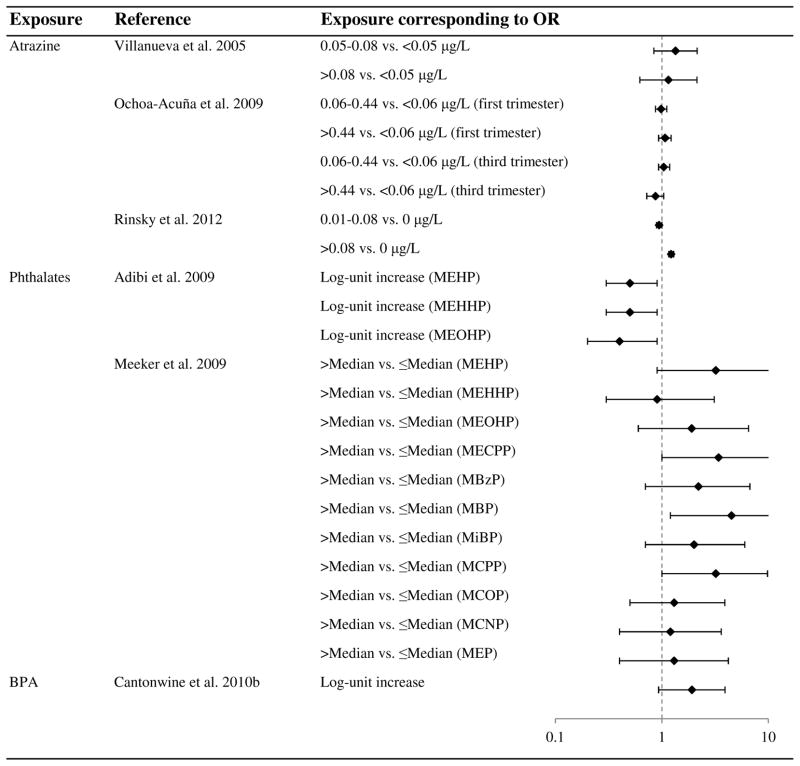
Odds ratios and 95% confidence intervals for other environmental contaminants in relation to preterm birth Note. Adjusted odds ratios are presented where available. Abbreviations: Mono(2-ethylhexyl) phthalate (MEHP); mono(2-ethyl-5-hydroxyhexyl) phthalate (MEHHP); mono(2-ethyl-5-oxohexyl) phthalate (MEOHP); mono(2-ethyl-5-carboxypentyl) phthalate (MECPP); monobenzyl phthalate (MBzP); mono-n -butyl phthalate (MBP); mono-isobutyl phthalate (MiBP); mono(3-carboxypropyl) phthalate (MCPP); monocarboxyisooctyl phthalate (MCOP); monocarboxyisononyl phthalate (MCNP); monoethyl phthalate (MEP); bisphenol-A (BPA).

References

    1. Adibi JJ, Hauser R, Williams PL, Whyatt RM, Calafat AM, Nelson H, Herrick R, Swan SH. Maternal urinary metabolites of di-(2-ethylhexyl) phthalate in relation to the timing of labor in a US multicenter pregnancy cohort study. Am J Epidemiol. 2009;169:1015–1024. - PMC - PubMed
    1. Aggazzotti G, Righi E, Fantuzzi G, Biasotti B, Ravera G, Kanitz S, Barbone F, Sansebastiano G, Battaglia MA, Leoni V, Fabiani L, Triassi M, Sciacca S. Chlorination by-products (CBPs) in drinking water and adverse pregnancy outcomes in Italy. J Water Health. 2004;2:233–247. - PubMed
    1. Ahmad SA, Sayed MH, Barua S, Khan MH, Faruquee MH, Jalil A, Hadi SA, Talukder HK. Arsenic in drinking water and pregnancy outcomes. Environ Health Persp. 2001;109:629–631. - PMC - PubMed
    1. Andrews KW, Savitz DA, Hertz-Picciotto I. Prenatal lead exposure in relation to gestational age and birth weight: a review of epidemiologic studies. Am J Ind Med. 1994;26:13–32. - PubMed
    1. Apelberg BJ, Witter FR, Herbstman JB, Calafat AM, Halden RU, Needham LL, Goldman LR. Cord serum concentrations of perfluorooctane sulfonate (PFOS) and perfluorooctanoate (PFOA) in relation to weight and size at birth. Environ Health Perspect. 2007;115:1670–1676. - PMC - PubMed

Publication types

MeSH terms

LinkOut - more resources