


The impact of high-deductible health plans on men and women: an analysis of emergency department care
- PMID: 23685403
- PMCID: PMC4012427
- DOI: 10.1097/MLR.0b013e31829742d0
The impact of high-deductible health plans on men and women: an analysis of emergency department care
Abstract
Background: Prior studies show that men are more likely than women to defer essential care. Enrollment in high-deductible health plans (HDHPs) could exacerbate this tendency, but sex-specific responses to HDHPs have not been assessed. We measured the impact of an HDHP separately for men and women.
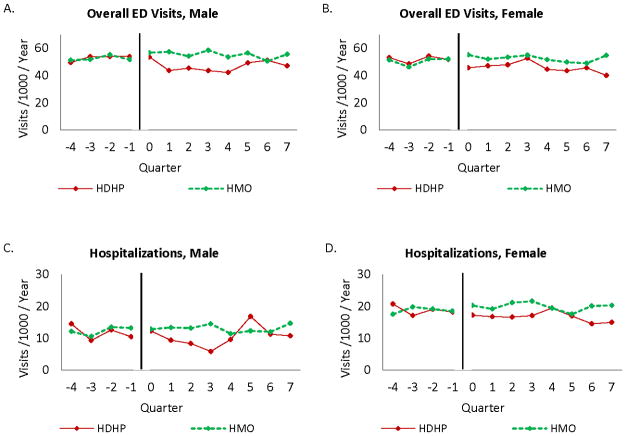
Methods: Controlled longitudinal difference-in-differences analysis of low, intermediate, and high severity emergency department (ED) visits and hospitalizations among 6007 men and 6530 women for 1 year before and up to 2 years after their employers mandated a switch from a traditional health maintenance organization plan to an HDHP, compared with contemporaneous controls (18,433 men and 19,178 women) who remained in an health maintenance organization plan.
Results: In the year following transition to an HDHP, men substantially reduced ED visits at all severity levels relative to controls (changes in low, intermediate, and high severity visits of -21.5% [-37.9 to -5.2], -21.6% [-37.4 to -5.7], and -34.4% [-62.1 to -6.7], respectively). Female HDHP members selectively reduced low severity emergency visits (-26.9% [-40.8 to -13.0]) while preserving intermediate and high severity visits. Male HDHP members also experienced a 24.2% [-45.3 to -3.1] relative decline in hospitalizations in year 1, followed by a 30.1% [2.1 to 58.1] relative increase in hospitalizations between years 1 and 2.
Conclusions: Initial across-the-board reductions in ED and hospital care followed by increased hospitalizations imply that men may have foregone needed care following an HDHP transition. Clinicians caring for patients with HDHPs should be aware of sex differences in response to benefit design.
Figures
Comment in
-
Health care utilization differences between women and men after employers switch to high-deductible plans: a cause for concern?Med Care. 2013 Aug;51(8):637-8. doi: 10.1097/MLR.0b013e3182a1e90f. Med Care. 2013. PMID: 23857433 No abstract available.
References
-
- Claxton G, Rae M, Panchal N, et al. Health Benefits in 2012: Moderate premium increases for employer-sponsored plans; young adults gained coverage under ACA. Health Aff. 2012 doi:1-.1377/hlthaff.2012.0708 published online ahead of print. - PubMed
-
- Kaiser Family Foundation and Health Research and Education Trust. Employee Health Benefits Survey 2012. Washington, DC: 2012. [Accessed December 13, 2012.]. Available at: http://ehbs.kff.org/
-
- Yoo H. January 2011 Census Shows 11.4 Million People Covered by Health Savings Account/High-Deductible Health Plans (HSA/HDHPs) Washington, DC: America’s Health Insurance Plans, Center for Policy and Research; 2012.
-
- National Conference of State Legislatures (NCSL) [Accessed December 13, 2012.];State Health Insurance Mandates and the PPACA Essential Benefits Provisions. 2012 Available at: http://www.ncsl.org/issues-research/health/state-ins-mandates-and-aca-es....
-
- Herzlinger RE. Let’s put consumers in charge of health care. Harv Bus Rev. 2002;80(7):44–50. - PubMed
Publication types
MeSH terms
Grants and funding
LinkOut - more resources
Full Text Sources
Other Literature Sources
Medical
