


Performance of anti-cyclic citrullinated Peptide assays differs in subjects at increased risk of rheumatoid arthritis and subjects with established disease
- PMID: 23686569
- PMCID: PMC3776020
- DOI: 10.1002/art.38017
Performance of anti-cyclic citrullinated Peptide assays differs in subjects at increased risk of rheumatoid arthritis and subjects with established disease
Abstract
Objective: To compare the diagnostic accuracy and agreement of commonly available assays for anti-citrullinated protein antibodies in patients with established rheumatoid arthritis (RA) and subjects at increased risk of RA.
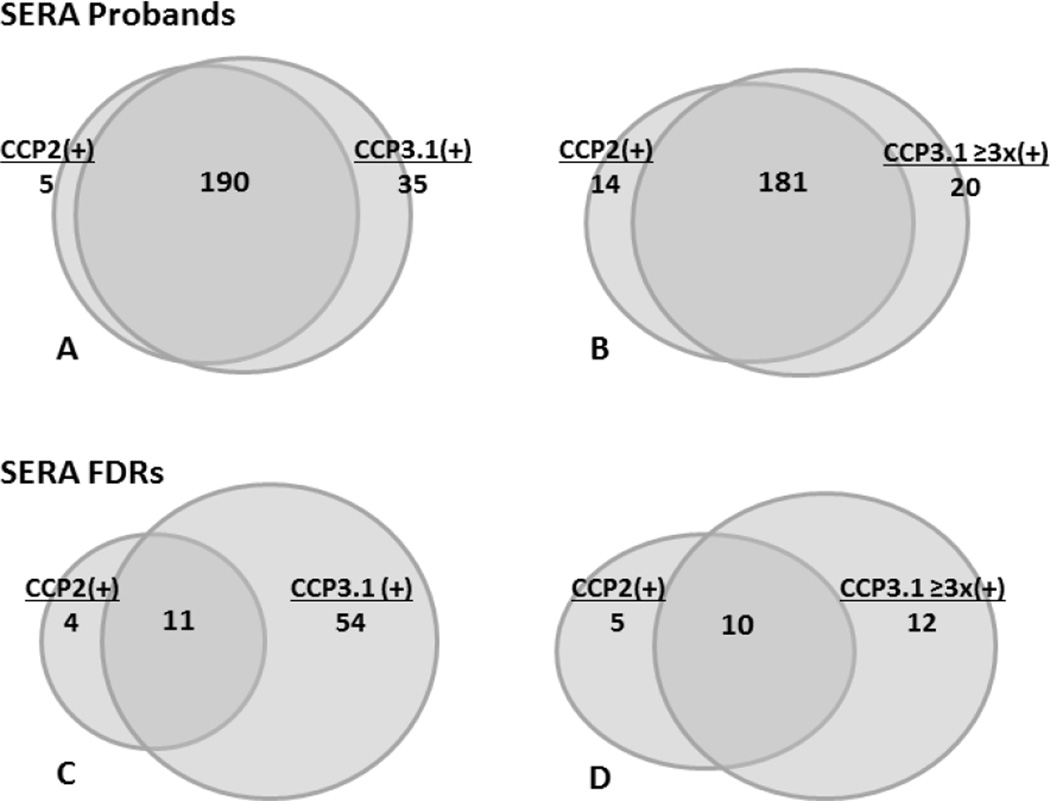
Methods: Tests for anti-cyclic citrullinated peptide (anti-CCP) antibodies were performed using CCP2 IgG and CCP3.1 IgA/IgG enzyme-linked immunosorbent assays in the following groups: probands with established RA (n = 340) from the Studies of the Etiology of Rheumatoid Arthritis (SERA) cohort and their first-degree relatives (FDRs) without inflammatory arthritis (n = 681), Department of Defense Serum Repository (DoDSR) RA cases with pre-RA diagnosis samples (n = 83; 47 cases also had post-RA diagnosis samples), and blood donor and DoDSR control subjects (n = 283).
Results: In patients with established RA, the CCP2 assay was more specific (99.2% versus 93.1%; P < 0.01) but less sensitive (58.7% versus 67.4%; P = 0.01) than the CCP3.1 assay; the specificity of the CCP3.1 assay increased to 97.2% when cutoff levels ≥3-fold the standard level were considered. In all subjects, CCP3.1 assay positivity (using standard cutoff levels) was more prevalent. Among DoDSR cases, the CCP2 assay was more specific than the CCP3.1 for predicting a future diagnosis of RA, and higher CCP levels trended toward increasing specificity for the development of RA within 2 years. At standard cutoff levels, assay agreement was good in patients with established RA (κ = 0.76) but poor in FDRs without inflammatory arthritis (κ = 0.25).
Conclusion: Anti-CCP assays differ to an extent that may be meaningful for diagnosing RA in patients with inflammatory arthritis and evaluating the natural history of RA development in subjects at risk of RA. The mechanisms underlying these differences in test performance need further investigation.
Copyright © 2013 by the American College of Rheumatology.
Figures
References
-
- Whiting PF, Smidt N, Sterne JA, et al. Systematic review: accuracy of anti-citrullinated Peptide antibodies for diagnosing rheumatoid arthritis. Ann Intern Med. 2010;152:456–464. W155-66. - PubMed
-
- Nielen MM, van Schaardenburg D, Reesink HW, et al. Specific autoantibodies precede the symptoms of rheumatoid arthritis: a study of serial measurements in blood donors. Arthritis Rheum. 2004;50:380–386. - PubMed
-
- Rantapaa-Dahlqvist S, de Jong BA, Berglin E, et al. Antibodies against cyclic citrullinated peptide and IgA rheumatoid factor predict the development of rheumatoid arthritis. Arthritis Rheum. 2003;48:2741–2749. - PubMed
Publication types
MeSH terms
Substances
Grants and funding
LinkOut - more resources
Full Text Sources
Other Literature Sources
Medical
Miscellaneous
