Review
. 2013 Jul;10(3):486-97.
doi: 10.1007/s13311-013-0194-5.

Antisense oligonucleotides: treating neurodegeneration at the level of RNA

Affiliations
Review

Antisense oligonucleotides: treating neurodegeneration at the level of RNA

Sarah L DeVos et al. Neurotherapeutics. 2013 Jul.

Abstract

Adequate therapies are lacking for Alzheimer's disease, Parkinson's disease, Huntington's disease, amyotrophic lateral sclerosis, and other neurodegenerative diseases. The ability to use antisense oligonucleotides (ASOs) to target disease-associated genes by means of RNA may offer a potent approach for the treatment of these, and other, neurodegenerative disorders. In modifying the basic backbone chemistry, chemical groups, and target sequence, ASOs can act through numerous mechanisms to decrease or increase total protein levels, preferentially shift splicing patterns, and inhibit microRNAs, all at the level of the RNA molecule. Here, we discuss many of the more commonly used ASO chemistries, as well as the different mechanisms of action that can result from these specific chemical modifications. When applied to multiple neurodegenerative mouse models, ASOs that specifically target the detrimental transgenes have been shown to rescue disease associated phenotypes in vivo. These supporting mouse model data have moved the ASOs from the bench to the clinic, with two neuro-focused human clinical trials now underway and several more being proposed. Although still early in development, translating ASOs into human patients for neurodegeneration appears promising.


Figures
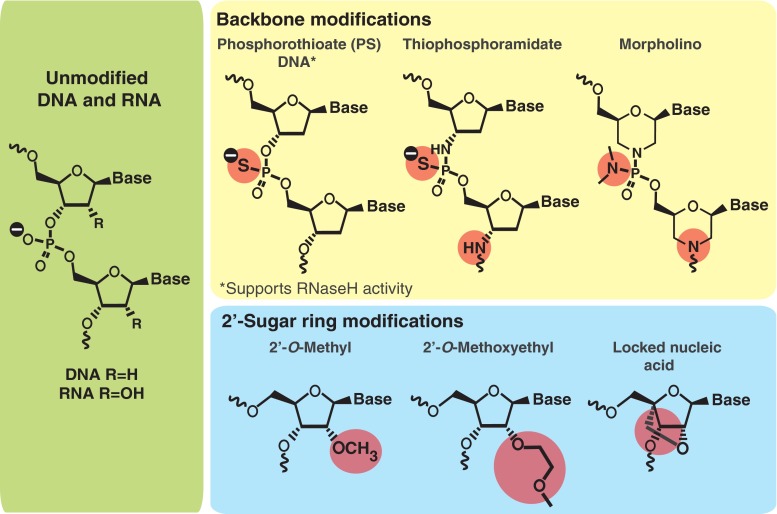
Fig. 1
Fig. 1
Antisense oligonucleotide (ASO) chemical structures. Schematic of unmodified DNA/RNA base pair (left). Different backbone modifications that can be applied (top row) and different 2’-sugar modifications that can be used (bottom row) to increase nuclease resistance and RNA binding affinity of the ASO. Deviations from the original unmodified DNA/RNA are highlighted by circles
Fig. 2
Fig. 2
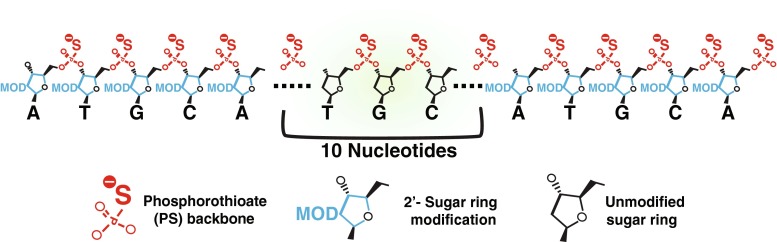
Antisense oligonucleotide (ASO) ‘gapmer’ design. Example of a 20-base pair ASO that would be designed to support RNaseH activity. The phosphorothioate backbone is used along the entire length of the ASO to provide nuclease resistance, while the 2’-sugar modification is used exclusively on the first and last 5 nucleotides, leaving the middle 10 nucleotides unmodified at the 2’-sugar position. This provides increased target RNA binding affinity on the outer portions of the ASO, while still allowing RNaseH cleavage at the central region of the ASO
Fig. 3
Fig. 3
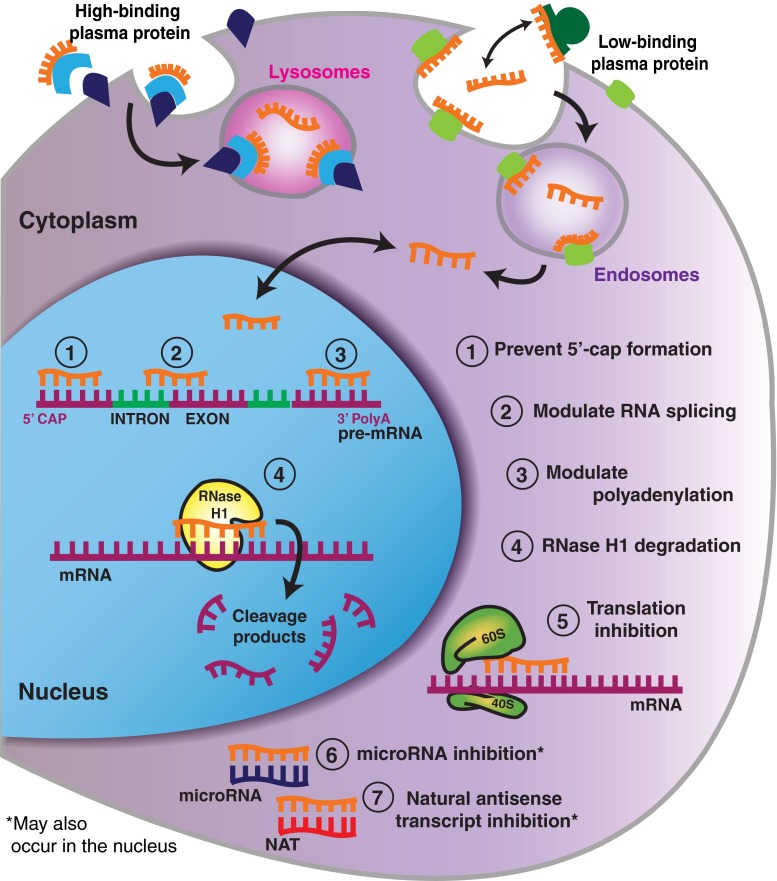
Antisense oligonucleotide (ASO) mechanisms of action. ASOs have been proposed to enter into cells through high- and low-binding plasma protein receptors on the cell surface, resulting in ASO compartmentalization into lysosomes and endosomes [58]. Through a largely unknown mechanism, ASOs are released from the vesicles into the cytoplasm where they can freely move in and out of the nucleus [24, 60]. Upon entry into the nucleus, ASOs can bind directly to mRNA structures and prevent the formation of the 5’-mRNA cap (1), modulate alternative splicing (2), dictate the location of the polyadenylation site (3), and recruit RNaseH1 to induce cleavage (4). ASOs in the cytoplasm can bind directly to the target mRNA and sterically block the ribosomal subunits from attaching and/or running along the mRNA transcript during translation (5). ASOs can also be designed to directly bind to microRNA (miRNA) sequences (6) and natural antisense transcripts (NATs) (7), thereby prohibiting miRNAs and NATs from inhibiting their own specific mRNA targets. Ultimately, this leads to gene upregulation of the miRNA and NAT targets
Fig. 4
Fig. 4
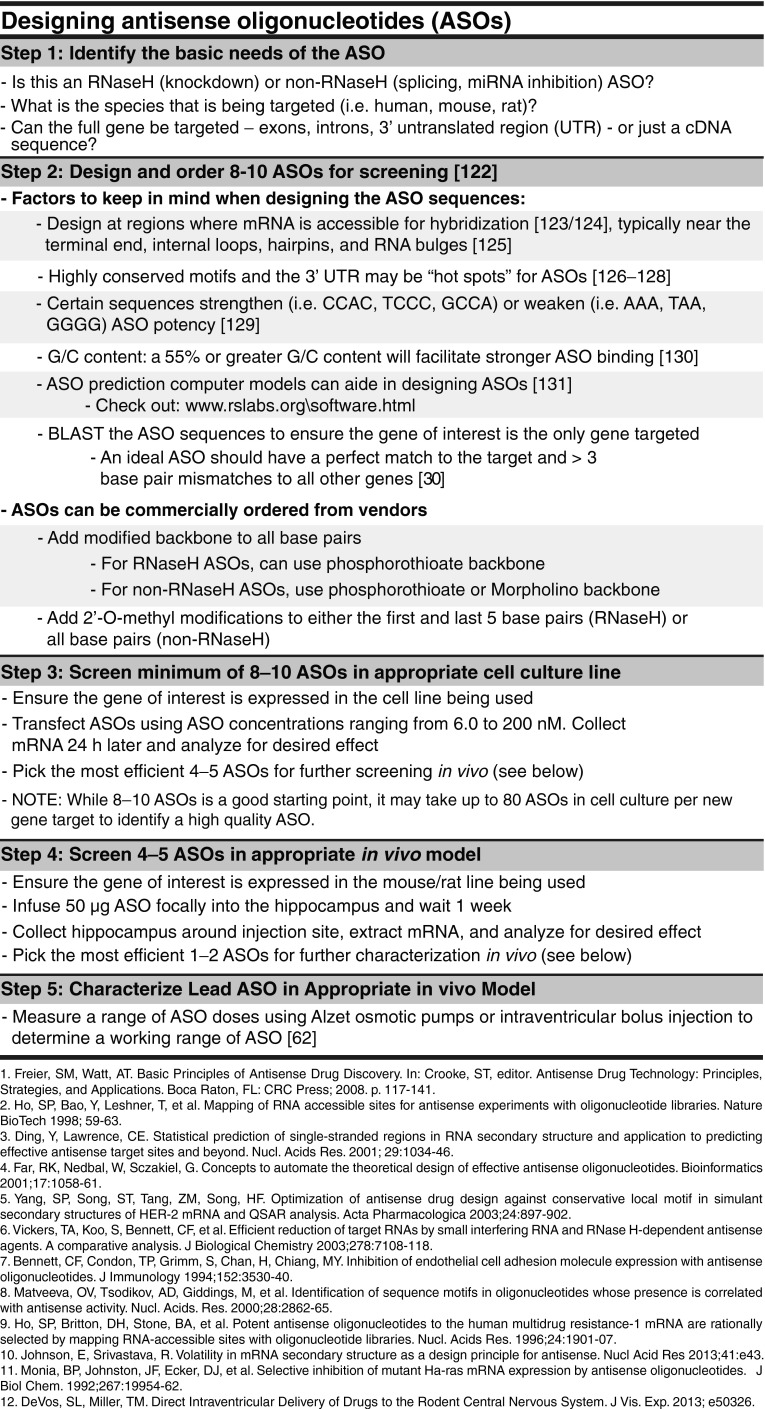
Designing antisense oligonucleotides (ASOs). Designing ASOs for a new genetic target from scratch can be an overwhelming task. However, there are certain guidelines that can be taken into account that can increase the chances of generating a successful ASO. Certain ASO characteristics need to be first identified (Step 1) and then specific ASO sequences can be generated using the listed guidelines as a starting point (Step 2). ASOs should first be screened in vitro (Step 3) and then the most successful ASOs can be moved forward for in vivo screening, both in the brain parenchyma (Step 4) and through intraventricular delivery (Step 5). These steps do not guarantee success as there are many exceptions to the guidelines when designing ASOs. Instead, this figure provides a starting guide for designing basic ASO sequences that can be translated to the central nervous system of in vivo rodent models

References

    1. Eckstein F. Phosphorothioate oligodeoxynucleotides: what is their origin and what is unique about them? Antisense Nucleic Acid Drug Dev. 2000;10:117–121. - PubMed
    1. Stein CA, Subasinghe C, Shinozuka K, Cohen JS. Physicochemical properties of phosphorothioate oligodeoxynucleotides. Nucleic Acids Res. 1988;16:3209–3221. - PMC - PubMed
    1. Cerritelli SM, Crouch RJ. Ribonuclease H: the enzymes in eukaryotes. FEBS J. 2009;276:1494–1505. - PMC - PubMed
    1. Brown D, Kang S, Gryaznov S, DeDionisio L, Heidenreich O, Sullivan S, et al. Effect of phosphorothioate modification of oligodeoxynucleotides on specific protein binding. J Biol Chem. 1994;269:26801–26805. - PubMed
    1. Gryaznov S, Skorski T, Cucco C, Nieborowska-Skorska M, Chiu CY, Lloyd D, et al. Oligonucleotide N3’-- > P5’ phosphoramidates as antisense agents. Nucleic Acids Res. 1996;24:1508–1514. - PMC - PubMed

Publication types

MeSH terms