


Low cerebral blood flow is associated with lower memory function in metabolic syndrome
- PMID: 23687103
- PMCID: PMC3742665
- DOI: 10.1002/oby.20170
Low cerebral blood flow is associated with lower memory function in metabolic syndrome
Abstract
Background: Metabolic syndrome (MetS)--a cluster of cardiovascular risk factors--is linked with cognitive decline and dementia. However, the brain changes underlying this link are presently unknown. In this study, we tested the relationship between MetS, cerebral blood flow (CBF), white matter hyperintensity burden, and gray matter (GM) volume in cognitively healthy late middle-aged adults. Additionally, the extent to which MetS was associated with cognitive performance was assessed.
Design and methods: Late middle-aged adults from the Wisconsin Registry for Alzheimer's Prevention (N = 69, mean age = 60.4 years) underwent a fasting blood draw, arterial spin labeling perfusion MRI, T1-weighted MRI, T2FLAIR MRI, and neuropsychological testing. MetS was defined as abnormalities on three or more factors, including abdominal obesity, triglycerides, HDL-cholesterol, blood pressure, and fasting glucose.
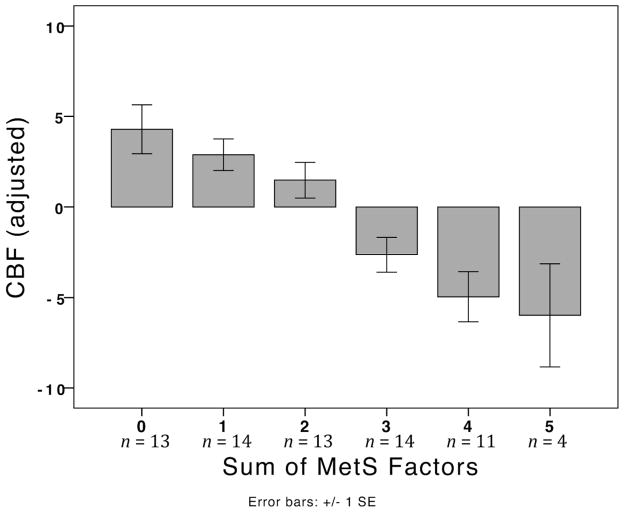
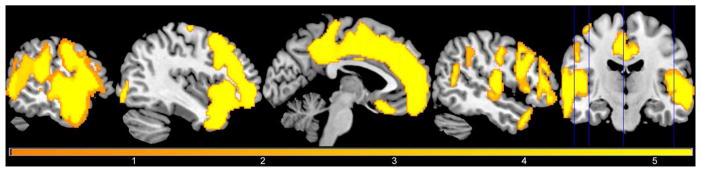
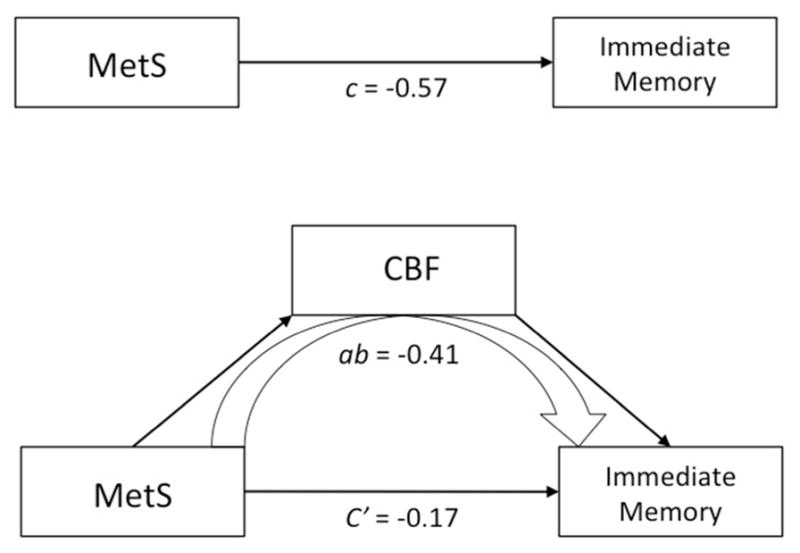
Results: Mean GM CBF was 15% lower in MetS compared to controls. Voxel-wise image analysis indicated that the MetS group had lower CBF across a large portion of the cortical surface, with the exception of medial and inferior parts of the occipital and temporal lobes. The MetS group also had lower immediate memory function; a mediation analysis indicated this relationship was partially mediated by CBF. Among the MetS factors, abdominal obesity and elevated triglycerides were most strongly associated with lower CBF.
Conclusions: The results underscore the importance of reducing the number of cardiovascular risk factors for maintaining CBF and cognition in an aging population.
Copyright © 2012 The Obesity Society.
Figures
References
-
- Alberti KG, Eckel RH, Grundy SM, et al. Harmonizing the metabolic syndrome: a joint interim statement of the International Diabetes Federation Task Force on Epidemiology and Prevention; National Heart, Lung, and Blood Institute; American Heart Association; World Heart Federation; International Atherosclerosis Society; and International Association for the Study of Obesity. Circulation. 2009;120:1640–5. - PubMed
-
- Ervin RB. National health statistics reports; no 13. National Center for Health Statistics; Hyattsville, MD: 2009. Prevalence of metabolic syndrome among adults 20 years of age and over, by sex, age, race and ethnicity, and body mass index: United States, 2003–2006. 2009. - PubMed
-
- Centers for Disease Control and Prevention and The Merck Company Foundation. The State of Aging and Health in America, 2007. The Merck Company Foundation; Whitehouse Station, N.J: 2007.
-
- Kivipelto M, Ngandu T, Laatikainen T, Winblad B, Soininen H, Tuomilehto J. Risk score for the prediction of dementia risk in 20 years among middle aged people: a longitudinal, population-based study. Lancet Neurol. 2006;5:735–41. - PubMed
-
- Vanhanen M, Koivisto K, Moilanen L, et al. Association of metabolic syndrome with Alzheimer disease. Neurology. 2006;67:843–7. - PubMed
Publication types
MeSH terms
Substances
Grants and funding
LinkOut - more resources
Full Text Sources
Other Literature Sources
Medical
