


Social and emotional information processing in preschoolers: Indicator of early school success?
- PMID: 23687402
- PMCID: PMC3653330
- DOI: 10.1080/03004430.2012.682728
Social and emotional information processing in preschoolers: Indicator of early school success?
Abstract
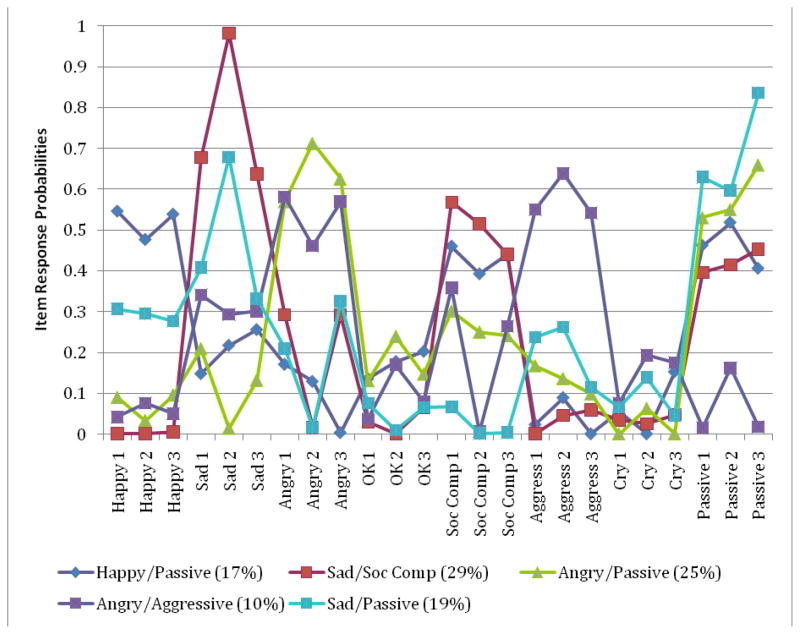
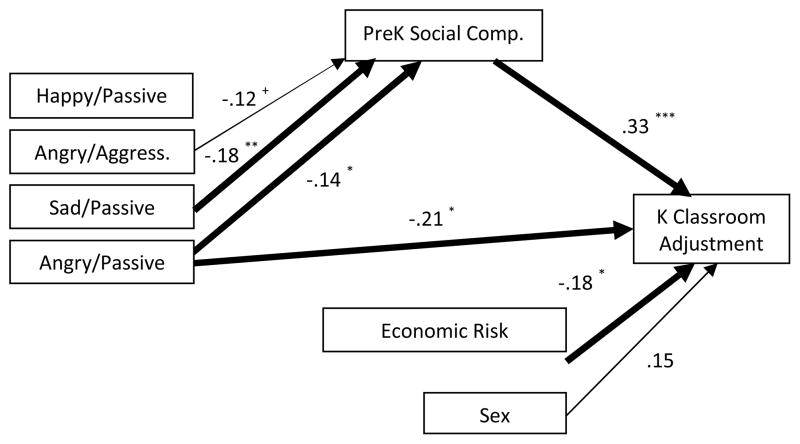
To better connect emotional development and social cognition literatures, the intersection of preschoolers' emotion and behaviour response choices to hypothetical peer conflicts was examined among 305 4 ½-year-olds in private childcare and Head Start. Latent class analyses identified five subgroups of children with connections between their emotion and behaviour response choices (Happy/Passive, Sad/Socially Competent, Angry/Passive, Angry/Aggressive, Sad/Passive). Subgroup membership differed across gender and economic risk status, and was also a predictor of early school success (i.e., social competence, classroom adjustment, and academic readiness). Overall, even after accounting for the associations between known predictors of young children's behaviour and school success (i.e., gender and SES), membership in the subgroups at preschool was uniquely predictive of both concurrent and later social competence, classroom adjustment, and academic readiness. Further, preschool social competence partially mediated contributions of subgroup membership on kindergarten classroom adjustment. These findings are discussed in relation to existing social information processing and emotional development literatures, including potential implications for understanding young children's early school success.
Keywords: classroom adjustment; latent class analysis; preschool; readiness; social information processing.
Figures
References
-
- Akaike H. Factor analysis and AIC. Psychometrika. 1987;52:317–332.
-
- Andrews RL, Currim IS. A comparison of segment retention criteria for finite mixture logit models. Journal of Marketing Research. 2003;40:235–243.
-
- Attar BK, Guerra NG, Tolan PH. Neighborhood disadvantage, stressful life events, and adjustment in urban elementary-school children. Journal of Clinical Child Psychology. 1994;23:391–400.
-
- Barrett KC, Campos JJ. Perspectives on emotional development II: A functionalist approach to emotions. In: Osofsky JD, editor. Handbook of infant development (Second edition) Oxford, England: John Wiley and Sons; 1987.
Grants and funding
LinkOut - more resources
Full Text Sources
Other Literature Sources