


Persistent hypertransaminasemia in asymptomatic children: a stepwise approach
- PMID: 23687411
- PMCID: PMC3653148
- DOI: 10.3748/wjg.v19.i18.2740
Persistent hypertransaminasemia in asymptomatic children: a stepwise approach
Abstract
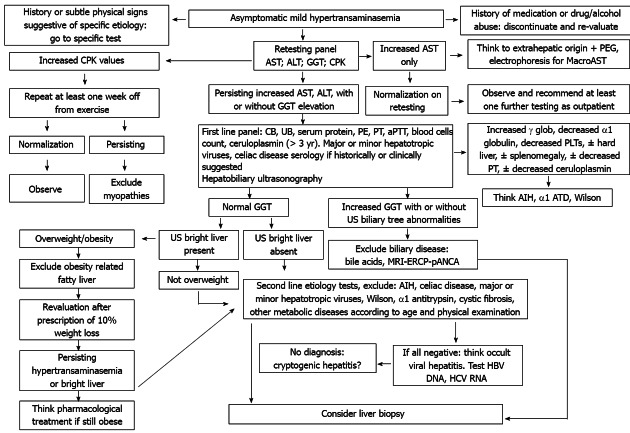
We aimed to examine the major causes of isolated chronic hypertransaminasemia in asymptomatic children and develop a comprehensive diagnostic flow diagram. A MEDLINE search inclusive of publications throughout August 2012 was performed. We found only a small number of publications that had comprehensively investigated this topic. Consequently, it was difficult to construct a diagnostic flowchart similar to those already available for adults. In children, a "retesting panel" prescription, including gamma-glutamyl transpeptidase and creatine kinase in addition to aminotransferases, is considered a reasonable approach for proficiently confirming the persistence of the abnormality, ruling out cholestatic hepatopathies and myopathies, and guiding the subsequent diagnostic steps. If re-evaluation of physical and historical findings suggests specific etiologies, then these should be evaluated in the initial enzyme retesting panel. A simple multi-step diagnostic algorithm incorporating a large number of possible pediatric scenarios, in addition to the few common to adults, is available. Accurately classifying a child with asymptomatic persistent hypertransaminasemia may be a difficult task, but the results are critical for preventing the progression of an underlying, possibly occult, condition later in childhood or during transition. Given the high benefit/cost ratio of preventing hepatic deterioration, no effort should be spared in diagnosing and properly treating each case of persistent hypertransaminasemia in pediatric patients.
Keywords: Aminotransferase; Children; Hypertransaminasemia; Liver disease; Transaminase.
Figures
References
-
- Rook M, Rosenthal P. Caring for adults with pediatric liver disease. Curr Gastroenterol Rep. 2009;11:83–89. - PubMed
-
- Riley MR, Bass NM, Rosenthal P, Merriman RB. Underdiagnosis of pediatric obesity and underscreening for fatty liver disease and metabolic syndrome by pediatricians and pediatric subspecialists. J Pediatr. 2005;147:839–842. - PubMed
-
- Franzese A, Vajro P, Argenziano A, Puzziello A, Iannucci MP, Saviano MC, Brunetti F, Rubino A. Liver involvement in obese children. Ultrasonography and liver enzyme levels at diagnosis and during follow-up in an Italian population. Dig Dis Sci. 1997;42:1428–1432. - PubMed
-
- Morisco F, Pagliaro L, Caporaso N, Bianco E, Sagliocca L, Fargion S, Smedile A, Salvagnini M, Mele A. Consensus recommendations for managing asymptomatic persistent non-virus non-alcohol related elevation of aminotransferase levels: suggestions for diagnostic procedures and monitoring. Dig Liver Dis. 2008;40:585–598. - PubMed
-
- Pratt DS, Kaplan MM. Evaluation of abnormal liver-enzyme results in asymptomatic patients. N Engl J Med. 2000;342:1266–1271. - PubMed
Publication types
MeSH terms
Substances
LinkOut - more resources
Full Text Sources
Other Literature Sources
Medical
