


Association between perceived unmet health care needs and risk of adverse health outcomes among patients with chronic medical conditions
- PMID: 23687534
- PMCID: PMC3654502
Association between perceived unmet health care needs and risk of adverse health outcomes among patients with chronic medical conditions
Abstract
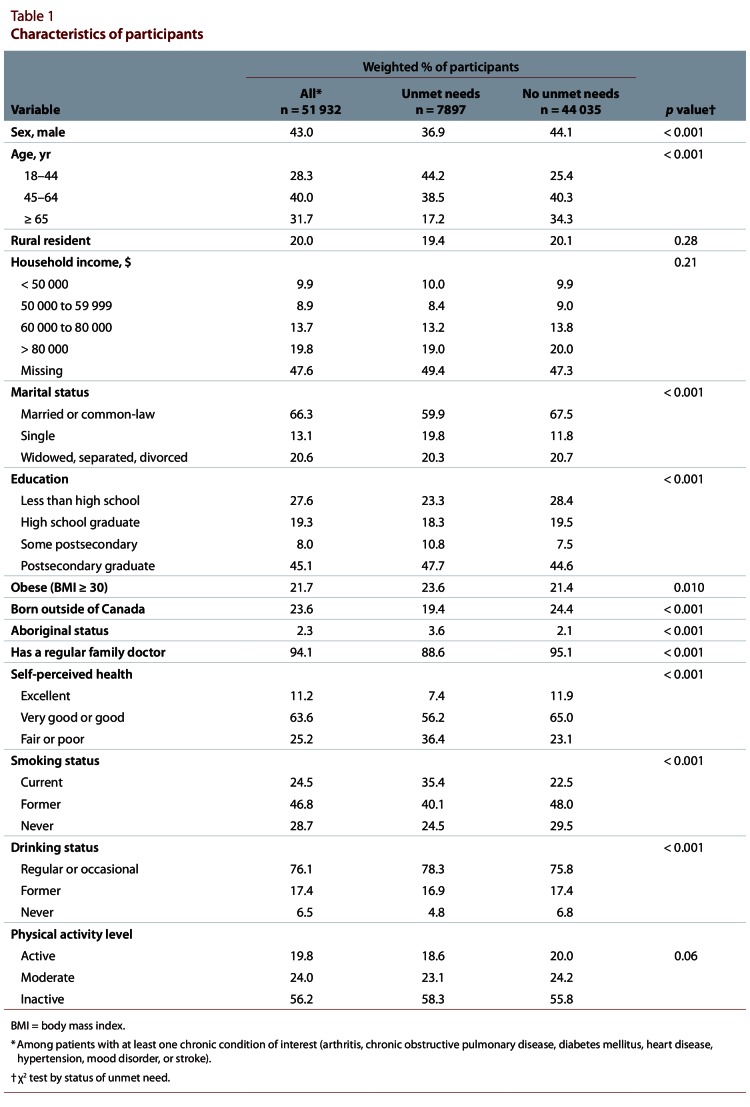
Background: Adults with chronic medical conditions are more likely to report unmet health care needs. Whether unmet health care needs are associated with an increased risk of adverse health outcomes is unclear.
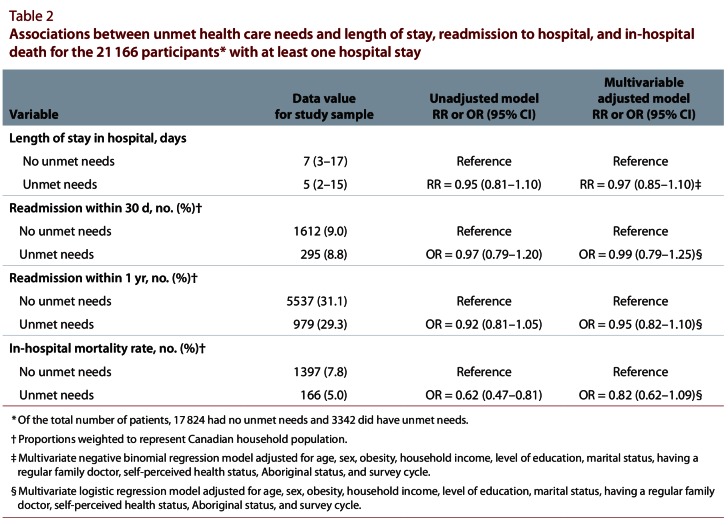
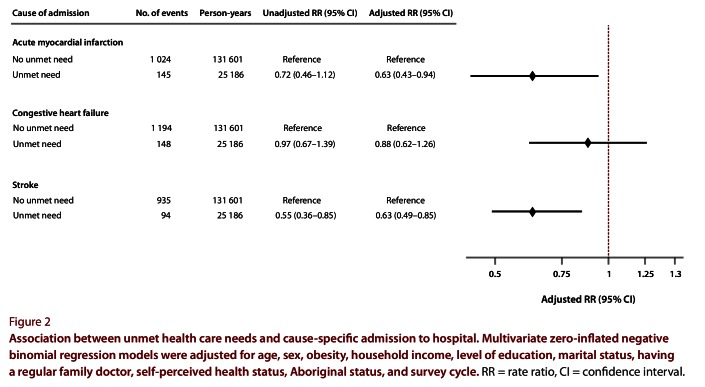
Methods: Adults with at least one self-reported chronic condition (arthritis, chronic obstructive pulmonary disease, diabetes mellitus, heart disease, hypertension, mood disorder, stroke) from the 2001 and 2003 cycles of the Canadian Community Health Survey were linked to national hospitalization data. Participants were followed from the date of their survey until March 31, 2005, for the primary outcomes of all-cause and cause-specific admission to hospital. Secondary outcomes included length of stay, 30-day and 1-year all-cause readmission to hospital, and in-hospital death. Negative binomial regression models were used to estimate the association between unmet health care needs, admission to hospital, and length of stay, with adjustment for socio-demographic variables, health behaviours, and health status. Logistic regression was used to estimate the association between unmet needs, readmission, and in-hospital death. Further analyses were conducted by type of unmet need.
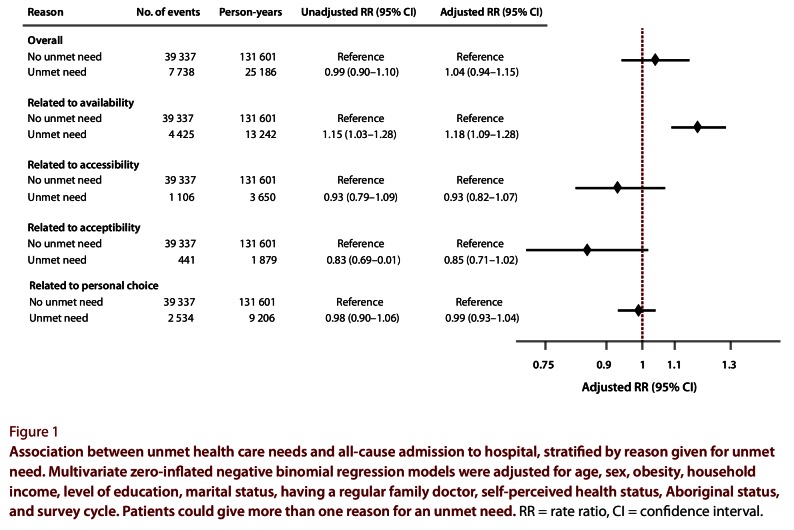
Results: Of the 51 932 adults with self-reported chronic disease, 15.5% reported an unmet health care need. Participants with unmet health care needs had a risk of all-cause admission to hospital similar to that of patients with no unmet needs (adjusted rate ratio [RR] 1.04, 95% confidence interval [CI] 0.94-1.15). When stratified by type of need, participants who reported issues of limited resource availability had a slightly higher risk of hospital admission (RR 1.18, 95% CI 1.09-1.28). There was no association between unmet needs and length of stay, readmission, or in-hospital death.
Interpretation: Overall, unmet health care needs were not associated with an increased risk of admission to hospital among those with chronic conditions. However, certain types of unmet needs may be associated with higher or lower risk. Whether unmet needs are associated with other measures of resource use remains to be determined.
Conflict of interest statement
Competing interests: None declared.
Figures
References
-
- Broemeling Anne-Marie, Watson Diane E, Prebtani Farrah. Population patterns of chronic health conditions, co-morbidity and healthcare use in Canada: implications for policy and practice. Healthc Q. 2008;11(3):70–76. http://www.longwoods.com/product.php?productid=19859. - PubMed
-
- Why health care renewal matters: learning from Canadians with chronic health conditions. Toronto (ON): Health Council of Canada; 2007. [accessed 2011 Apr. 17]. http://www.healthcouncilcanada.ca/tree/2.20-Outcomes2FINAL.pdf.
-
- Canadians’ experience with chronic illness care in Canada: a data supplement to Why health care renewal matters: learning from Canadians with chronic health conditions. Toronto (ON): Health Council of Canada; 2007. [2011 Apr. 17]. http://www.healthcouncilcanada.ca/rpt_det.php?id=144.
-
- Manuel Douglas G, Leung Mark, Nguyen Kathy, Tanuseputro Peter, Johansen Helen. Burden of cardiovascular disease in Canada. Can J Cardiol. 2003;19(9):997–1004. http://www.scholaruniverse.com/ncbi-linkout?id=12915926. - PubMed
-
- Mirolla M. The cost of chronic disease in Canada. Ottawa (ON): Chronic Disease Prevention Alliance of Canada; 2004. [2012 Jan. 19]. http://www.gpiatlantic.org/pdf/health/chroniccanada.pdf.
Publication types
MeSH terms
Grants and funding
LinkOut - more resources
Full Text Sources
Medical