


Galactomannan Antigen Testing for Diagnosis of Invasive Aspergillosis in Pediatric Hematology Patients
- PMID: 23687575
- PMCID: PMC3656552
- DOI: 10.1093/jpids/pis044
Galactomannan Antigen Testing for Diagnosis of Invasive Aspergillosis in Pediatric Hematology Patients
Abstract
Objective: Invasive aspergillosis (IA) can cause significant morbidity and mortality in immunocompromised children. The galactomannan (GM) enzyme immunoassay (EIA) has been shown in adult studies to be a useful adjunct in diagnosing IA. Data on this assay in children are limited by small sample sizes and conflicting results; false-positive assays were a concern in historical studies. We sought to evaluate the GM EIA in a large cohort of children who received intensive chemotherapy and/or hematopoietic stem cell transplant. A focus was placed on evaluating the assay specificity, and the potential of measuring GM antigen in urine.
Methods: A multicenter prospective observational study in children with anticipated prolonged neutropenia was performed. Serum specimens were collected twice weekly, and urine was collected once weekly during neutropenic periods. Operating characteristics were calculated using the GM EIA optical density index cutoffs of 0.5 and 1.0 for both serum and urine specimens.
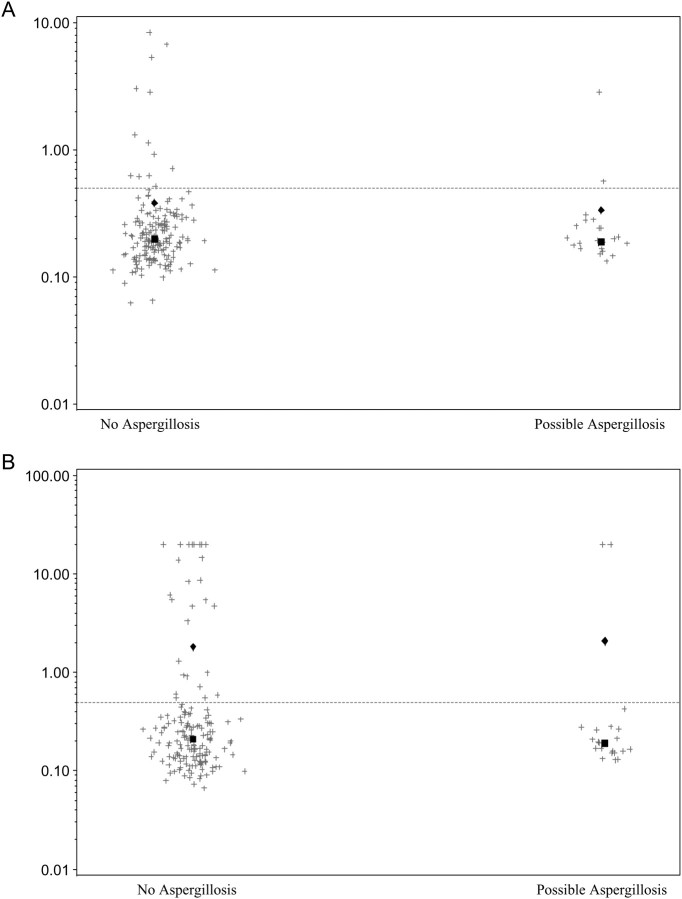
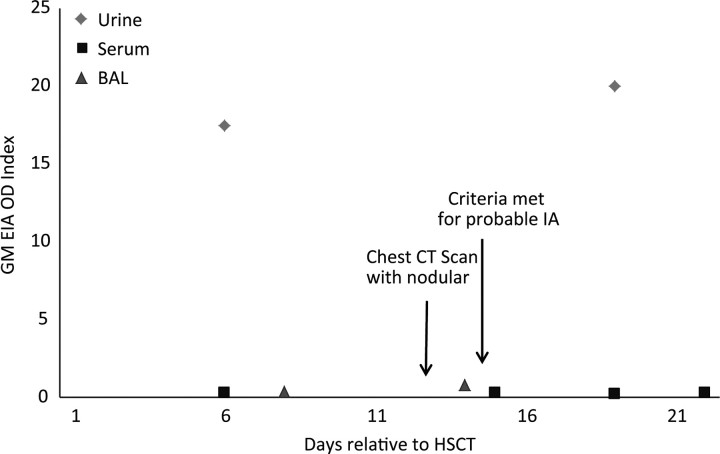
Results: At least one serum or urine specimen was tested from 198 patients. Ten patients had one or more repeatedly positive serum specimens, while 37 patients had one or more repeatedly positive urine specimens. The specificity of serum and urine testing was 95% and 80%, respectively. Although the urine test resulted in a higher false positivity rate, it successfully identified the only case of probable IA.
Conclusions: Data suggest that the serum GM EIA does not provide frequent false-positive results as previously reported. Screening for galactomannan, or a related antigen in urine, needs to be further evaluated as it may be amenable to development of surveillance strategies.
© The Author 2012. Published by Oxford University Press on behalf of the Pediatric Infectious Diseases Society. All rights reserved. For Permissions, please e-mail: journals.permissions@oup.com.
Figures
References
-
- Edmond MB, Wallace SE, McClish DK, Pfaller MA, Jones RN, Wenzel RP. Nosocomial bloodstream infections in United States hospitals: a three-year analysis. Clin Infect Dis. 1999;29:239–44. - PubMed
-
- Groll AH, Kurz M, Schneider W, et al. Five-year-survey of invasive aspergillosis in a paediatric cancer centre. Epidemiology, management and long-term survival. Mycoses. 1999;42:431–42. - PubMed
-
- Martin GS, Mannino DM, Eaton S, Moss M. The epidemiology of sepsis in the United States from 1979 through 2000. N Engl J Med. 2003;348:1546–54. - PubMed
-
- McNeil MM, Nash SL, Hajjeh RA, et al. Trends in mortality due to invasive mycotic diseases in the United States, 1980–1997. Clin Infect Dis. 2001;33:641–7. - PubMed
-
- Sung L, Lange BJ, Gerbing RB, Alonzo TA, Feusner J. Microbiologically documented infections and infection-related mortality in children with acute myeloid leukemia. Blood. 2007;110:3532–9. - PubMed
Grants and funding
LinkOut - more resources
Full Text Sources
