


Effectiveness of nutrition training of health workers toward improving caregivers' feeding practices for children aged six months to two years: a systematic review
- PMID: 23688174
- PMCID: PMC3668136
- DOI: 10.1186/1475-2891-12-66
Effectiveness of nutrition training of health workers toward improving caregivers' feeding practices for children aged six months to two years: a systematic review
Abstract
Background: Nutrition training of health workers can help to reduce child undernutrition. Specifically, trained health workers might contribute to this end through frequent nutrition counseling of caregivers. This may improve child-feeding practices and thus reduce the risk of undernutrition among children of counseled caregivers. Although studies have shown varied impacts of health workers' nutrition training on child feeding practices, no systematic review of the effectiveness of such intervention has yet been reported. Therefore, we conducted this study to examine the effectiveness of nutrition training for health workers on child feeding practices including feeding frequency, energy intake, and dietary diversity among children aged six months to two years.
Methods: We searched the literature for published randomized controlled trials (RCTs) and cluster RCTs using medical databases including PubMed/MEDLINE, CINAHL, EMBASE, and ISI Web of Knowledge, and through WHO regional databases. Our intervention of interest was nutrition training of health workers. We pooled the results of the selected trials, evaluated them using the Grades of Recommendation, Assessment, Development, and Evaluation (GRADE) criteria, and calculated the overall effect size of the intervention in meta-analyses.
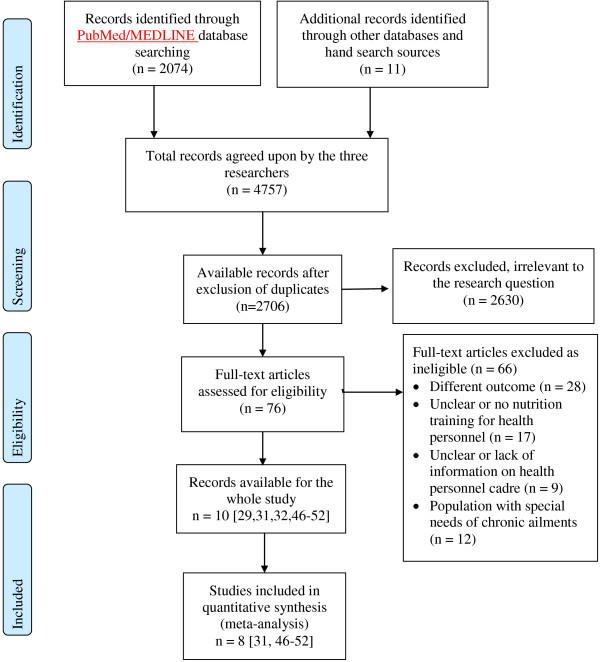
Results: Ten RCTs and cluster RCTs out of 4757 retrieved articles were eligible for final analyses. Overall, health workers' nutrition training improved daily energy intake of children between six months and two years of age. The pooled evidence from the three studies reporting mean energy intake per day revealed a standardized mean difference (SMD) of 0.76, 95% CI (0.63-0.88). For the two studies with median energy intake SMD was 1.06 (95% CI 0.87-1.24). Health workers' nutrition training also improved feeding frequency among children aged six months to two years. The pooled evidence from the three studies reporting mean feeding frequency showed an SMD of 0.48 (95% CI 0.38-0.58). Regarding dietary diversity, children in intervention groups were more likely to consume more diverse diets compared to their counterparts.
Conclusion and recommendations: Nutrition training for health workers can improve feeding frequency, energy intake, and dietary diversity of children aged six months to two years. Scaling up of nutrition training for health workers presents a potential entry point to improve nutrition status among children.
Figures
References
-
- Black RE, Allen LH, Bhutta ZA, Caulfield LE, de Onis M, Ezzati M, Mathers C, Rivera J. Group MaCUS. Maternal and child undernutrition: global and regional exposures and health consequences. Lancet. 2008;371(9608):243–260. - PubMed
-
- UNICEF. State of the World's children 2008. New York, USA: United Nations Children's Fund; 2007.
-
- Petrou S, Kupek E. Poverty and childhood undernutrition in developing countries: a multi-national cohort study. Soc Sci Med. 2010;71(7):1366–1373. - PubMed
-
- Oldewage-Theron WH, Dicks EG, Napier CE. Poverty, household food insecurity and nutrition: coping strategies in an informal settlement in the Vaal Triangle, South Africa. Public Health. 2006;120(9):795–804. - PubMed
Publication types
MeSH terms
LinkOut - more resources
Full Text Sources
Other Literature Sources
Medical
